

Your conversion rates, your sales cycle, even your retention: all of them sit downstream of one asset most startups neglect. Their story.
A quick test. Put your homepage next to your closest competitor's. Strip away the logos and company names. Now read what's left. Is there a single line that gives a buyer a reason to care, or are you both saying the same thing?
Most founders treat this as cosmetic: the product should stand on its own, the words are just decoration. Then they're surprised when every sales call feels like pulling teeth. At a loss over their dismal conversion rates and lack of engagement across their marketing efforts.
This week, we explore why story is one of the biggest, most neglected growth levers for startups. And we share the exact framework our strategists use to find yours.
Let's get into it.
P.S. Our Story System has been fixing this exact problem for years. The catch: it ran expensive and slow, best suited for our later-stage clients. That changes today: we've rebuilt it for startups. Same methodology, same senior strategists leading the work, now at startup speed and startup pricing. A few spots are open. Book a call to learn more →
Rocksalt
> LinkedIn pipeline doesn’t start with your posts. It starts in the comments. > > Your buyers are already in conversations on LinkedIn, forming opinions about vendors in your category without you. > > Rocksalt finds those conversations. Enter your URL and it surfaces the discussions worth joining.
> One founder, Ali Hafizji, CEO of Wednesday.is, just booked 8 qualified calls a month from being in the right discussions. > > You can preview the conversations Rocksalt finds before creating an account. No credit card. No LinkedIn login. No generic demo.
> See what Rocksalt finds for your company in 30 seconds.
> Find my buyer conversations →
The tie you don't know you're in
Insights from Devon Reynolds, Growth Strategist @ Demand Curve
A buyer is choosing between you and your closest competitor. Your product is stronger. Your customers say so and the review sites back them up. On paper, a layup.
Then the buyer reads both websites:
- Yours says "Save 10 hours a week." So does theirs.
- Yours says "All in one place." So does theirs.
- Yours says "Trusted by fast-growing teams." So does theirs.
The buyer scrolls both, nods twice, and opens a spreadsheet to compare prices. The deal you thought was a product comparison is, to them, a coin flip.
And coin flips get settled by whatever still separates the options. Mostly familiarity and price. The more familiar brand usually wins the tie; when familiarity is even, the cheaper option tends to.
A benefit is not a reason
So why does the stronger product keep getting into this mess?
Because those claims ("save time," "all in one," "built for scale") are benefits. They describe what the customer gets, and they're true of the entire category. A value prop answers a harder question: out of every option available, why you?
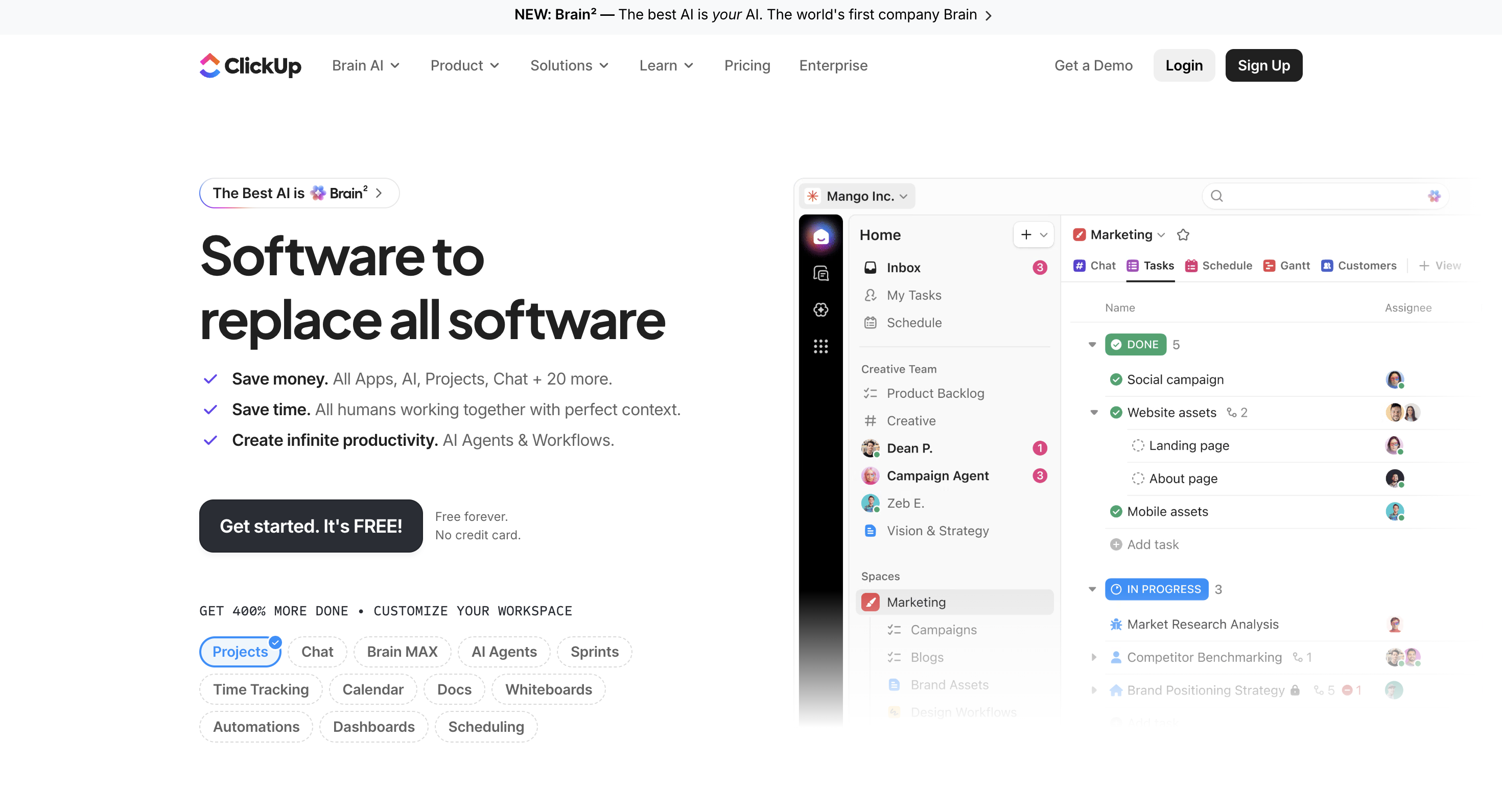
The difference is ownability. "Built for scale" is a sentence any company can type. ClickUp's "One app to replace them all" was a jab at category fragmentation that only ClickUp could credibly throw, because ClickUp had actually built the "everything-app" to back it.
Yet most startups don't have one.
Writing a real value prop means committing to a point of view. In public. One that maybe not everyone agrees with. And committing is scary.
Mirroring the rest of the market feels safer. After all, if the market leader says "save time," repeating it can't be wrong. (It can. It mostly is.) Sameness became the default because mirroring is the safest-feeling move, and because translating what's truly special about your product into words a buyer feels is hard, unglamorous work.
One weak claim infects the whole funnel
If a benefit only costs you one bland sentence, you could live with it. But it doesn't stay contained. Whatever claim sits at the top of your homepage becomes the seed for everything downstream: hooks, ad copy, onboarding emails, the sales deck. Every asset repackages that same core claim for a different stage of the funnel.
Seed a benefit and every downstream asset inherits it. The ad asks "Tired of wasting hours on manual work?" The homepage subhead promises saved time. The onboarding email repeats the promise, this time with an emoji. When the campaign underperforms, the postmortem blames the channel, because no single asset looks broken. So budget moves to a new channel, the same seed gets replanted, and the results repeat.
Meanwhile the coin flips keep landing against you. Buyers who can't tell challengers apart default to the brand they already know, and the challengers left standing get compared on price.
The incumbent can afford to sound average. You can't.
AI industrialized the sameness
Sameness used to spread at human speed. Over the last few years, it got automated.
Regular readers will remember the consensus machine, Justin's name for what AI does to creative work. The short version: tools like ChatGPT work like your phone's autocomplete, scaled up. They predict the most probable next words based on the data they're trained on. For a legal summary or a SQL query, the most probable answer is exactly what you want. Marketing has the opposite job. Copy earns attention by being the least expected thing in the feed, and a probability engine is built to produce the most expected thing.
So ask AI for your value prop and it hands back the statistically safest claim in your category (ten thousand homepages can't be wrong), which is almost always a benefit. And as more of the web gets written by AI, the average these models learn from drifts toward their own output. Founders across a category run positioning through the same tools, pull from the same shrinking pool of safe language, and land on the same words at the same time.
The dangerous part is how finished it feels. The copy comes back fast and sounds confident. Nothing about it warns you that the competitor two tabs over got the same sentence.
To be clear: AI is a strong fit for plenty of marketing jobs. Point it at research, or at turning one strong message into twenty ad variants, and it earns its keep. Inventing what makes you different is the job it's least built for, and it's the job founders keep handing it.
Three steps to find your value prop
Start with an old gut-check from the positioning world, sometimes called the swap test. Open your homepage and read your value prop out loud. Would it still be true with your closest competitor's name swapped in? If the honest answer is yes, you're holding a benefit.
The swap test only catches impostors, though. Passing it isn't the prize. The fix lives upstream, in the failures your product exists to end. Positioning people will recognize this starting point; April Dunford built a whole practice on studying the alternatives your customers would otherwise settle for. What follows is our compressed, founder-speed version. Three steps:
- List the bad alternatives. Every option your customer uses instead of you: competitors, spreadsheets, a junior hire wearing five hats, doing nothing. For each one, write down the specific failure. Not "it's outdated." What breaks, and when.
- Answer each failure directly. For every bad alternative, write the claim that speaks to that exact failure.
- Keep only what's ownable. Keep the two or three claims that are true of you, hard for your closest competitor to claim honestly, and important to your buyer. Cut the rest, however good they sound.
Run it on an imaginary collaboration tool competing with spreadsheets and email threads. The spreadsheet's failure: two people edit at once and the "real" version becomes a guess. The email thread's failure: decisions get buried three replies deep, usually under a calendar invite.
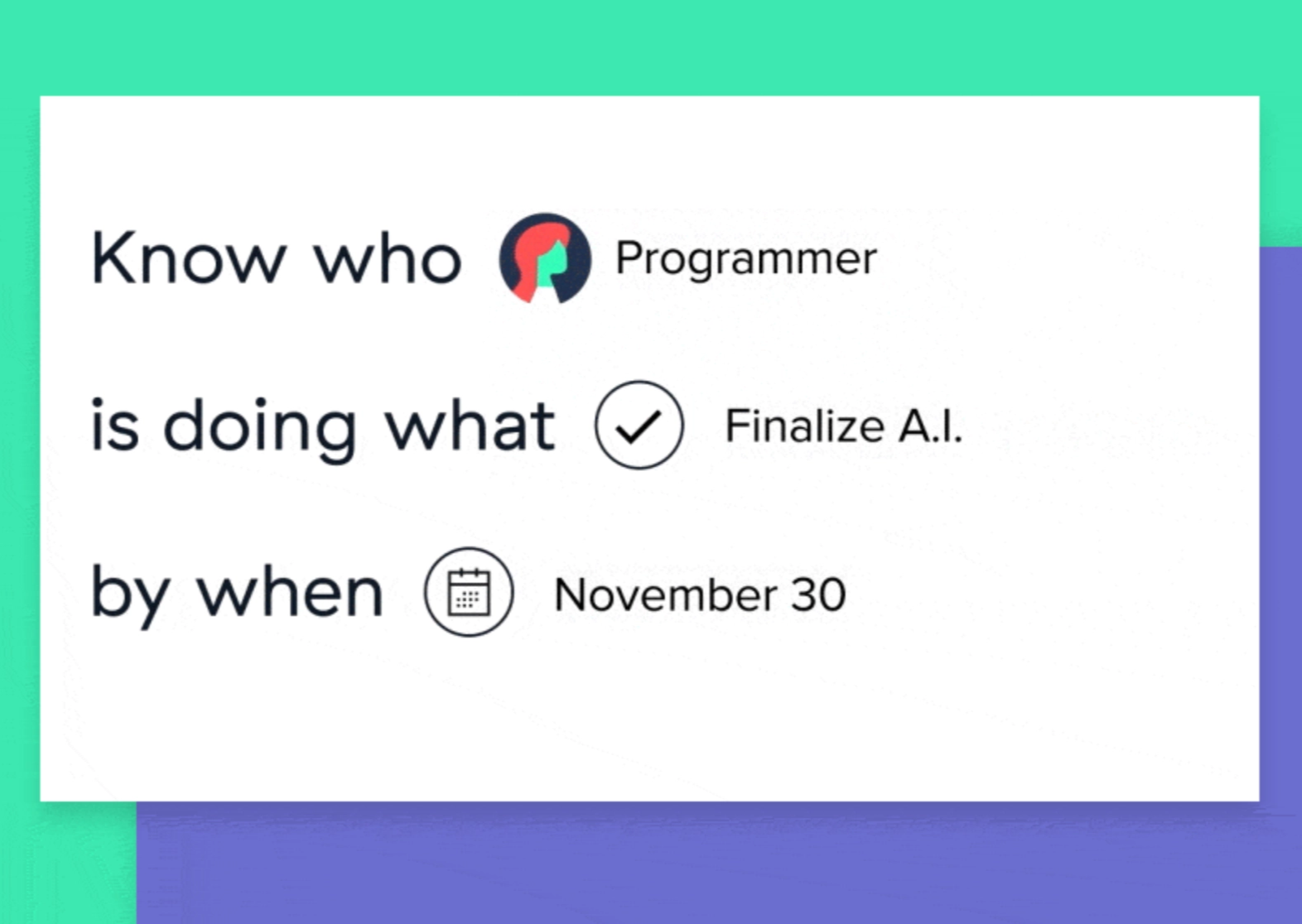
Answer those failures and you get claims like "never wonder which version is real" and "every decision has a home." Both make the same promise: your team always knows where things stand. Compress that to its sharpest form and you land where Asana landed. One word, clarity, made concrete in a single line: "know who's doing what by when." A competitor could type that sentence tomorrow, but they couldn't back it with the same two named failures, and buyers can feel the difference.
The bad alternative doesn't have to be a competitor, either. For Calendly, it was the fact that scheduling a meeting eats an email thread of its own. Its story has always been the end of that back-and-forth, a claim aimed at a specific, felt annoyance rather than at calendar management in general.
Two survivor stories prove nothing on their own, of course. The reason to trust the exercise is the direction it works in: it starts from your customers' failures and works toward words, instead of starting from words you admire and working backward.
That direction is the real mark of a value prop: it points back to a failure your competitors can't equally claim to solve. If yours points at a problem anyone in the category says they fix, go back to step one. You're still holding a benefit.
Run it yourself, or we'll run it for you
Everything above is the exact problem our Story System fixes.
It’s the same methodology we’ve used to produce results like these:
- Stacker (YC): we rebuilt their story, and homepage conversions doubled, landing pages converted 2.5x better, ad clickthrough rose 22%.
- Perfect Keto: conversions jumped 30% from the messaging rewrite alone.
- Unspun: we handed the custom-fit apparel brand a homepage line no competitor could copy: “We only make jeans in one size. Yours.”
For years this ran as a $30K, six-week engagement. Now it runs at startup speed and startup pricing.
We’re taking five companies in this batch.