
Hey y’all,
One of the most common growth problems we see founders run into? Watching their product lose to a worse one. Not a cheaper one or a better-funded one. Somehow they’re just losing customers to an inferior competitor.
Truth is, the company that wins is often the one that explains its value best. The one with the better story.
That’s the work we do through Story Systems: a complete messaging system that fuels your ads, landing pages, funnels, and sales.
If you’re losing to worse competition and you don’t know why, give us a shout and we’ll see if you’re a fit.
Today, we’re covering why your next hook is hiding in your competitor’s three-star reviews, how a higher conversion rate can cost you customers, and what comes after ugly ads.
—Nick
Brought to you by Pitch.
Go beyond on-brand slides
With Pitch's MCP, connect your workspace once and create, find, and share on-brand decks through conversation. Ask for a proposal built from your call notes and CRM record, and get a shareable link back in the same chat. For teams automating at scale, Pitch API brings the same power to your CRM workflows and builds decks automatically.
Market leaders Perplexity, Legora, and Synthesia use Pitch to create collaborative, on-brand decks at scale, while leveraging digital deal rooms and engagement tracking.
Use code DEMANDPITCH for 2 months free on Plus, Team, or Business plans →
Hooks hiding in 3-star reviews, when a higher conversion rate backfires, and what comes after ugly ads.
01.Ad creative & copy
Your next hook is in your competitor’s three-star reviews
Insight from Michael Snook, Growth Strategist at Demand Curve.
The usual advice is good advice. Read your reviews, find the phrases your happiest customers repeat, and put their words in your ads.
But think about who writes a review. Someone bought, kept using the product, and liked it enough to come back and type. That makes reviews great proof. They tell a person who’s leaning in that the product does what it says.
A cold prospect is weighing something else: whether the thing they use now is bad enough to be worth the hassle of changing. Your customers stopped thinking about their old product the day they left it. So your reviews rarely mention it.
A brand I work with saw its cost per new customer rise about 90% in a year. When I broke it down by funnel step, ad prices explained about 2% of it. About two-thirds came from one step: new visitors adding to cart fell from 23% to 15%. Returning customers still added to cart at 43%, same as before.
So the targeting was fine, and fans were as keen as ever. Nearly 60% of spend was telling the brand’s favorite story to people who largely agreed with it already. (These are Meta's own numbers, so I treat the exact split as directional, and it was clear enough to act on.)
An acquisition ad has two jobs: give someone a reason to stop, then a reason to believe. The material for each lives in a different place.
- The proof brief is your own four- and five-star reviews. It shows what you reliably deliver, in your customers’ words. It goes at the end of the ad.
- The hook brief is your category’s one- to three-star reviews: your competitors’ unhappy customers on Amazon, Trustpilot, G2, app stores and Reddit. It shows what people are putting up with right now. It goes in the first three seconds.
Start with the three-star reviews. One-stars are loud, and plenty are about late packages and refunds. Three-stars read “it’s fine, but…” and that “but” names the trade-off the buyer has already accepted.
Picture a three-star review of a running shoe: light and fast, but it feels worn out after a few hundred miles. They’ve written your hook for you. Your job is to show them the compromise is optional.
Try it this week. Pull 50 two- and three-star reviews of the brand your best customers switched from, and highlight every “but.” I’d bet at least one of them is an ad you haven’t made yet.
02.Conversion
A higher conversion rate can cost you customers
Insight from Devon Reynolds, Growth Strategist at Demand Curve.
A higher landing page conversion rate usually means you won. But not always.
Say you run a B2B SaaS company and your landing page gets 10,000 visitors a month. You redesign it. Here’s what happens:
Metric | Before | After
Visitors | 10,000 | 10,000
Lead conversion rate | 5% | 8%
Leads generated | 500 | 800
Lead-to-customer rate | 20% | 8%
New customers | 100 | 64
Your conversion rate jumped 60%. You also ended up with 36% fewer customers.
These numbers are made up, but the problem is common. Making one part of your funnel better doesn’t always make the business better.
Maybe your new headline pulls in a broader crowd, including people who aren’t a good fit.
Maybe you cut the qualifying questions. Booking a demo got easier, and now your sales team spends its day on calls with people who can’t afford the product.
Or maybe the page promises something the product can’t deliver. More people sign up, but fewer actually buy.
Conversion rate is still a good metric. It just doesn’t tell you enough on its own.
Here’s how to avoid optimizing for the wrong thing:
1. Track what happens after the conversion. For leads, watch how many become qualified opportunities and paying customers. For signups, watch activation and retention.
2. Judge tests by business results. Before you launch an A/B test, decide which downstream metrics matter. A higher conversion rate isn’t a win if customer quality drops.
One metric worth using for landing page tests is revenue per visitor. It ties your traffic to the value it actually creates, so you’re not stopping at the first conversion. At a $5,000 deal size, the table above goes from $50 per visitor to $32.
The goal is more of the right people becoming customers.
03.Ad creative
What comes after ugly ads
Insight from Nick Costelloe, Content Lead at Demand Curve.
In 2024 we wrote about the seductive power of ugly ads. The point being, the internet got so polished that ugly became the fastest way to stand out.
Ugly ads used to work so well that ad tools now ship an “ugly ad” preset. Some can take a product photo and turn it into a deliberately low-polish, screenshot-style ad.
That’s a problem. Barry Hott, the king of ugly ads, has said the whole point is to get past people’s subconscious visual ad blockers. But now ugly is a template. Those blockers are built to skip templates.
So what replaces ugly? My hunch is nostalgia.
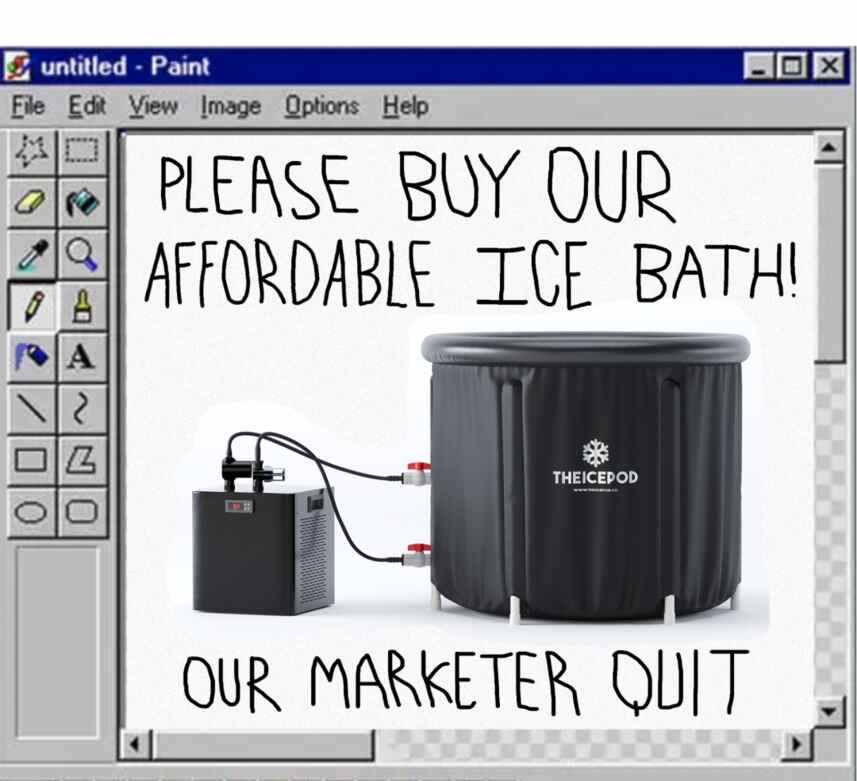
Ad: The Pod Company, “Our Marketer Quit” (The Ice Pod).
This one is ugly, sure. But I’d stop scrolling just because of Paint. That window does two jobs. It doesn’t look like an ad, so it slips past the blocker. And it gives you a feeling that most ugly ads don’t.
People are already paying for that feeling. Y2K-related searches are exploding. CDs and disposable cameras are back, and there’s a hard return to analog and web 1.0.
Advertisers have noticed. But most of them went nostalgic and stayed polished. The open lane is both at once: ugly enough to get past the blocker, nostalgic enough to make someone feel something. Think grainy film photos, camcorder footage, anything that feels web 1.0.
Obviously test it, don’t assume it’ll work for you. It has to fit your product, your market, and the channel. But if it fits, consider trying a nostalgic lo-fi ad in your next creative batch, and see how it does.
Something fun
A fraud-detection startup just ran one of the better growth tactics of the year.
On Nov 7, Washington Square Park filled up for an Elizabeth Holmes and Nathan Fielder lookalike contest. Days later, Austin-based Verisoul revealed it was behind the event.
Verisoul says over 4,000 people showed up and that the posts cleared 21 million views.
A company that sells fake-user detection ran a stunt whose entire mechanic was not telling anyone who it was. Not a bad way to lean into the moment.
Photo: Erica Camille Productions