
Today, we dive into the various ways to get your first batch of customers.
There's no one-size-fits-all. It depends on your product, your market, your customers, their buying intent, and more.
Let's dive in 🤘
– Neal

Brought to you by dofollow.com—the B2B SaaS link building specialists.
NectarHR used to get 1,000 visits a month. More importantly, 0 leads from organic traffic.
dofollow.com got them links from Hubspot, Monday.com, The Economist, and dozens of DR80-90 sites.
Now, NectarHR sees 40,000+ visits and +50 demos from organic search per month.
Want to get started on your own success story? dofollow.com is offering Demand Curve readers a free backlink assessment:
- Audit of your content & strategy
- In-depth competitor backlink analysis
- Low-hanging fruit to reap in the next 90 days
Brought to you by Lifecycle 0 to 1: Master the Buildout.
Drew has sent over 6,000,000,000 emails to tens of millions of Grammarly users. They range in goals from awareness, activation, conversion, winback, and engagement.
Creating messaging funnels can be overwhelming.
With his new course, Drew Price will teach you how to standup a scalable foundation quickly & effectively.
The course includes 2.5 hrs of instructor-led tutorials, frameworks, demos, and case studies.
Preview the full lesson gallery and watch the first two chapters for free here.
PS: Demand Curve subscribers get 10% off a full course purchase by June 30 with code DCGrow10 at checkout.
12 Go-to-Market Strategies (and when to use them)
Insight from Ali Abouelatta’s First1000.
Getting your first batch of customers can be one of the hardest or easiest parts.
It’s really hard if you do it incorrectly for your product type.
How you approach it depends on:
- Purchase intent of the customer (high vs low)
- High: Something people already know they need. A known problem that people know there’s a solution for.
- Low: Something people don’t know they need yet! An unknown problem or an unknown solution.
- The competitiveness and makeup of the market
- How broadly appealing the product is
- If they’re actively looking for a solution
- If the customer has switching costs (aka opportunity costs)
- Complex vs simple product
- Product category (B2B vs B2C)
- Geographic constraints
- Self-serve vs high-touch
Luckily, Ali created two flow charts depending on customer purchase intent.
GTM motions for high-intent customers
Here’s the flow chart, explanations of each channel below:
.jpeg)
#1. Produce discoverable content:
High-intent, no competitors, looking for solution
Create content that people find while searching for a solution. This can be on Quora, Reddit, communities, YouTube, TikTok, or good ol' fashioned Google.
#2. Overservice 1 customer:
High-intent, no competitors, not looking for solution, complex product/solution
For complex, high-ticket products, go above and beyond for a single customer. Create a product/service that absolutely wows them.
Then, get referrals and create a case study.
#3. Hack a distribution channel:
High-intent, no competitors, not looking for solution, simple product/solution
Use clever hacks on existing marketplaces to get visibility:
- Airbnb: Automatic “post to craiglist” feature to increase visibility. [Source]
- “Tiktok: Appended “for Facebook & Instagram” at the end of the app name on the app store to get in front of people looking for FB or IG. [Source]”
- “Paypal: Created bots that reached out to eBay sellers pretending to be real customers and insisting on paying only via PayPal. [Source]”
Note: Quoted examples are from Ali’s article.
#4. Fish on forums/communities
High-intent, competitive space, no switching costs
Similar to #1, except you find existing posts/questions on Quora/Reddit/Forums, answer their question, and link to your product.
Don’t be spammy.
#5. Cold outreach (and reduce the friction)
High-intent, competitive space, high switching costs
If it’s harder for customers to switch from competitors, reach out to your customers directly, offer free value, and be willing to help them migrate. ConvertKit famously did this to get creators off of competitors like Mailchimp.
GTM motions for low-intent customers
.jpeg)
#6. Launch somewhere (+ PR)
Low-intent, enterprise competitors, self-serve product
If your customers are massive, slow, clunky enterprises, get in front of the small guys. Launch on Product Hunt, Techcrunch, Hacker News, Indiehackers, or KickStarter, or do a PR push (see #12).
A great way to have a big launch is to be “building in public” (see #10) for months before launch.
#7. Warm outreach/intro
Low-intent, enterprise competitors, high-touch product
Low-intent, no competitors, B2B
Find people in your network who likely have the problem but haven’t found a solution (in person or via LinkedIn), overdeliver, and ask for a referral.
In general, warm outreach is infinitely better than cold outreach, so putting yourself out there is an excellent way to increase response and close rates.
#8. Embed yourself in a community
Low-intent, modern competitors, niche appeal
If the product is niche, be a key member in communities around this niche. These could be on Reddit, Facebook, Stack Overflow, campuses, community centers, or dedicated sites and forums.
Or create your own community around it on Reddit, Facebook, Meetup, or Circle.
#9. Grab attention [on the streets]
Low-intent, modern competitors, broad appeal, geographically constrained
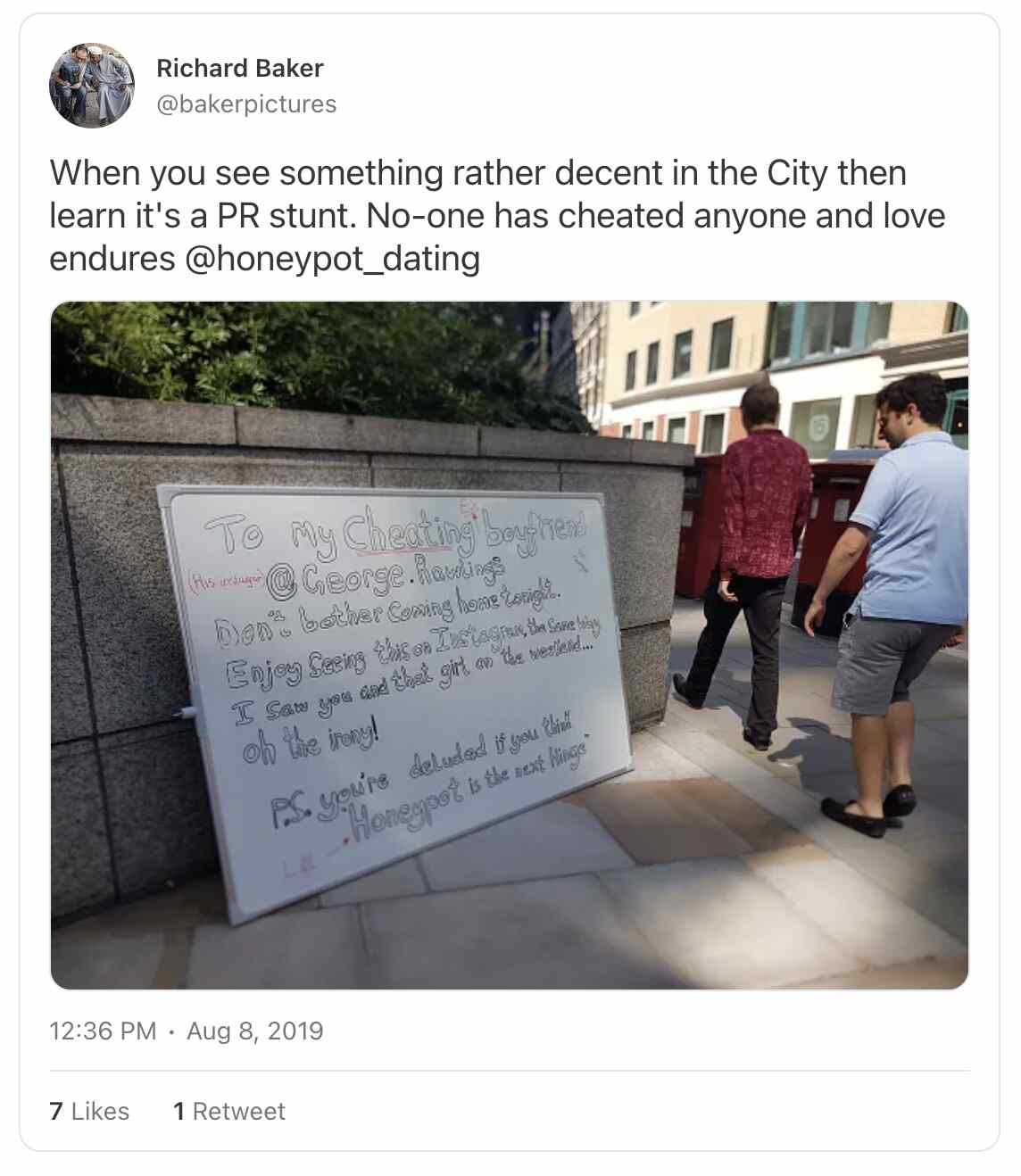
Place objects and signs where your customers hang out. For example, “the dating app Honeypot (now Thursday) got its first users by placing whiteboards with quirky messages around the streets of London. [Source]”
#10. Build in public
Low-intent, modern competitors, broad appeal, worldwide
If your product is broadly appealing and the market is competitive, then use social platforms to build an audience that likes and believes in you and your product. Attract people to you by being authentic.
#11. Use influencers
Low-intent, no competitors, B2C
If it’s a new product category targeting consumers, strike deals with micro and nano influencers to share your product on TikTok, Instagram, YouTube videos, and blogs.
Or, at the very least, get them using it.
Note B2B influencers are also on the rise ;0
#12. Full blown PR
Low-intent, strong social mission
If you have a strong social mission, like Tom’s “buy 1 give 1” business model where they’d give shoes to those in need, then you’re a strong candidate for a full blown PR cycle. You can manage this by contacting editors/writers at publications or working with a PR agency.
Ali gives examples of companies for each in the full article.
Takeaway: Find yourself in the flow chart, and then focus on that channel.
Something fun
Did I say fun? I actually meant mildly depressing.