

Hey y'all, Justin here. I've somehow managed to get sick twice in the last 2 months (idk about you, but something about getting sick in the summer just doesn't sit right with me).
Now that my head's clear again, I realized we never announced the launch of our brand-new website. Big shout-out to Joey, who built the whole thing from the ground up. (Sorry for the slow credit, Joey 😬.) If you're curious, take a look at the new site here and let us know what you think!
Today we're getting into one of the biggest (and least-discussed) reasons startups struggle with paid marketing.
Let's dive in.

Brought to you by Hard Skill Exchange
What should AI agents execute autonomously (and when does work need a human?)
On July 30, executives from 1mind, Outreach, Gainsight, Dialpad, and six other leading AI companies are sharing the operating models behind their live autonomous revenue deployments.
You'll learn how leading AI companies are deploying Autonomous Revenue Agents in production, including the operating models, governance, decision frameworks, and implementation patterns behind autonomous GTM.
Paid marketing is largely won or lost off-channel
A couple of years ago, I was casually advising a founder friend who runs a DTC skincare brand. One day, she came to me because her investors were pushing the company to launch Meta Ads and wanted a second opinion.
I cautioned her against it for one simple reason: their unit economics couldn't support it. Given their contribution margin, cash balance, and payback requirements at the time, they would've needed a CAC under $15. For an early-stage, unknown brand in their category, that just wasn't in the cards.
But, as it tends to happen, the investor pressure won. They found an agency that was all too happy to lock them into a six-month contract. $100,000 of spend later, the agency delivered its conclusion: Meta Ads isn't right for them.
The agency got it half right. Paid marketing didn't work for them (no shit). But not for the reasons anyone was looking at. Turned out, it wasn't a channel problem. It was everything outside of the channel that was wrong.
Everyone's trying to “crack” the channel
“We've gotta find product-market fit first. Then we'll test some channels and figure out growth.”
(I made this quote up. But far too many founders have said some version of this at some point in their career.)
Most startups treat paid channels, and really customer acquisition as a whole, like a puzzle to be solved. With enough experimentation, trial and error, and brute force, eventually the channel cracks and the floodgates open. And if one channel doesn't crack, you just move to the next one and keep trying until you find the magical recipe.
Here's what that mentality misses. At the highest level, there are only a handful of ways to scale customer acquisition. And for any individual company, only a slice of those are viable, because viability is dictated by the DNA of the business: its product, its model, its market. So the company that quits paid after a short test is usually pulling the plug on one of the only motions available to it, then wandering into lanes that are fundamentally misaligned with its business.
So where does the “crack the channel” approach come from?
Start with the classic startup teachings. Founders are taught that product-market fit is everything: nail PMF, and growth takes care of itself. Take your product-market fit to a marketing channel and open the floodgates. So growth gets bolted on in the ninth inning instead of engineered into the core of the business from day one.
Second, it feels safer. A startup that spent months or years iterating its way toward product-market fit does not want to hear that the foundation is the problem. It's far easier to blame the channel and work at the channel level: new creatives, new messaging, new landing pages, different levers in the ad platform. Asking whether the fundamentals of your growth system are broken means questioning the product, the model, maybe even the market you spent years building toward. Few volunteer for that.
Those two explain where the approach comes from. Two more explain why it survives.
The brands and thought leaders we all learn from solved their off-channel architecture long ago. That's why they're the leading advertisers. Most of their remaining challenges live on-channel, so on-channel work is all they talk about, and the off-channel work rarely gets passed down to newer operators.
And then there's our industry's dirty little secret: agencies keep the problem alive. Instead of telling a company the honest thing, that its fundamentals can't yet support the channel, most agencies happily sign the client and lock in the contract. The problem that should get nipped in the bud becomes a six-month retainer.
The channel is one part of a bigger system
When most people think about growth, they think about the channels themselves. But if you've been part of the Demand Curve community for a while, you know we view growth as a system, and a channel is only one component of it.
Our Five Fits framework is one of our favorite ways to convey this (quick hat tip to Brian Balfour, whose original Four Fits framework this builds on):
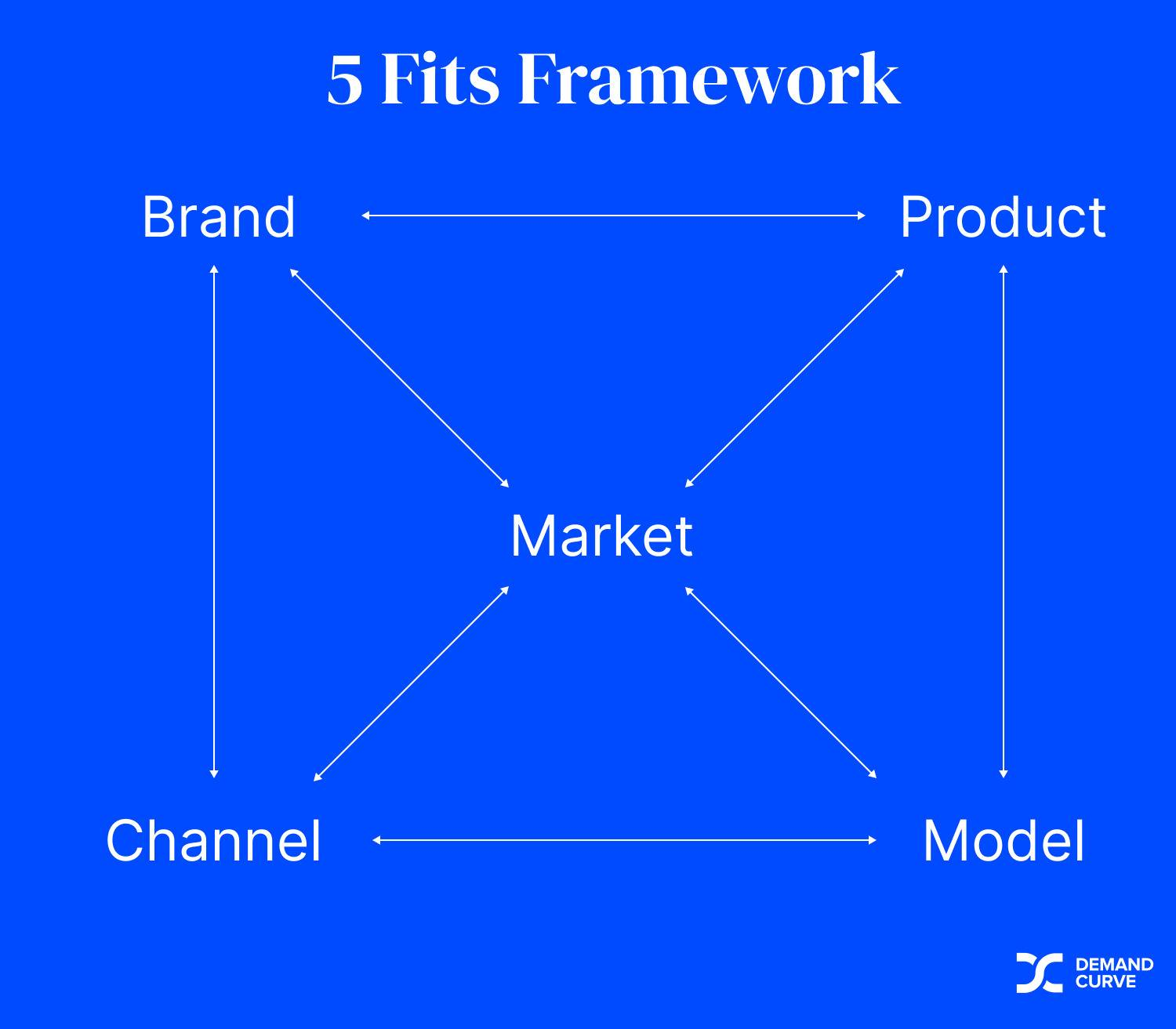
There's a lot to unpack in the framework, but for today it helps us see one big thing: which components of a growth system we control, and which we don't.
You can engineer your product however you want. You can develop any revenue model. You can craft whatever story/brand you can dream up. But you cannot engineer your market, and you cannot engineer the channel. Those two play by their own fixed rules.
Which means the job is to engineer the components you control to fit the ones you don't. For paid, that means engineering your product, model, and story for the channel. Not the other way around.
But the other way around is exactly what most companies attempt. They take a channel made of rules, policies, algorithms, and cultures they do not control, and try to force it to fit the rest of their system.
Let's look at the specific ways these alignment problems show up.
Product-channel misalignment
There's a whole breed of entrepreneur that identifies startup opportunities by reverse engineering from the channel itself. They pick the channel first, then design the entire business, product included, specifically for it.
Most operators do the opposite. They build toward product-market fit in a vacuum, then try to slap a channel on top.
Balfour wrote a fantastic essay on product-channel fit. He outlines the required conditions for a product to be a fit for paid acquisition:
- Quick time-to-value (can someone click an ad and immediately understand the product value?)
- A medium-broad value prop (basically, is this product something a lot of people want?)
- A transactional model (as Brian puts it: the product is built to extract transactional value to fund paid marketing)
I'd add a couple other factors to the list: friction, channel intent, and channel context. People will impulse-buy a $30 t-shirt off a single Instagram ad. Time-to-value is quick (everyone knows what a t-shirt is). That's a component of friction. But so is the price point, and more broadly, the risk. If they end up hating the shirt, they're only out thirty bucks. But that pre-bedtime doomscrolling ritual rarely leads to an insta-purchase of enterprise software or a $4,000 training program. That's a high-friction ask. It also doesn't match the intent and context of the user (i.e. your market) when they're on the channel.
People are on Instagram to unwind after a busy day. A little retail therapy as a prize for surviving Tuesday… that fits the moment perfectly. But asking that same person to sit up and run a SWOT analysis on a purchase decision? I don't know about you, but I'm not a huge fan of homework at 11pm. Especially when a cute cat gif is just one scroll away.
Your model can't afford the channel
One of the most frequent conversations I have with founders goes something like this.
- Founder: “Our target CAC is X. Can you hit that for us?”
- Me: “How was that target established?”
- Founder: “Our investors told us target CAC should be about a third of LTV.”
- Me: “Adjusted for margin?”
- Founder: “No.”
- Me: “Payback period factored in?”
- Founder: “No...”
- Me: “What about current cash balance and cash flow?”
- Founder: “...no.”
The one-third-of-LTV rule is one of those things our industry tosses around as if it were a law of nature. It's fine as a starting point. But as the whole analysis, it's terrible advice. Blindly trusting it can destroy a business. Or it leads a team to conclude paid doesn't work when it might, because nobody did the real growth-finance work: Not just what you can afford to pay for a customer today, but how that math moves as you scale, as audiences get lower-intent, payback stretches, and auctions get more expensive.
Back to that DTC founder. This was exactly the problem I warned about. Investors were pushing an aggressive paid investment, and nobody had run the numbers. $100,000 of wasted spend was entirely preventable. And it was the category of problem you cannot optimize your way out of: channels dictate their own cost realities. You can improve against them, but there are limits, and this math won't fly.
A model story from the other direction: my days at Grammarly. For years, Grammarly was a pay-to-use product, which made it a niche tool for professional writers. It grew profitably with paid media under that model, then hit a plateau. There was a much larger market out there (students and everyday working professionals) that we couldn't reach affordably with paid, because of the model itself. Casual writers weren't going to put a credit card down for a writing tool.
Freemium changed what the channel could do. The offer became dramatically more powerful (“use Grammarly for free”), and that massive casual segment could now experience the value with zero friction. Paid media went from capped to compounding. And here's the part worth sitting with: nothing changed at the channel level. Same team, same systems, same sophistication on the ads. The difference was the model.
You're not reading the room
When I was thinking about how to explain this last concept, it took me back to a cruise my family took one summer. I don't know if cruises still do this, but back then they'd seat you at a huge dinner table with a bunch of strangers. And as one does in that awkward social setting, the table started making small talk: so, what do you all do for work?
I started chuckling to myself, because I could see my parents squirming as their turn got closer. They were both high school teachers, and they'd told me how this goes. The moment teenagers find out, the mood dies. One second they're fellow vacationers, the next they're school authority figures, and definitely not people you can comfortably shoot the shit with on summer break. Sure enough, the teens at the table spent the rest of dinner acting like they were in class.
My parents understood something a lot of marketers never learn: read the room. A summer table full of teenagers is not the moment to introduce yourself as a teacher. Yet marketers show up to social settings and deliver that exact mood-killing introduction every single day.
B2B companies are the worst offenders. They show up on TikTok, Instagram, and Reddit, where people are there to unwind, explore their interests, and socialize, and they arrive armed with corporate lingo, stock photography, and buzzwords. Then they're shocked when they get flamed in the comments or ignored entirely.
Same mistake as the dinner table. The channel has a culture and a context, and you don't control either. This is also where rigid brand guidelines sabotage paid performance: refusing to adapt to channel-native formats is optimizing for a look instead of the room you're standing in. The winners keep their brand's DNA recognizable and let the surface adapt to each channel's culture. (That's what “story” means here: adapting your message to the channel's culture. It's a different job from deep brand narrative work.)
Sometimes it really is the channel
To be clear: sometimes the channel is the weak link, and the system around it is aligned. We see this often with our clients.
Sometimes a team has all the right ingredients but lacks sophistication in creative experimentation. Sometimes they're making genuine mistakes in account and campaign architecture. And one we see constantly: training the algorithm on the wrong conversion event. Most companies default to optimizing for the event they care about most, usually a purchase or a lead. But if that event is too rare for the budget, the algorithm never gets enough conversions to learn from. Swing to a high-frequency event instead, and it can be too far removed from real intent, so the algorithm optimizes toward the wrong people. Custom and proxy events exist precisely to strike the balance between event volume and closeness to real purchase intent. Few teams use them.
And sometimes the ads are fine and the measurement is lying. We had a company come to us for an audit convinced they were crushing it with paid. We had to burst their bubble: they were double-counting purchases. They were planning their Series B on performance data inflated by 2x.
So no, the point is not that the channel doesn't matter. Channel sophistication matters as much as the off-channel architecture. The system needs every piece. But for the vast majority of startups struggling with paid marketing, and with customer acquisition as a whole, the channel is getting the blame, and all the attention, while the off-channel pieces sit misaligned.
It's why we run an audit before starting paid with any client, and why we turn away companies whose systems can't support the channel they want to run. No amount of account work fixes a model that can't afford its own CAC, a story that fights the channel's culture, or a market that was never mapped in the first place.
The next time paid disappoints, skip the question of why the ads underperformed. Ask what would have to be true about your product, model, and story for this channel to work at all.
Alrighty, that's all for today, folks. Until next week!
— Justin
Demand Curve Co-Founder & CEO