Howdy folks,
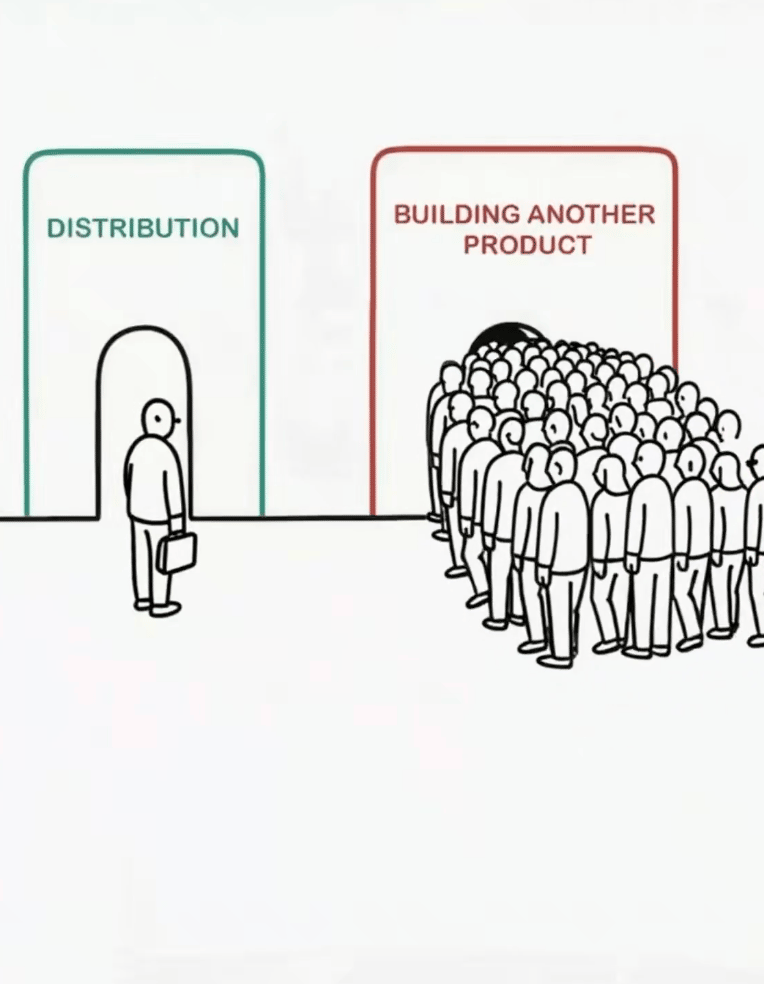
The more I write about marketing, the more I notice the sharp, sticky stuff tends to live at the edges. When everyone's zigging, it's worth considering the zag. Which is exactly our first insight this week: sometimes the win is simply the move nobody else is making. This week we cover unoptimized marketing, onboarding friction, and AI search.
-Nick
Unoptimized marketing, onboarding friction, and AI search
1. Chubbies founder on the few things that actually moved brand and growth
Insight from Preston Rutherford, co-founder of Chubbies.
Preston Rutherford co-founded Chubbies in 2011 and sold it a decade later for over $100M. Looking back, he says only a handful of things actually made a difference for marketing and growth:
- Content for content's sake. They sent an email every Friday with one job: make people laugh. No revenue goal, no product links. People forwarded it to friends, and it turned into an acquisition channel they never planned for.
- Memorable interactions. Funny product names, easter eggs on the site. "5.5-inch inseam khakis with an elastic waistband" became "Khakinators," something easy to tell a friend when they ask about your shorts, and something for people to search.
- Escalating box inserts. Customers got a special gift on the first order. The second was better. The third, better than that. People posted their gifts and asked each other how to unlock the next one. It drove LTV. It also drove new customers.
Here’s his point:
"It's so easy to get into the day-to-day machine of Facebook ads and ROAS and CAC and sending the next batch and blast that we miss the things that truly make the difference... everyone's doing the same stuff, so for the brands who can go in a slightly different direction and create those tiny (or big) special moments, those little wins compound and act as the rising tide that lifts all boats."
Our take: most of this wouldn't survive a modern growth review. It's brand work, and you can't cleanly track it. Which is probably part of why Chubbies worked. When everyone's turning the same dials, and using the same prompts and models, the only thing left to win on is the stuff you can't automate. The human stuff.
2. More or less onboarding friction?
Insight from Gaurav Vohra's Superhuman onboarding playbook.
Superhuman's onboarding gets copied constantly, and the debate is usually about friction. Less or more? Vohra, who built that onboarding, has results pointing both directions:
- They cut the navigation lesson out of self-serve onboarding, teaching only the two keys that produce inbox zero, and activation went from 40% to 50%.
- They turned an optional setup checklist into full-screen panels with no skip button, and completion went from 30% to over 98%, partly because users now had to finish or bounce.
Less friction in one case, more in the other, and both were hits.
The thing both changes share: Superhuman knew exactly one outcome it was pushing every new user toward, an empty inbox, for a specific customer, in under 30 minutes. Once you know that, you can decide when to add friction and when to strip it, all for that one goal.
Vohra's rule is simple: an interruption has to be really valuable, or it's gone. That kills about 90% of what you'd otherwise add. But the rule only works if you know the one goal you're steering people toward. Teams that can't name it just drop in a dismissible tooltip and move on. It's the thing you ship when you haven't decided what onboarding is even for.
Friction isn't good or bad on its own. It all depends on where you're pointing it. We've covered the upside of stripping it with opinionated defaults, as well as when more friction is good. It pays when it's pushing someone toward an outcome you've already committed to, and it's just friction when it isn't.
Before you touch the flow, write the sentence: the one outcome, for the one customer, that your onboarding exists to deliver. If you can't, no tactic downstream is going to rescue it.
3. The information gain problem
Insight from Zach Boyette, Managing Partner @ Saturation.
In AI search, your best-written page can get skipped while a worse one gets cited. Rewriting it won't help, because writing quality isn't what the model is grading.
What it's grading is information gain, an idea Google patented back in 2022. Plain version: how much does your page add that the reader hasn't already seen a hundred times somewhere else?
Old-school search rewards authority and backlinks, so a page that just repeats what everyone else says can still rank. AI answers work differently. For a straight factual question, authority still wins. But for the "what's the best way to handle X" questions your buyers actually type, the citation goes to whoever said something the model hadn't seen before.
So better writing is a dead end here. The move is better inputs.
Here's the trap. Writing about a topic usually starts with researching it. You read the pages already ranking, skim a couple reports, scroll LinkedIn, ask ChatGPT for a summary. Every one of those inputs is already indexed. So your finished page comes out as a remix of stuff the model has read a thousand times, and its information gain rounds to zero.
The way out is to start with stuff that was never published in the first place. Your sales calls. Your own numbers. The real reason your product works the way it does. None of that is on the internet, which makes it the one thing you can say that nobody else can.
Here's how Saturation runs it, in four steps:
- Access. Mine your own sources for insights: The objection your reps answer on every call. How long onboarding really takes by industry. Why the founder built it this way instead of the obvious way. Churn in your customers' actual words.
- Filter. Keep only the claims a competitor couldn't make and you can prove. The test: is it better than the best few pages already covering this? If not, cut it.
- Anchor. Publish the finding as its own thing (a report, a benchmark, a dataset) with the methodology attached, on a URL that doesn't move. Make it the thing people cite, not commentary about it.
- Expand. Point your other content back at that URL, and keep the asset updated so citations stack on one page instead of spiking and fading.
Quick real example. A consumer SaaS came to us getting buried in search and AI results. They assumed they were doing something wrong, that competitors were just out-publishing them. They weren't. They had genuinely unique features and were barely mentioning them anywhere, on their own site or off it. It wasn't a volume problem, it was a story problem. So we sat down with their product team, wrote down what the product actually does that nobody else does, and published it. App downloads rose 109%. Non-branded clicks rose 58%.
You almost certainly have stuff like this lying around too. Having it and actually publishing it are two very different things.
PS for newer readers: Saturation is our sister company. Getting startups cited in AI search is the whole thing they do. If you need some help with it, reach out here.
News you can use
- A US appeals court said AI shopping agents can buy on Amazon. On Aug 4 the Ninth Circuit lifted the court order that had blocked Perplexity's Comet since March, ruling that an agent doing what you told it to is legally you, not the software. The case isn't over, but it removes the main legal tool platforms had for keeping agents out. (The Next Web)
- OpenAI shut down its own browser. Atlas stopped working Aug 9, less than a year in, and agentic browsing moves into the ChatGPT app and a Chrome extension instead. So the fight for AI visibility is happening in the assistant and the extension, not in some new browser you have to win. (9to5Mac)
- Cloudflare will block "mixed-use" AI crawlers on ad pages by default starting Sept 15, and it's moving to pay-per-use. Plainly: the open web is starting to charge AI for access. If your growth plan leans on free traffic from AI answers, the crawling that feeds those answers is getting priced right now, so take a position before the deadline. (TechCrunch)
Something fun
Always. From @launch_llama