
What’s up everyone!
As Nick teed up last week, some changes are coming to the newsletter. Here's one we think long-time subscribers will be particularly stoked about: we're bringing back the OG format. Here's why.
Demand Curve started because challengers deserved a growth edge over incumbents. And back then, growth (as a discipline) was just emerging. Our original newsletter format, 3 insights/tactics/playbooks from the operators leading the fastest-growing startups out there, kept our community on the bleeding edge.
Then growth matured. Knowing the latest tactics mattered, but maintaining that edge required going deep. So we began prioritizing longer-form content.
But in the AI era, it's feeling a lot like the old days. Keeping up is a real struggle.
So we're bringing back the newsletter designed for just that. If you're a recent subscriber, here's what you can expect:
- 3 actionable insights from our team and other frontier operators
- The week’s marketing news that actually matters
- And something fun ;)
This week, we’re covering landing page audits, positioning, and AI content. Let us know what you think.
-Justin
Brought to you by Tatari, the TV platform built for modern performance marketers.
Think TV is just for soda and car insurance?
Gusto, Relay, and Otter would disagree. These B2B brands are using TV to reach buyers beyond search, email, and LinkedIn – explaining complex products and earning trust before anyone hits a demo form.
It's convergent too: streaming and linear TV bought and measured in one platform, targeted around your audience (including ABM or retargeting lists), with real business outcomes tracked.
We've got some updates
1. How Joey audits a landing page
Insight from Joey Noble of Demand Curve.
After reviewing literally hundreds of client pages, I check the same seven things. They don’t all matter equally, but together they tell me whether a page is actually doing its job. Ranked by how much they move conversion:
- Clarity. Can someone grasp the offer in five seconds? What is it, who’s it for, why care, what next? Is there one obvious primary action? No jargon unless your market genuinely speaks it.
- Intent. Does the page match the visitor’s traffic source and awareness level? If a cold social ad sends problem-aware people, pick up the story where the ad left off instead of jumping three steps ahead. Branded search, retargeting, and comparison traffic all arrive warmer.
- Value. Is the outcome concrete and desirable? People buy the quarter-inch hole, not the drill. “Book 30% more qualified calls” beats “AI-powered outbound automation.”
- Proof. Is there specific evidence next to every big claim? A real case study (who, what changed, by how much) beats five stars from an anonymous “verified buyer.” The bigger the claim, the stronger the proof needs to be.
- Friction. What adds effort, doubt, or distraction? Nav links that lead off the page, value props buried in tabs, walls of text, an unclear price, a CTA that feels like a huge commitment. I flag these and remove them.
- Differentiation. Could your closest competitor put your headline on their page without lying? If so, it’s describing your category, not you. “Save time” and “built for modern teams” both fail. More on benefits vs. value props here.
- Momentum. Does each section answer the next question in the visitor’s head and push toward the action, in sequence, instead of jumping around?
Nail clarity first. A perfectly sequenced page won’t work if nobody understands what you do.
This is one lens I run on client landing pages. You can try it yourself. But if you want me to do it for you, reach out here.
2. Your biggest competitor isn’t in your category
Insight from Andrew Chen.
Ask an AI founder who they’re competing with and you’ll likely get a list of AI companies. But here’s what Andrew Chen actually thinks they’re up against:
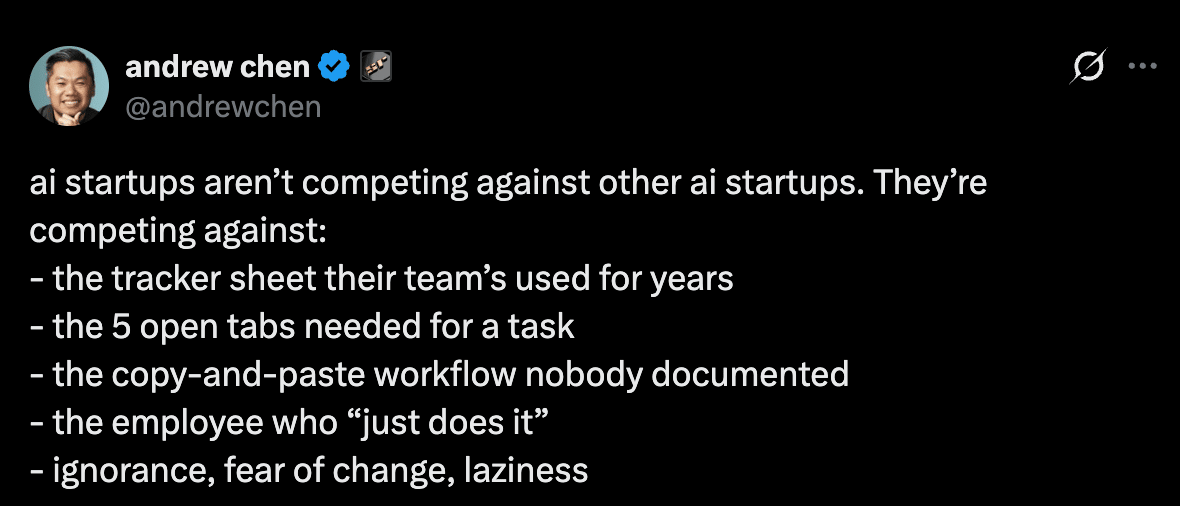
Put another way, companies are also competing with the status quo: how people are spending time, how they’re spending money, how they’re currently doing things.
It’s a good instinct to prioritize the customers who are already in market. Those people already decided they want to solve the problem. They’re high intent. But don’t mistake it for the easier bucket, because every competitor you have is fighting over it, and it’s expensive.
The bigger pool is everyone who hasn’t started looking at all. Convert them at a worse rate and you can still come out ahead per dollar.
So what’s working just well enough for the people in your market? Those are your competitors.
Talk to your customers and find out what actually broke right before they went looking. Three questions in a post-purchase survey gets you this. Ask the people still on the workaround what they like about it, too.
Then you can figure out what that workaround was really costing them. Hours, mistakes, one person holding knowledge nobody else has. That’s what you position against, instead of somebody’s feature grid. So write a landing page for the person who isn’t shopping. “Better than [competitor]” only lands on someone already comparing. “Still tracking this in a spreadsheet?” lands on everyone who isn’t.
Anthropic’s hard questions ad, however controversial, is actually a good example of this in practice. It highlights people asking whether AI can be trusted, who gets to decide the rules, whether it makes the world more dangerous. No competitors named. The ad isn’t for anybody deciding between Claude and ChatGPT. It’s mostly for the people who aren’t using AI, and/or those who are skeptical of it. That’s a huge audience.
Your category is the small pool, and most of the room for growth is outside it.
3. Take a great insight, make it deliberately messy
Insight from Nick Costelloe of Demand Curve.
It used to be enough to have sharp insight. Something novel, contrarian, spiky. Then share it in a punchy, deliberate way. That was the recipe, and we built this newsletter on it.
Now there’s a new variable “quietly killing” your content. ~ gasp 😂 ~
Cassandra Naji’s post last week hit me, and it’s worth reading in full. She can spot AI-written content in seconds, mostly from the fake drama. “This quietly kills your pipeline.” “Silent failure.” She calls it tension cosplay, and says the manufactured drama is usually cover for insight that’s…not that great.
The part that stuck was the first bit—she spotted it in seconds. (Yeah, that’s right. I’m reclaiming the em dash. AI took it from me and I want it back.)
I’ve got the same detector, and so does anyone who’s written for a living since before ChatGPT. The moment I notice AI writing, my whole lens changes. I decide the writer’s lazy, the ideas will be dull, and I start thinking about the consensus machine and how AI converges on the mean. I came here for the edges. So I bounce.
Here’s the messy part: everyone’s detector is calibrated differently. There are obvious tells. “Quietly.” (So sick of this one.) “It’s not X, it’s Y.” But mostly it’s fuzzier than that. I’ve written things completely from scratch and been accused of using AI. The way I used to write, sharp insights and all, is pretty close to how Claude writes for engagement.
So over the last two years I changed how I write. More mess, more personal stories, the occasional deliberate ramble. Fewer punchy one-liners. Drama only when it’s earned. All of it so it sounds like a person wrote it, because I did.
I didn’t want to change. But an idea only travels as far as it gets read, and the second someone smells AI you’re the writing equivalent of a Cybertruck on the road. People get mad or they ignore you. Either way, you lose.
I still use AI often. Research, outlines, pressure-testing an argument. My voice is the one thing I won’t outsource. When everyone runs the same tools and the same prompts, everyone lands on the same mean, and voice is what’s left. That’s the moat.
So: start with a great insight, add personality, and please, make it messy.
News you can use
- 41% of long-form LinkedIn posts are likely AI-written, per detection service Pangram, and 30% of short ones. LinkedIn’s answer is a “Seems like AI slop” option in the three-dot menu on posts and comments, which hides whatever you flag. It’s also retiring “enhance your post” and replacing it with a proofreader that fixes grammar without touching your voice. (404 Media)
- OpenAI appears to be building ChatGPT ads that open an AI agent instead of a webpage. Tapping one would start a conversation built from your site and product feed, making the chat the destination rather than a click-through. Nothing announced yet. We already run ChatGPT ads for clients, so talk to us if you want a head start on this one. (Search Engine Land)
- Reddit is testing a “video Reddit” you can watch or just listen to. On the Q2 call, CEO Steve Huffman said it’ll turn popular posts into background video and audio, TikTok-style. Worth watching if Reddit is a channel for you, since it’s one more place your posts get consumed without anyone clicking through. (TechCrunch)
Something fun
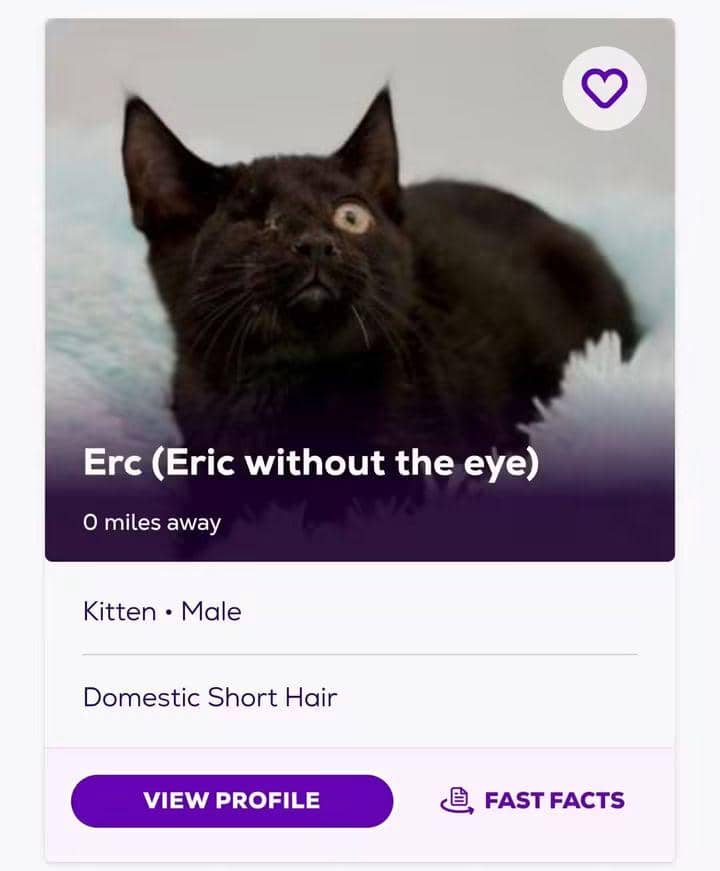
Howdy, Erc.