

We’ve sent 250+ growth newsletters over the years. Some covered quick wins. Others taught fundamental frameworks.
With Growth Program 2.0 launching soon, we pulled three evergreen concepts that changed how we think about growth.
Hope you enjoy.
- Kevin

Brought to you by Insense — the UGC engine behind Revolut, Glovo, and Blvck Paris.
In need creator content but don’t have time for manual outreach and asset wrangling? Insense is the fix. Use their platform to get matched with responsive, vetted creators across the globe, access to brief templates, creator moderation team, and fully licensed raw + edited UGC in 14 days or less.
💰 Book a free strategy call by July 11th and get $200 in platform credit.
Greatest Hits Series
Let's start with the math that changed how we think about growth.
Growth Loops, not Growth Hacks
Insight from Reforge.
Which would you choose:
- Initiative A: Gives you 500 new users this week but nothing afterward.
- Initiative B: Gives you 20 new users in week one, 22 in week two, etc (growing 10% WoW) for every week going forward.
Initiative B will take 14 weeks to reach 500 new users.
But after 1 year, you’ll have 28,208 new users and grow by ~2600 per week. By the end of year 2, you have 4,035,039 new users (assuming a constant 10% growth rate).
This is the general principle behind compounding Growth Loops:

In short, the output of a marketing initiative feeds back into the input. Examples:


Another classic example is ads:
- You spend money to run ads
- You profitably acquire new customers
- You use said profit to acquire more customers. If you need help running ads, we’ve built an ad agency specifically designed for startups.
In short, your primary marketing efforts should not be one-off tactics. Instead, they should be initiatives that can compound. Here are examples that do not compound:
- Launching on Product Hunt: You get an influx of users. You… can’t launch on Product Hunt again.
- Timed-limited Promos: You get a big influx of customers and revenue. You can’t just run another promo.
- Press coverage: You get featured in Forbes. You get a big spike in traffic. It disappears a couple of days later. You can’t be featured all the time.
Compound growth sounds great. But how do you know which loops to build? This is where strategy comes in.
Create a real strategy, not just a list of goals & tactics
Insight from Mark Pollard.
Most companies' "strategies" are either purely:
Goals:
- Become relevant with Gen Z
- Increase sales by 30%
Tactics:
- Post on LinkedIn 5 times per week
- Create lead magnets
Mark (aka Strategy Friend) defines a strategy as "an informed opinion about how to win."
Your strategy is supposed to tell you exactly what your team needs to do to grow. Yet, according to Mark, most strategies look like this:
_01HKDX748DHCD7G8QF6XKJXY59.avif)
They're missing the key insight to the real cause of the problem and a strategy to help solve the problem. Instead, they just jump straight into tactics with no clear vision.
"Tactics are simply the activities that make a strategy happen."
Here are two examples of what a good strategy looks like:
_01HKDX74P3K81JDEZEXSP0E3RS.avif)
_01HKDX752P9MGE96D7WGRGS07T.avif)
We've covered the power of compounding growth. We understand how strategy drives tactics. Now let's simplify growth to its essence.
This mental model will help you shrink the big wide world of growth opportunities into four logical buckets.
The 4 high-level ways to drive growth
Insight from a great article from MKT1.
Fundamentally, there are only four high-level ways to drive growth.
This image from MKT1 summarizes it perfectly:
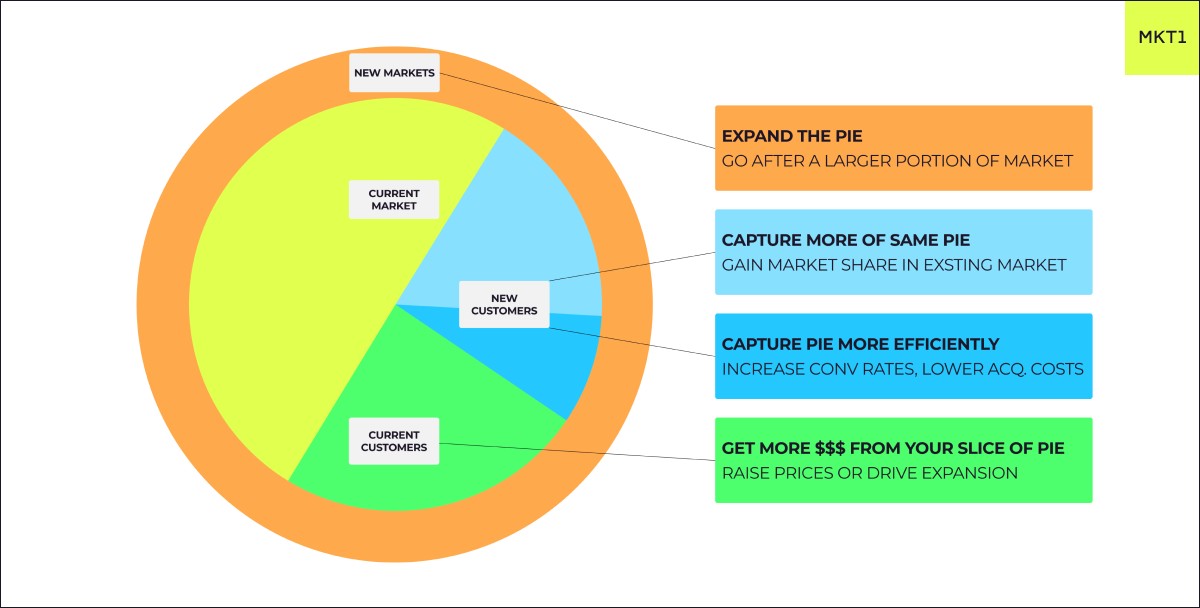
A startup can do a million things to grow (we’ve covered over 455 of them here), but given extremely limited resources, you should find the highest leverage place to apply pressure to grow now.
Understanding these four primary levers helps you prioritize. Let’s dive into each:
1. Get more $$$ from your current slice of pie
- Charge more money from existing customers (make sure to increase perceived value too).
- Sell more products to existing customers (upsell/cross-sell)
- For SaaS, increase revenue per customer by adding new features and tiers, increase the number of seats they use, or increase product usage.
- Reduce churn so revenue can grow over time. The SaaS Quick Ratio is a handy metric for determining whether your growth and churn are healthy.
2. Capture the same pie more efficiently
You’re always getting new customers, but you can do it better. You can generate more revenue with the same or less cost and effort.
There are really only two fundamental ways to do this:
- Increase conversion rates with better funnels (copy, landing pages, lead magnets, sales, etc).
- Lower acquisition costs with better creatives, targeting, lead quality, (and conversion rates ;0)
Note: Check our Growth Vault for 84+ tactics to increase conversions
3. Capture more of the same pie
You’re growing within the same market segment but can get MORE leads:
- Double down on what’s working, but always experiment with creative ideas.
- Watch out for diminishing returns (increasing acquisition costs), especially on ads, if you’ve been going after the same market for a while and keep increasing budgets. That’s especially true if it’s a niche market.
- If you’re steadily growing, don’t wait until you cap out before expanding the pie because it takes longer than you think.
- Set up a different growth engine (content or sales instead of ads)
Note: No matter how good you are, you will never get the whole pie, sorry!
4. Expand the pie (or test new pies entirely)
- Go after new markets/segments (industries, company sizes, geos, verticals).
- If you’re very early stage, this is just trying to find product-market fit.
- Depending on the new segment, you can either use the same growth engine (ads) or you need to set up another one (i.e., outbound or content).
- Create new content, messaging, and funnels tailored to the new “pie”.
- Always run small tests before going all in. Make sure to prioritize your tests using the RICE/DRICE frameworks.
- Double down if you have similar or higher conversion rates with this new market or segment.
How to use it
Every few months, pick one of these to prioritize and go hard on it. What matters most will depend on your current circumstances (and likely stage). For example:
- A very early-stage company is either focusing hard on one market/segment or testing several to find product-market fit.
- A startup with PMF will likely want to improve conversion rates with well-optimized funnels, great onboarding, and strong retention.
- Then they'll want to focus on capturing more of the same pie by ramping up their current growth engine (ads) or setting up a second (outbound).
- Then they might want to get more from their current customers by charging more and upselling and cross-selling.
- Then, they might want to expand markets/segments as they reach saturation in their current ones.
If you want some support...
Growth Program 2.0 takes these frameworks deeper with personalized growth paths, AI-powered feedback, and human coaching to help you implement and iterate.
Knowing frameworks is step one. Executing and adapting is where the real work lives. We’re here to support you along the way.
Join Growth Program 2.0 Waitlist →
— Kevin and the Demand Curve Team
Something fun
“Did a full 360 and I still can’t find it." From Critical_Ad3024