Welcome to the 528 new marketers and founders who joined last week!
This week we're covering big-ticket item emails, copywriting frameworks, and respectful personalization.
Email customer acquisition for big, once-in-a-lifetime purchases
Insight from Rejoiner.
Most content on ecommerce email marketing focuses on DTC: retention, maximizing lifetime value, and bringing customers back to purchase again and again.
But what should you do if you’re a store selling $1,000+ products that are typically once-in-a-lifetime purchases for customers?
These businesses tend to get fewer repeat purchases, so they can’t afford to give away a huge discount upfront in hopes of profiting off future orders.
Instead of the standard percentage off first purchase promo that most DTC companies use to acquire emails, here are a few alternatives for high-priced items:
- Dollar amount off: If you sell a $2,000 product, try “$200 off” instead of “10% off.” Dollar amounts feel more substantial (and tangible) than percentages and look more attractive when you’re selling a pricey item.
- Free gift with purchase: Free gifts are a popular option with luxury brands. Skip discounting altogether but still offer something that gets customers excited. For example, if you're selling an expensive couch, throw in a low-cost item like an end table as a free gift.
- A chance to win a discount: Everybody who signs up is entered and you announce a winner periodically.
- Custom content with educational value, rather than dollar value: A product recommendation or downloadable PDF. This is a great option if discounting doesn’t fit your brand, but your product is more difficult to understand.
Consider testing two of these at a time until you find a winner that works best for your long-term acquisition strategy.
When using personalization, avoid the creepiness ditch
Insight from Preeti Kotamarthi and John Berndt.
Personalization works.
We see it every year with Spotify Wrapped, when personalized content goes massively viral. 80% of consumers are more likely to buy when brands offer personalized experiences. Personalized recs account for 75% of Netflix’s watched content and 70% of YouTube’s.
But when personalizing your marketing or product, avoid the creepiness ditch. That’s the no-man’s-land where personalization starts to feel creepy, resulting in fewer conversions, not more.
Examples of creepy personalization: You feel singled out, your privacy seems invaded, or a mistake annoys you and reminds you that you’re being targeted, like when Pinterest congratulated single women on their weddings.
Ways to avoid the creepiness ditch:
- Don’t retarget too fast or too much. Consider waiting at least 24 hours before retargeting, and keep frequency conservative. Over 30% of people actually get angry at an advertiser if they see the same ad 10 times.
- Make sure messaging is relevant. In a study from Gartner, nearly half of participants said they would unsubscribe if content seemed personalized but irrelevant to them. But don’t get so relevant that people feel ill at ease—e.g., by targeting based on sensitive search history.
- Pay attention to bias and stereotypes. Another study found that people who received an ad for weight loss based on their size felt judged. Also be careful about stereotyping if your product uses personalized avatars.
Real-world examples of three copywriting frameworks
Insight from Demand Curve. Porsche ads source: Airows.com; Keloptic image source: Klenty.
Frameworks are so acronym-riddled—think BAB, PAS, and AIDA—that they can be more confusing than helpful. Plus, they’re often discussed without any context, adding to the sense that they’re just a bunch of letters.
But here are three of the most powerful copywriting frameworks in context, using classic Porsche ads to explain how they work.
BAB framework:
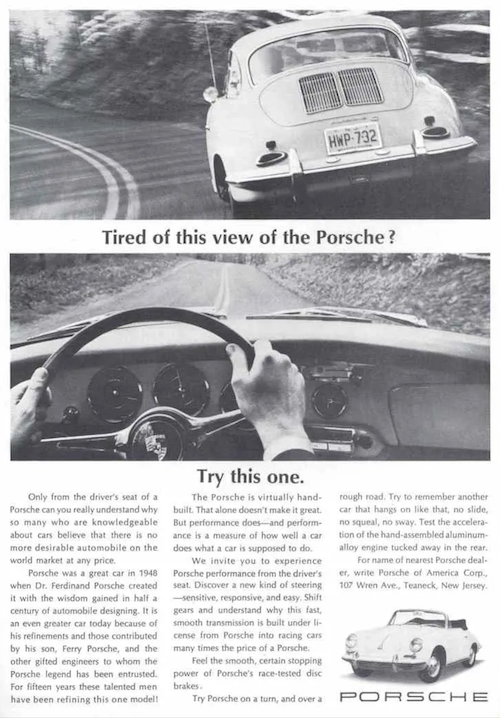
First up, BAB: before-after-bridge.
- Before: The pain point your audience is facing. Like driving behind a Porsche in a car that’s not a Porsche.
- After: What life is like when that pain is resolved. Hands grip a sport steering wheel. The road ahead is all yours.
- Bridge: The solution—your product. The bridge that takes you from before to after.
The reason we like BAB and the other two frameworks we’ll discuss: They spotlight experience. They zero in on, and accentuate, what it’s like to have or not have your product. Think of it as another form of highlighting benefits, not features.
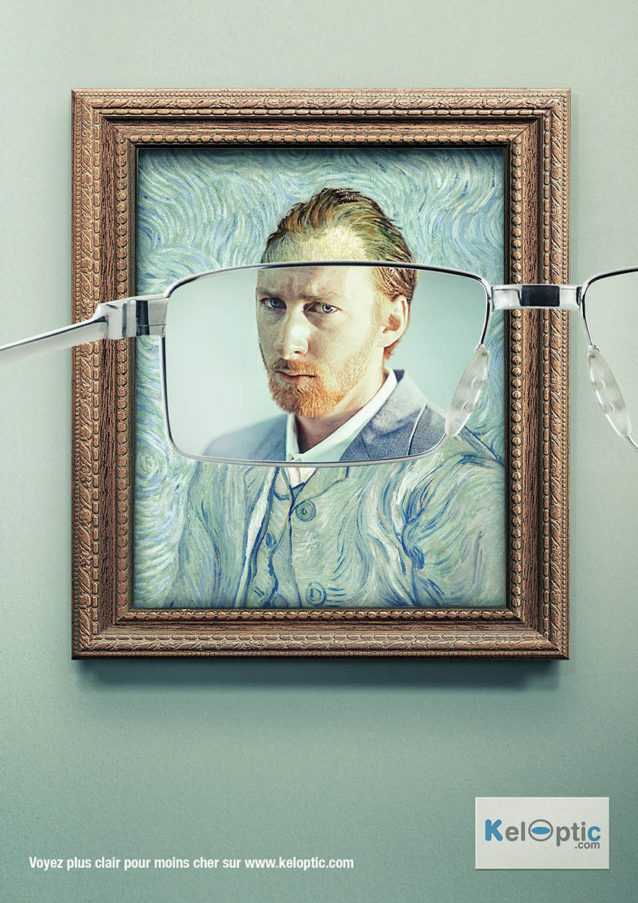
Another great BAB example, no copywriting even needed:
PAS framework
“In the beginning I looked around and could not find quite the car I dreamed of. So I decided to build it myself.” –Ferry Porsche
That simple statement encapsulates the next framework, PAS: problem-agitate-solve.
- Problem: The pain point. Ferry couldn’t find his dream car.
- Agitate: Agitate the problem. Heighten the negative emotions it provokes—frustration, anger, fear—or the pain it causes. Add some drama.
- Solve: Your product is the solution. Ferry built his dream car: a Porsche.
This example isn’t an ad; it’s a quote. But you can see how PAS can pack a full story into just a few words.
Admittedly, the quote doesn’t have much agitation. We’re including it anyway because we admire its concision and full arc. If this were an ad, it might linger longer on what life is like without Ferry’s dream car. It takes longer to get places, you’re on a first-name basis with your mechanic, you’re embarrassed to drive around in your old ride. Then it would get to that dream-realizing Porsche 911.
AIDA framework
(The example below is an old ad and the copy is a bit blurry. We call out the lines that matter below.)
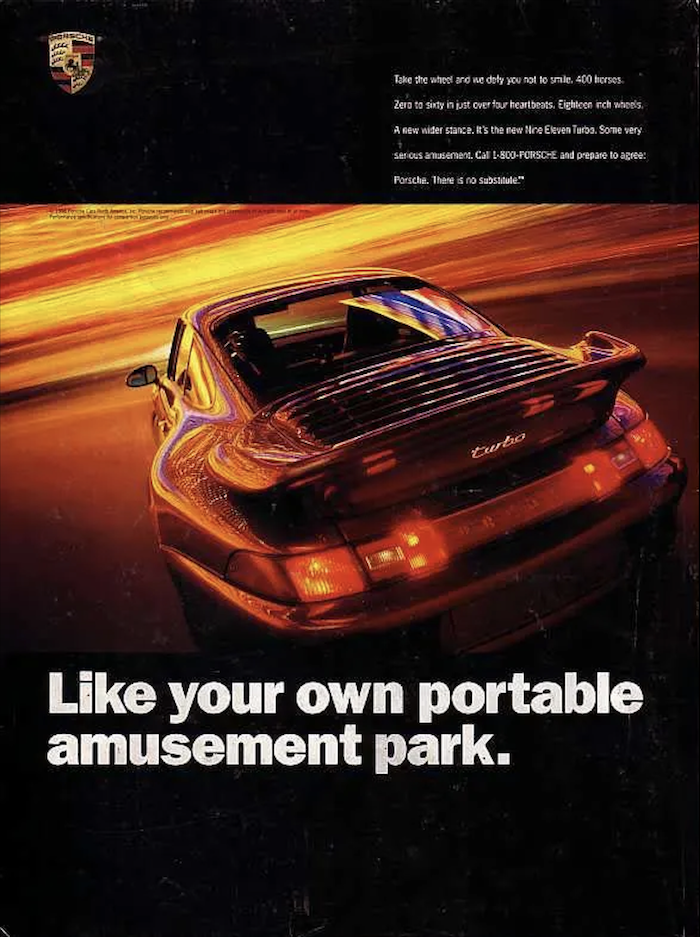
The third framework is AIDA: attention-interest-desire-action.
- Attention. Grab attention with an eye-catching headline, image, or both.
- Interest. Nurture interest and intrigue. This ad does that by describing the experience of driving a Turbo: “400 horses. Zero to sixty in just over four heartbeats.”
- Desire. Stimulate desire. Want “some very serious amusement”? To get it…
- Action. Take action. Call 1-800-Porsche.
AIDA is a copywriting classic—it goes all the way back to 1898. The fact that it’s still one of the most widely used and recommended frameworks among copywriters is a testament to how dependably it works.
For more on copywriting, check out our favorite examples here.
News and links
News you can use:
- Walmart and Roku are teaming up to make shopping while streaming as easy as shopping while scrolling. Users simply press “OK” on a shoppable TV ad to move to checkout, with products fulfilled by Walmart.
- Pinterest’s Idea Pins look like the Stories format of other apps—and they now come with ads. Businesses can use both video and image content and even partner with creators to produce Idea ads.
- A heads up that Google is testing new featured snippet formats, like showing as many as four featured snippets at a time. Expect changes in your organic search traffic, clicks, and conversions as a result.
Links:
- Resources Library: We've created a new hub for our content. Bookmark it for easy access to our articles, playbooks, landing page teardowns, and other growth resources.
- How I Became a Content Marketer Without a Marketing Background: Demand Curve's very own Joyce Chou shares tips for pursuing and advancing a marketing career on Superpath's blog.
Something fun