
Hello everyone,
This week we're talking about specific suggestions, specific numbers, and the sold-out effect.
Let's dive in!
–Neal
Exclaimer
Content we recommend: Email Signature Dummies Guide*
Tap into the power of email signatures as a marketing tool.
Get your Email Signature Dummies Guide, a comprehensive eBook that walks you through eight ways to make the most of email signatures.
With the guide, you’ll learn how to:
- Use your email signature for promotions, social media, and brand management.
- Get consistent email signatures across your organization.
- Manage your company’s email signatures more quickly and effectively.
Make your email signature work for you.
Use specificity to anchor people
Insights from Why We Buy.
The first number we see becomes our point of comparison for future numbers—known as the anchoring bias.
For example, if someone says their service costs $5,000 per month and up, you're anchored to the number $5,000. If they then give you a quote of $25,000 per month, you're gonna have sticker shock—even if you're being offered way more value than the $5k/mo package.
Snickers grew sales by 38% simply by adding an anchor (the number 18) to their ad:
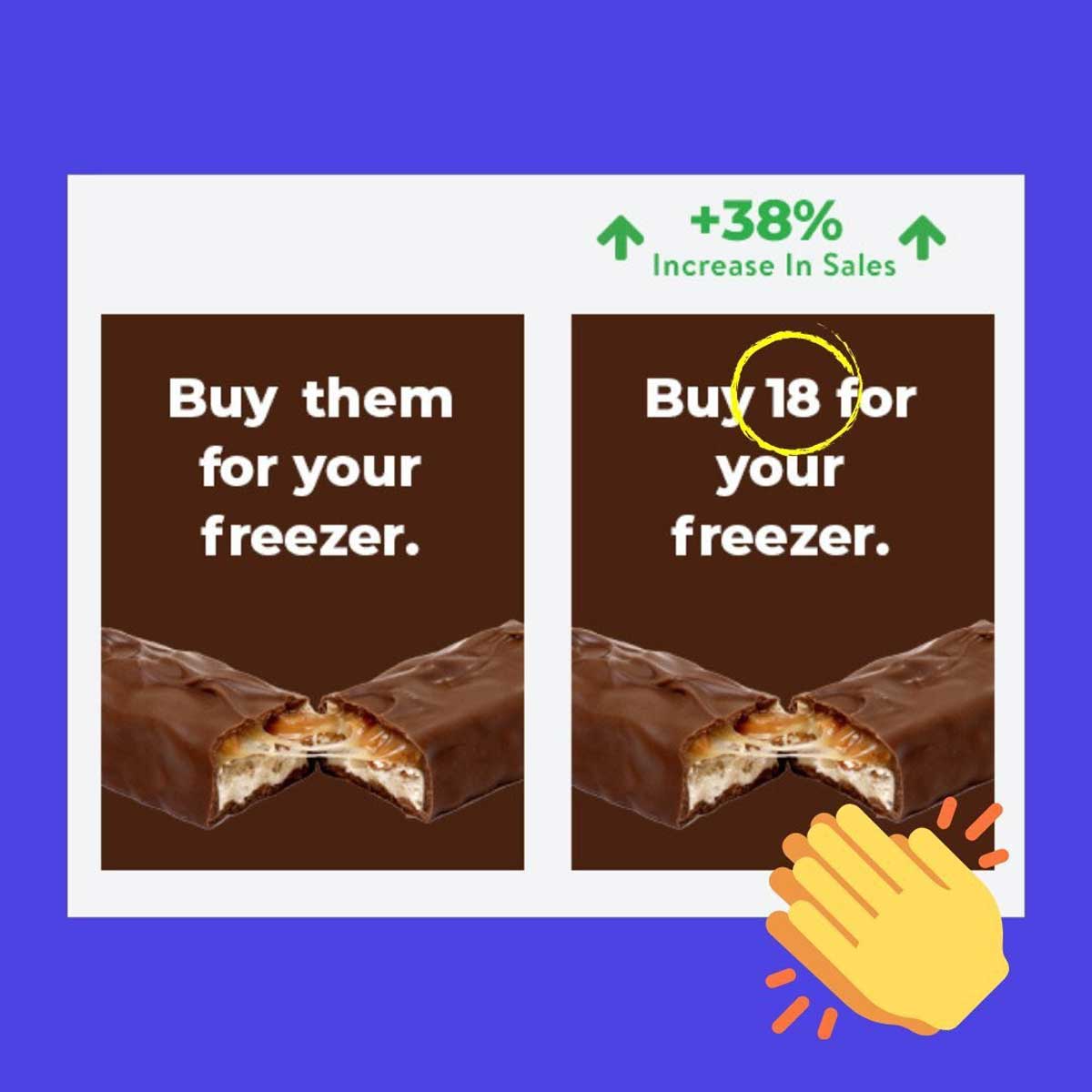
By including that number, Snickers suggested that 18 chocolate bars was a typical amount to have in your freezer. If you ordered fewer than that, you were being positively virtuous.
As in Tactic #1, the specificity here makes it easier to picture the items in your life. I know what 18 Snickers bars in my freezer look like. And now that I can picture them, I realize that that’s where they ought to be.
The "sold-out" effect
Insight from Ariyh.
Say you’re in the market for some biker shorts.
You find the perfect ones:
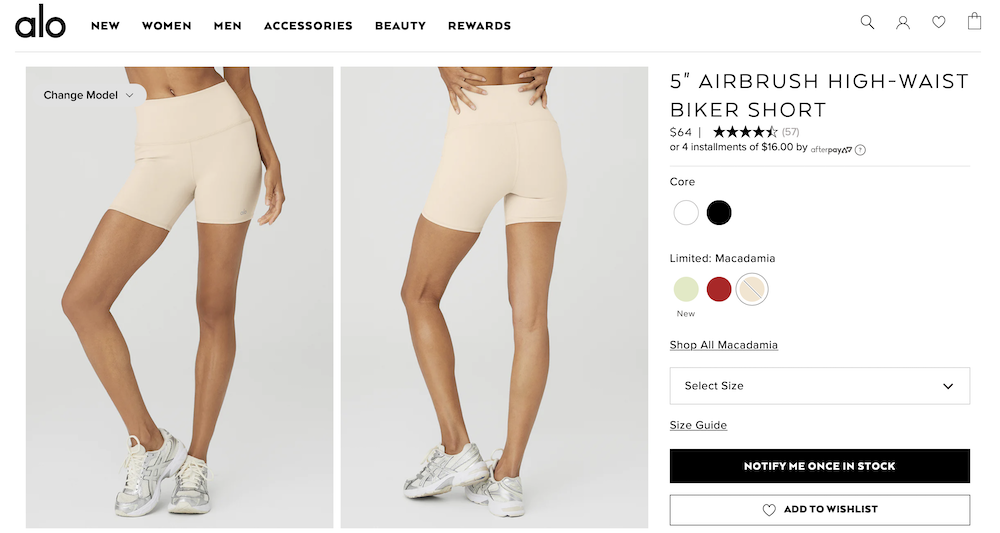
But drat, they’re sold out in the macadamia color! So you hurry up and order them in red, before those sell out too.
When you see sold-out options/models, you’re more likely to buy whatever’s left (assuming you weren’t looking for a super-specific version).
Why? The "sold out" label acts like social proof. It tells you that the product is desirable and high quality.
And it adds time pressure. If you want it, you better buy it before it sells out too.
But there’s a caveat: Seeing too many sold-out products reduces the likelihood of a purchase. Shoppers expect a certain amount of freedom of choice. We’ll jump ship if we think that freedom is being threatened.
Two important takeaways:
- Don’t immediately remove sold-out product options from display. Keeping them may make people perceive your product as being higher quality.
- But don’t display sold-out products if they make up more than 30% of your inventory. Between 10-30% is a good range of sold-out products to feature.
Use specific suggestions to increase sales
Insight from Neal and Second Cup.
When I was fresh out of university, I worked at a coffee shop called Second Cup. This Canadian chain trained its staff in a simple but effective sales technique:
"Make one specific, contextual cross-sell suggestion."
For example, if it was first thing in the morning and someone ordered a coffee to go, I might’ve asked them, "Would you like a blueberry muffin to go with your coffee?"
Or if it was 9pm and a couple ordered drinks, the barista might follow it up with, "How about a slice of cheesecake to go with that?"
Most of the time, people would say yes, effectively doubling the order value.
Specific suggestions were far more effective than generic ones like, "Would you like anything else?" To those, people automatically replied, "No, just gimme what I ordered."
A specific suggestion, on the other hand, made them picture the item and start craving it.
This is what makes cross-sells on Amazon and other retail sites work so well.
Amazon’s "Featured items you may like" and "What do customers buy after viewing this item?" sections make you go, "Hmmm, maybe I do need that nice-looking bag for this camera I'm buying." You can picture using the two items together.
Cross-selling can bump up order values at checkout too:
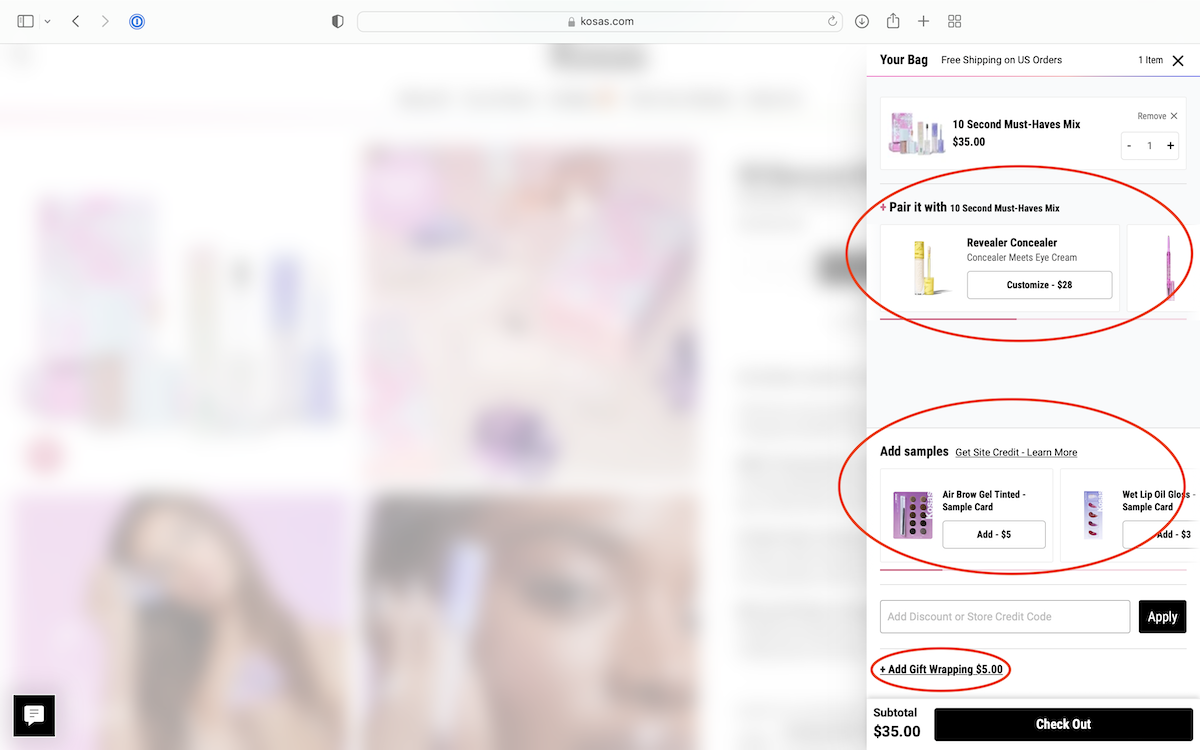
Try out specific suggestions in your sales funnels and conversations to boost average order values.
News and links
News you can use:
- A few experiments worth noting on the AI front: LinkedIn is testing out AI promptsfor ad copy creation and an InMail chatbot, while Instagram is testing its own AI chatbot in DMs.
- Some recent non-AI releases: LinkedIn announced DMs for company pages and three new ad formats: In-Stream Video ads, Conversation Ads, and Thought Leader Ads. Reddit launched two new ad products of its own—Contextual Keyword Targeting and Product Ads—although the bigger Reddit news was the 7k+ subreddits that went dark in protest of API pricing changes. WhatsApp debuted Channels, a feature that broadcasts updates from people and organizations you've followed. Yep, basically another social media tool.
- And going back to AI: We learned that ChatGPT can tell a joke—but only a few of them. Plus, its tendency to get the facts wrong sometimes got it in hot water last week, when a man sued OpenAI for libel after ChatGPT falsely said he’d been accused of embezzling money. It’s the first lawsuit of its kind but could be a signal of how wild the AI legal landscape might get (not to mention all those copyright concerns).
Content we recommend: Email Signature Dummies Guide*
Tap into the power of email signatures as a marketing tool.
Get your Email Signature Dummies Guide, a comprehensive eBook that walks you through eight ways to make the most of email signatures.
With the guide, you’ll learn how to:
- Use your email signature for promotions, social media, and brand management.
- Get consistent email signatures across your organization.
- Manage your company’s email signatures more quickly and effectively.
Make your email signature work for you.
*Sponsored by Exclaimer
Something fun
From @danielkenitz via @the_marketing_millennials