

A big thanks to our sponsors, who keep this newsletter free for all of you. Check them out—it's the best way to support this newsletter :)
Brought to you by Hopin. Generative AI search results will crush SEO. A decentralized community is a new way to grow your top-of-funnel and control pipeline. Create community with Hopin. Book a chat to learn more.
(We use Hopin Session for our events and love it!)
And by Doriane Stagnol, your content strategist with a twist—harnessing a decade of scientific insight for your tech company. She takes content from boring to brilliant.
Secure your free content audit now!
Brought to you by Doriane Stagnol, your content strategist with a twist—harnessing a decade of scientific insight for your tech company. Secure your free content audit now!
Hopin
- Turn your marketing funnel into a community flywheel with Hopin. Learn more ad book your free strategy call.
- AI is hot right now. You know what's even hotter? An event on AI. But people are busy. Travel is expensive. So go virtual. Go big. Go Hopin. Book your strategy call.
- Generative AI search results will crush SEO. A decentralized community is a new way to grow your top-of-funnel and control pipeline. Create community with Hopin. Book a chat to learn more.
Link: https://hopin.com/hopin-events/contact-sales?utm_source=demandcurve&utm_medium=demandcurve
How to leverage the Labor Illusion
Insight from... well us.
Imagine being served a fancy restaurant entrée within 23 seconds of ordering.
What would you think?
You'd likely question its quality and feel you overpaid for a precooked dish.
This is the Labor Illusion in action.
Customers perceive services as more valuable when they see the effort put into them, even if that labor doesn't necessarily improve the outcome.
This even applies to digital products and services.
For example, Kayak (a flight search tool) found users were more likely to convert if search results rolled in more slowly, giving the impression of a thorough, exhaustive search.
Pretty counterintuitive since we'd typically think faster = better.
You can also leverage the labor illusion in your content
People will take your content more seriously and value it more when you lead with the amount of work it took to create it:
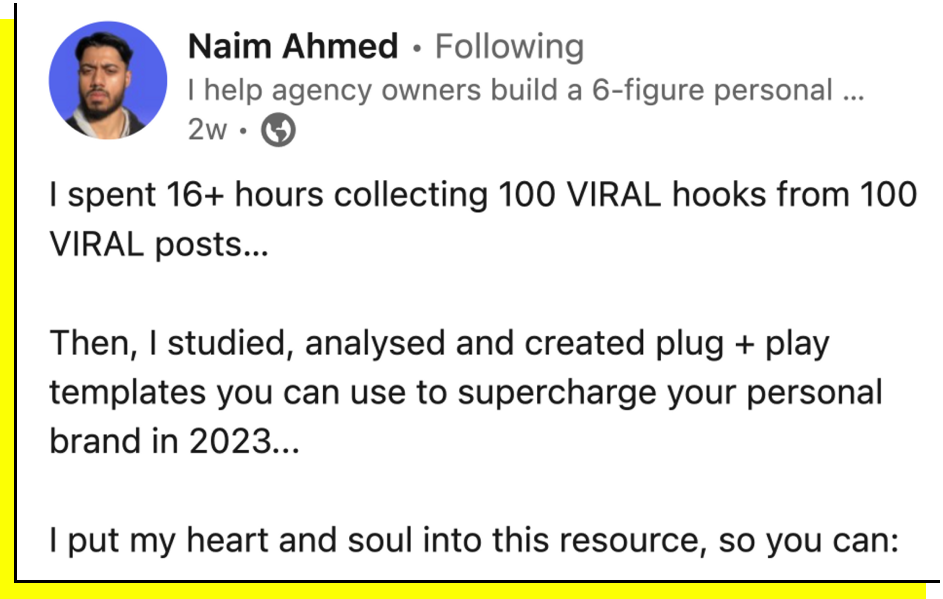
Naturally, this makes people think:
"If this took 16 hours to make, it's worth 5 minutes of my time to read."
So it hooks them in. And then they value it more.
In short, experiment with showing users the amount of time and effort that goes into your content to increase its perceived value.
If you'd like to dive deeper into this hook type (the Credibility one), and 11 other hook types, join our free 14-day email course, Un-ignorable Hooks. Learn how top creators grab your attention and keep it—without being clickbaity.
I spent dozens of hours studying hooks to make this course 😉
Incentivize newsletter shares with a spotlight section in your emails
Insight from Chenell Basilio (Growth in Reverse).
When we started the Growth Newsletter we didn't realize they'd become "the cool thing."
It seems like everyone’s got their own newsletter these days—and we get it! When you're building an audience, you want to get them off social and into a newsletter. It lets you have a direct relationship with them.
Anyway, if you’ve got a newsletter but are struggling to grow your subs, here’s a cool idea.
Newsletter referral programs can be tricky to incentivize correctly. Unless people love you, they probably don't want your swag. You also don't want to cannibalize your paid products. And some percentage of people will just try to game it.
One cool thing that Chenell does for her own newsletter, Growth in Reverse, is she regularly features folks in a Community Spotlight section (it was the inspiration for our own!).
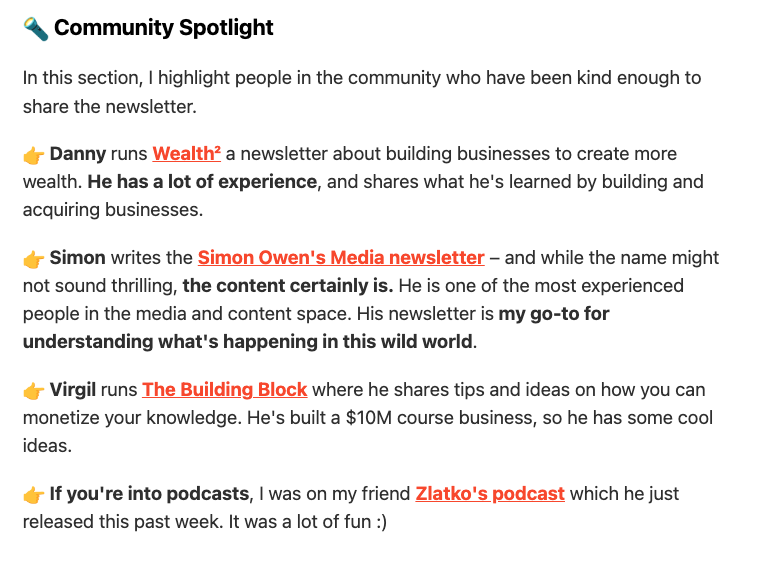
In it, she highlights the newsletters of people who have referred at least 10 subscribers to her newsletter (and she makes sure they aren't all spam ones before she does).
It's a perfect win-win.
Her newsletter breaks down how creators grew to 50k subscribers. So her audience is made up of people with newsletters. They can easily plug her newsletter into theirs—and they are actively trying to find ways to grow their own.
This same tactic might be good to test on your own. OR you can use this as inspiration for a creative win-win way to incentivize people with a referral program.
Run ads through a separate page
Insight from Savannah Sanchez.
Would you believe Tesla if they claimed they created the Car of the Year?
Definitely not. They're biased.
But if a reputable (or reputable-seeming) third party said it, maybe you would, right?
That's why Savannah created her own Facebook page called Savvy Finds. She's done a ton of tests where she runs her clients ads through their own page, and through Savvy Finds.
The result? The ads that ran through Savvy Finds were nearly always the winner.
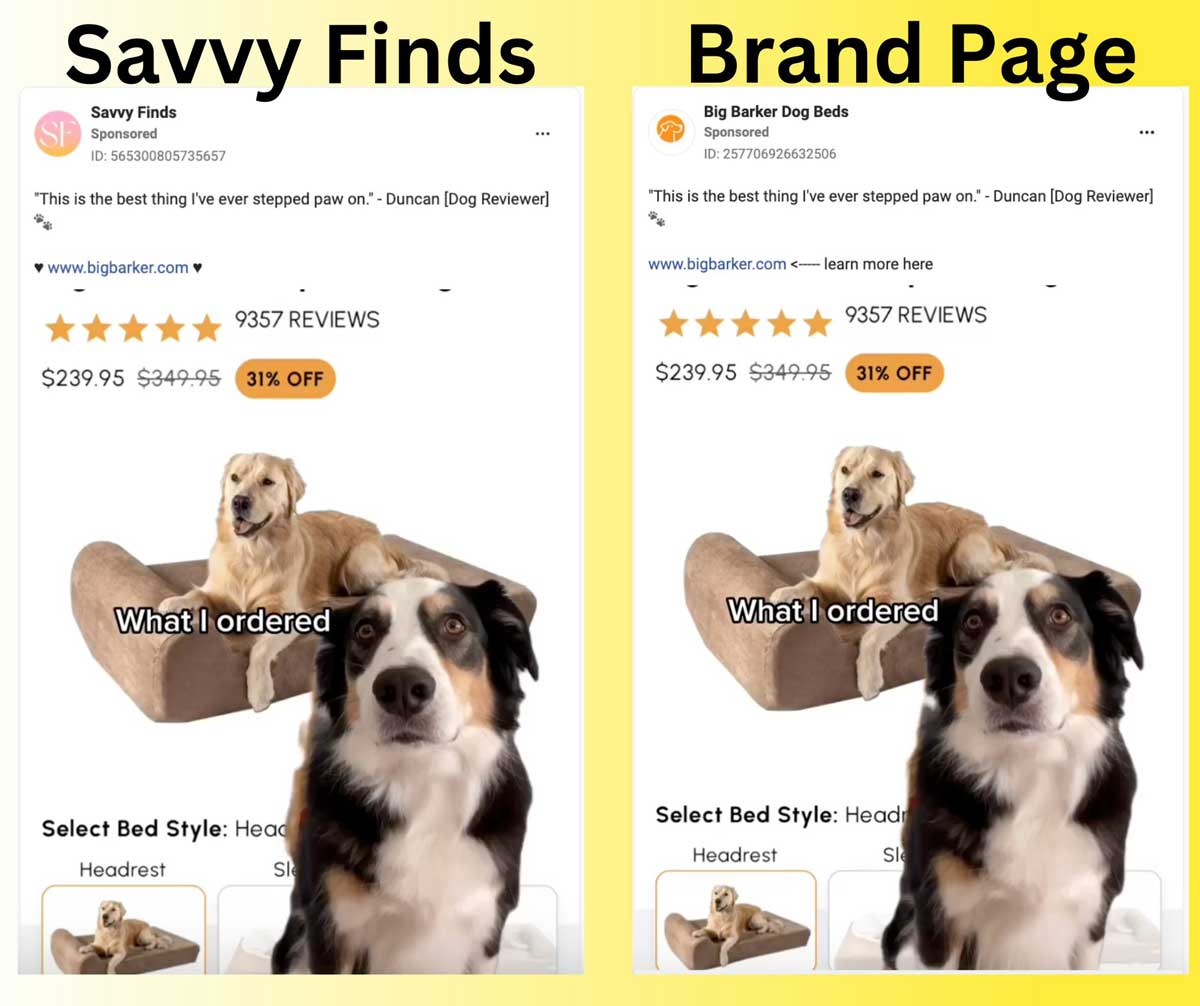
This technique is especially clever for agencies since it allows her to use client money to increase the reach of her page (which will naturally get likes/followers)—which builds an asset that becomes a competitive advantage for her agency.
If you spend a lot on social ads, consider testing this approach. Even minor improvements in conversion rates can make a significant difference—especially when you're paying for eyeballs.
News and links
News you can use:
- First, AI: Meta and Microsoft have teamed up to launch a responsible AI framework, prioritizing user privacy and ethical standards for marketers. TikTok launched "script generator," an AI tool for fast ad script creation. This could save marketers a lot of time and resources if it works. Snapchat is transforming its AI chatbot into an ad tool. The chatbot analyzes billions of messages to improve ad targeting and optimize ROI.
- LinkedIn is testing an expanded video ad placement on streaming services. This move, if successful, could provide marketers with additional channels to reach their target audience and drive engagement.
- Facebook released new creator tools, including enhanced Reels, Inspiration Hub, and Templates Hub, simplifying content creation and boosting audience growth.
- Lastly, here’s a thorough breakdown of the ongoing Reddit blackout.
Tool we use and recommend: Segment*
Being a founder is hard.
Finding product-market fit is one of the toughest challenges, and constantly has you asking questions like:
- Are people using my product?
- How are they using it?
- Are they returning to get value week over week?
When first starting out, the Segment co-founders didn't understand how important these questions were or how to use analytics to answer them.
So they spent 1.5 years and 7 different MVPs in their pursuit of product-market-fit before finding the secret sauce—they solved their own problem and turned it into a product.
Segment helps you collect, clean, and act on your customer data. And it handles the annoying task of integrating with different tools. So your team can focus on product, not integrations.
And Segment is now free for Startups! Apply to their Startup Program →
*Sponsored by Segment
Something fun
From @zainabmsheikh.