
Welcome all you growth-loving founders and marketers!
Happy (slightly-belated) Thanksgiving for my fellow Canadians 🦃🦃. It's like American Thanksgiving just earlier and without BFCM sales and football.
Anyway, topics for today: Unfair Advantage, psycho-logic, and better annual pricing.
Let's dive in 🍭
– Neal
Ortto
Program we recommend*: Ortto's Startup Program
Grow your startup faster with an all-in-one marketing automation, customer data, and analytics platform.
Eligible startups get $10,000 in free credits for Ortto. Apply now.
Get all the tools startups need to scale their marketing, including:
- Journey builder – engage with your audience wherever they are through email, SMS, and push notifications.
- One-click integrations – automate actions to keep people & systems up-to-date, including Salesforce, Slack, and more.
- Customer data platform – integrate, unify, and segment your customer data across platforms.
- Reports & dashboards – understand & visualize your customer data.
- Talk – AI-powered live chat and omnichannel inbox for 1-on-1 conversations.
Apply to Ortto's Startup Program today and get $10K in free credits, valid for 2 years.
Vanta
And by Vanta—compliance doesn’t have to be complicated.
In fact, with Vanta, it can be super simple. Trusted by over 5,000 companies, Vanta automates the pricey, time-consuming process of prepping for SOC 2, ISO 27001, HIPAA, and more.
Save up to 400 hours of compliance work and 85% of associated costs. And Vanta scales with your business, helping you successfully enter new markets, land bigger deals, and earn customer trust.
As a special offer, DC readers get $1,000 off Vanta. Claim your discount here.
Brought to you by Positional.
Google Analytics kinda sucks.
Positional is launching a Content Analytics tool I’ve wanted for years. Here’s why:
- It tells you exactly where in an article users are bouncing. Meaning: * You can strategically place CTAs before users bounce. * You can update the content so users don’t bounce. * You can optimize SEO, UX, and conversions simultaneously
- You can quickly see every article's bounce rate, time on site, AND scroll depth.
- It takes seconds to set up. Just copy/paste a small script.
Don't be logical, be psycho-logical
Insight from Rory Sutherland and Bell Curve.
We decide with emotions.
Logic is often what we use to convince ourselves that our emotional decision is the right one, or to justify a past emotional decision.
Rory Sutherland shares a prime example in his book Alchemy. One of his clients was sending out physical letters asking for donations. Like all good marketers they A/B tested several different variations to see which brought in the most money:
- Control. The regular letter asking for donations.
- Donation matching. They highlighted that the government would match their donations, effectively doubling the impact of their donation.
- Heavier paper. They put the letters on higher quality, thicker paper.
- Hand delivered. They highlighted that a volunteer hand-delivered to their door.
- Horizontal opening. They used a special envelope that opened on the end, not on the typical long side of the envelope.
Variations 3 through 5 seem rather weird and extraneous to the whole point. And logically, the variation that highlighted the donation matching should do the best, right? You tell people that a $10 donation is actually $20, isn't that more motivating?
Wrong.
Variation #2 (donation matching) did worse than control. Variations 3 through 5 all beat the control, and the best was variation #5 (horizontal opening).
But if you asked those people why they donated, they'd probably say "it's a worthy cause, blah blah blah" and not "the weird envelope got my attention."
This is what Rory calls psycho-logical—logical in the context of human psychology.
An ad example
We used this principle 6 years ago for a client of ours that sold powerful computers for machine learning/AI purposes. We made an ad variation that made no sense:

You wouldn't assume sloppily adding dog ears and nose onto a $10,000+ work computer would make it more likely that someone would purchase it.
Yet, this became one of their best-performing ads at the time.
It stopped the scroll and made them look a little closer. And no one else had done it.
So be a little crazy with your ideas.
A better way to price annual plans (and reverse engineer retention rates)
Insight from Daniel Layfield (Codecademy and Uber)
Monthly: $49
Annual: $490
^ every startup product ever.
It's simple, clean, and they save 17% by doing annual. And you guarantee 10 months of revenue and hopefully reduce churn. Win-win.
But, is it the right choice?
Probably not.
You don't see this trends as often with established companies.
Daniel says the trick is to price your annual plan at slightly more than your average LTV for monthly users.
So, if your average monthly user stays around for 4 months ($49 each), price your annual plan at 5 months ($245).
Daniel did this at Codecademy, and claims it was their best tactic at increasing LTV and reducing churn.
Takeaway: Consider running this pricing experiment if your average monthly retention is less than 12 months.
Another, counter-intuitive benefit
More mature companies have figured this out. Meaning you can estimate the average retention for mature software products. Examples that Daniel shares:
- Netflix: Only offers monthly plans. Their average user likely stays around for over 12 months (guilty). Spotify is the same.
- Headspace: $12.99/mo vs $69.99/yr. Ratio of 5.39, so their monthly users likely stay around for ~4 months.
- Calm: $14.99/mo vs $69.99/yr. Ratio of 4.67, so their monthly users likely stay around for ~3-4 months.
Build this into your competitor analysis process!
And check out Daniel's full write up here.
News and links
News you can use:
- Amazon is planning to revamp its search experience with generative AI.
- Google Analytics 4 just rolled out 2 new features to improve data security and report accuracy.
- Reddit released new features, courses, and certifications in its learning hub.
- Google Keyword Planner has stopped maintaining keyword forecasting.
- LinkedIn has started rolling out an AI-powered tool to simplify ad creation.
Program we recommend*: Ortto's Startup Program
Grow your startup faster with an all-in-one marketing automation, customer data, and analytics platform.
Eligible startups get $10,000 in free credits for Ortto. Apply now.
Get all the tools startups need to scale their marketing, including:
- Journey builder – engage with your audience wherever they are through email, SMS, and push notifications.
- One-click integrations – automate actions to keep people & systems up-to-date, including Salesforce, Slack, and more.
- Customer data platform – integrate, unify, and segment your customer data across platforms.
- Reports & dashboards – understand & visualize your customer data.
- Talk – AI-powered live chat and omnichannel inbox for 1-on-1 conversations.
Apply to Ortto's Startup Program today and get $10K in free credits, valid for 2 years.
*Sponsored by Ortto
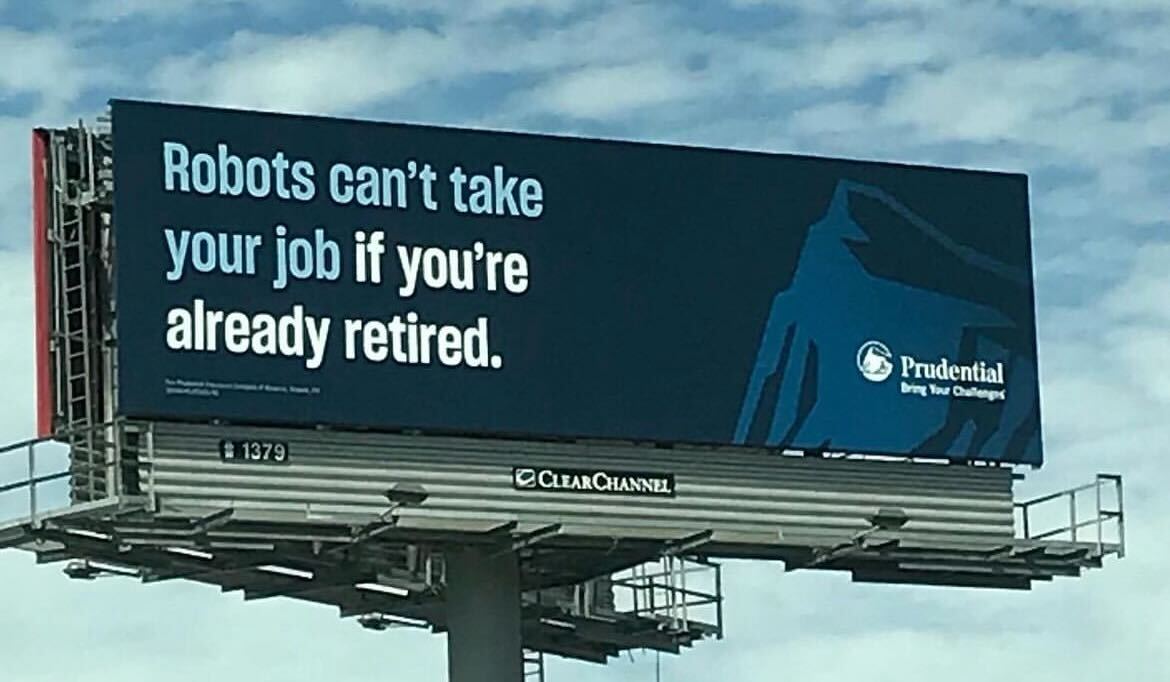
Something fun
From Prudential.