
Few brand launches have made my jaw drop to the floor like Slate’s.
The Bezos-backed automaker sent shockwaves through the auto industry when it emerged from stealth mode in April. Slate’s product was so brutally logical and contradictory to every industry trend, it almost felt fake. Like some AI-enabled fever dream at first glance.

To call their base model “bare bones” is like calling a car a horseless carriage; it’s a description so limited, it fails to grasp what’s really at hand. The base model has no speakers. No power windows. No paint.
Their peerless positioning is packed with lessons, from the deliberate constraints that sharpen their UVP, to their unexpected marketing stunt, to their modular product strategy that scales with user intent.
Let’s dive into some of the ways Slate exploited blind spots in their industry, and how you might be able to do the same.
— Gil

Brought to you by Numeral – “Wait, we need to collect sales tax?”
Sales tax is probably the last thing your growing startup is thinking about. But if you don’t handle it, you might rack up tax liability that gets in your way later.
Enter Numeral → Handling your sales tax compliance with:
- Registrations
- Filings
- Sales tax rates via API
- US and global support (~55 countries)
Backed by Y Combinator and Benchmark, join 1,500+ businesses trusting Numeral to take sales tax off their plate.
Right now, they’re offering a free audit to help you pinpoint where tax might be slipping through the cracks.

Brought to you by Insense - making UGC sourcing cost-effective for Q4.
Through Insense, you can source 20+ pieces of raw content (per creator) with lifetime usage rights, all delivered in 14 days or less.
That’s how Beauty Pie, Bones Coffee, Flo Health, and Aceable scale UGC without killing team bandwidth.
Book a free strategy call by September 5th and get $200 for your first campaign.
Product-Market Fit For a King
Insight from Gil Templeton — Staff Writer
As someone who drives a base model 2011 4Runner (or “2Runner” since it has no 4-wheel drive), I don’t need a lot in a car. I want something reliable, with enough room to access two car seats, and Bluetooth capabilities to play music from my phone.
As I waded into the car market earlier this year to probe for an upgrade, I was disheartened by my experience (and yes, I’m still rocking my 2Runner today).
For one, the prices were prohibitive for many models. Period.

Second, there were too many over-tech’d features solving non-existent problems. I don’t want to drag a tiny area on a huge screen to adjust my air vents. I don’t need to make wild hand gestures to turn the volume down. (Hot take alert) I don’t think automatic lift gates solve more problems than they cause. And I definitely don’t want to pay extra for all that stuff.
Third, the new car designs felt generally unexciting and indistinct from one another. Looking for a reasonable SUV to accommodate my family of four felt like playing an expert-level game of “Spot the Difference.”

These forces I felt are the exact gaps in the market Slate exploited. They saw these unmet needs hiding in plain sight: drivers feeling priced out, fed up with frilly features, and craving something more “their own.”
The Slate truck is a textbook case of product-market fit (PMF) covered in depth in the Five Fits Framework. It addresses what a large portion of the market was asking for (especially EVs under $40,000), while the rest of the category did tone-deaf things like charge drivers to use their own heated seats. Within one month of launching, 100,000+ buyers had reserved their Slate, showing signs of strong PMF.
It’s a reminder that PMF doesn’t need to come from “more.” So much of the time, it comes from sharpening your focus and pouncing on the spaces competitors leave open. Having a strong PMF is so important, a study showed startups are twice as likely to fail from lacking it (34%) than from financial problems (16%).

Let’s dive into some specifics around how Slate’s positioning delivered on real consumer needs.
Extreme Affordability, Despite a Regulatory Rug-Pull
When Slate launched with an EV priced below $20k (after tax credits were applied), it suddenly made EVs feel accessible and within reach for so many more Americans.
"There's a massive population of people out there that when it comes to safe, reliable, affordable transportation; there just really aren't many alternatives for them," — Chris Barman, CEO, Slate
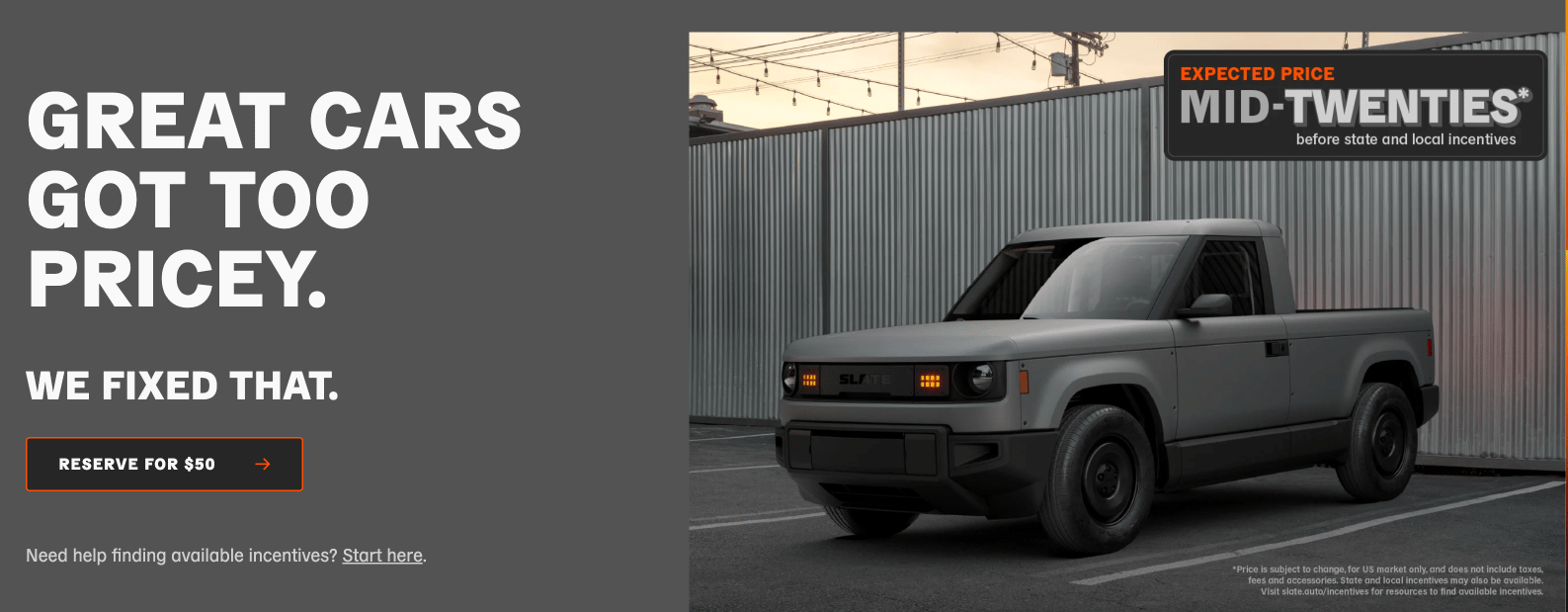
In a time when the average new car is nearing $50k, and the average new EV is north of $55k Slate launched with an EV that cost less less than half of those averages. At the original stated price of “under $20k” (after tax incentives), there was only one car on the American market that could say the same: the Mitsubishi Mirage. Woof.
“We are building the affordable vehicle that has long been promised but never been delivered.” — Chris Barman, CEO, Slate
Slate was making a clear value play, except their discerning, no-nonsense approach made “cheap” feel smart instead of like something you settle for.
But then came the “Big Beautiful Bill” which slashed EV tax credits and thus raised the price of a new Slate by $7,500. But even after losing $7,500 in tax credit benefits, Slate’s pricing is still competitive (albeit to a lesser degree), now in the “mid-twenties” according to their homepage. This shows they’ve built a model that could absorb regulatory shocks. And their made-in-America production might also help them sidestep potential tariff troubles.
There are about 20 car models on the American market priced below $30k, most of which are far less exciting than the Slate truck, and the only EV in this range is the Nissan Leaf, starting at $29,280. Meaning despite significant regulatory changes, Slate is still plenty differentiated.
For founders and startups, the lesson is: don’t be shades different from your competitors, be undeniably different. Even with vanishing tax credits nipping at their heels, Slate still has room to stay out in front as a value EV. They built something strong (and affordable) enough to weather this unforeseen storm.
If you’re building in a highly regulated space (or one that’s subject to change at a moment’s notice) make sure your value isn’t merely propped up by policy or a clever loophole. Ideally, it should hold up on its own merits regardless.
Marketing Hype With Wild Prototypes
You only get one chance to make a first impression, and Slate’s teaser campaign was a lesson in classic guerrilla marketing.
By partnering with the always-interesting ad agency Mischief, they unleashed a series of fake-business prototype vehicles, each more absurd than the last, strategically parked around LA to spark coverage and curiosity.

In an industry where humorous marketing is lacking, and banal taglines like “Experience Amazing” or “Innovation That Excites” come standard, this actually felt like fun. TAXIDER-MY-FAMILY, with an entire backstory? Come ON.
This sharp left turn sparked articles titled “The New Slate SUV Reportedly Funded By Jeff Bezos Was Just Revealed In The Most Insane Way” and popped up in Subreddits like r/whatisthiscar creating genuine intrigue for such a novel concept.
Not only did the playful and hilarious stunt signal Slate’s unique marketing stance, but it also put their modular and highly customizable nature at the forefront.
The lesson? If you’re going to pay for marketing, don’t pay for ignorable wallpaper. Stunts like Slate’s prove that entertainment can earn headlines and attention in a way that expected, descriptive messaging never will. (More on how to change that here.)
As a startup or challenger brand, you have to hold every idea to the standard of, “Is this working as hard as it possibly can?” And crucially, it has to reflect who you are. While Slate’s marketing made people laugh, it worked because it clearly served up their promise of modularity, play, and difference.
Customization as a Future Growth Engine
“It’s a blank Slate. You call the shots.” Says the copy a few modules down on Slate’s homepage.
It continues, “It's a blank canvas for personalization, so you can get exactly the Slate you want, with the stuff you want, at the price you want.”
With this, Slate is offering a platform with a low barrier to entry, endless DIY upgrades, and continuous personalization. Sure, it’s about individuality in a market largely devoid of it, but it’s also setting up a community-driven engine for growth. It’s a product that can scale 1:1 with each user’s exact intentions and desires, while starting at an inviting price point.
Speaking of inviting price points, their refundable $50 reservation fee acted as its own psychological “starter kit” that spawned 100,000+ signups within a month. This tripwire funnel invited people to join the Slate tribe without any real risk, while mirroring Slate’s product philosophy: start small, and add as you go.

The site features a carousel module with 32 wildly unique configurations, each with its own fun name, often hinting at different vignettes and use cases. It shows just how modular these things can be, and it lightens the cognitive load by showing creative thought-starters (most of which require plenty of add-ons, naturally).
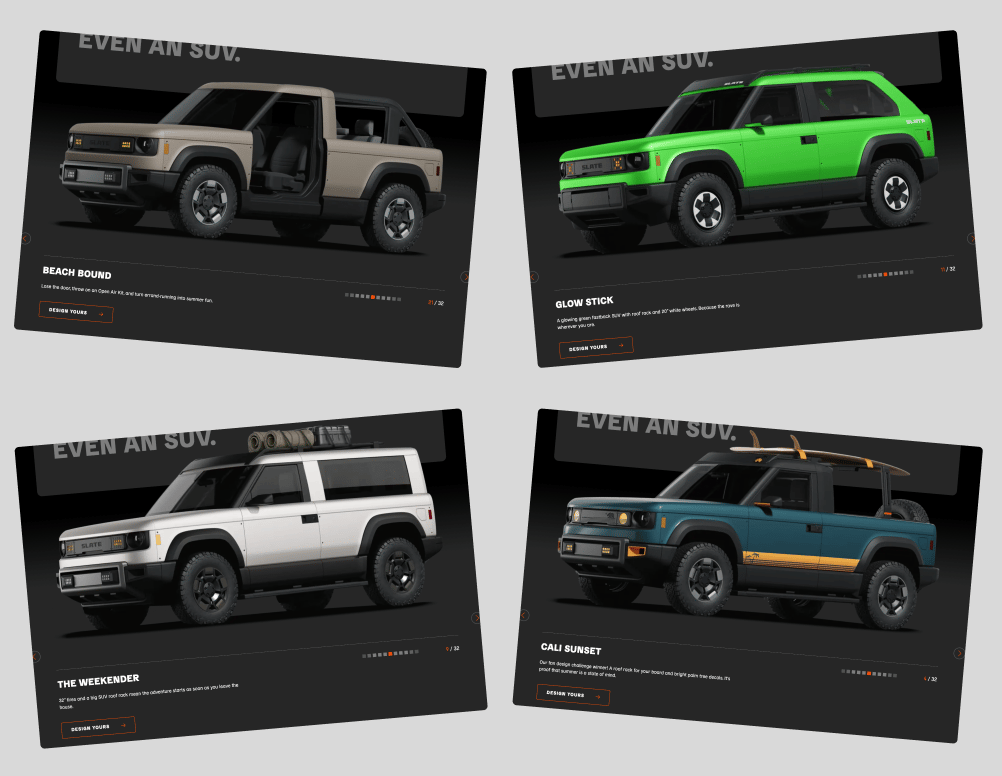
Slate’s design leverages mass customization, the concept of delivering tailored products at near mass-production efficiency through modular design and delayed differentiation. Their “Blank Slate” base model is not intended to be finalized. It’s begging to be customized.
Like a budget airline or à la carte menu, Slate unbundles the extras to let customers build exactly what they want. And whereas traditional trim packages bundle their features into pre-set tiers, Slate takes it a step further by letting buyers essentially create their very own trim package from scratch.
Want a nice set of speakers but the basic wheels? Great. Want to turn your truck into a doorless SUV? Bam. Want black seats and gunmetal HVAC knobs? Not a problem. Congrats, you just created your own bespoke trim package, and you didn't pay for a single "extra" you didn't want.
Your business can borrow this play by starting with an accessible hook, then building a roadmap of upsells that feel like added value or self-expression instead of nickel-and-diming.
The Takeaway: Push Perception Past Parity
It’s so easy to forget cars are parity products. Yes, Ferraris and Priuses seem like they’re worlds apart. But at the end of the day, cars are just four-wheeled vehicles built to take you from point A to point B.
That’s why positioning matters a lot more than fender flares or hand-gesture controls. Instead of trying to merely sell a more affordable EV, Slate positioned its product as the ultimate utilitarian vehicle. While middle-of-the-road car brands tout “innovation,” Slate proved it through an actual blank canvas for customization.
Whether they can deliver on building a quality vehicle or a great user experience remains to be seen (they’re likely hitting the streets in 2027). Even if two doors are a dealbreaker for me personally, I’ll be cheering them on from the sidelines.
If you’re in a crowded category, don’t aim for incremental differences and nuances. Tie your entire brand around one obvious wedge (Volvo has safety, Porsche has performance, Prius has stewardship, etc.) and drive that wedge like you stole it.
Gil Templeton
Demand Curve Staff Writer
Something fun
The more things change, the more they stay the same. From Ayush Kumar on LinkedIn.
.png)