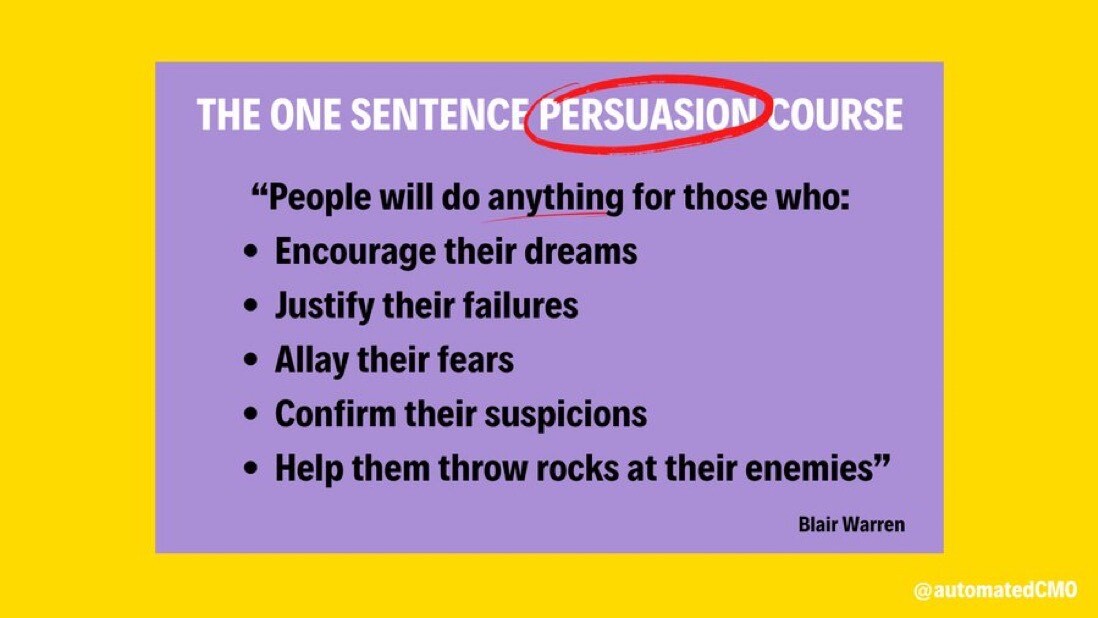

There is no such thing as too much social proof.
But the dynamics of collecting and displaying it optimally are a bit complicated.
Let's dive into what the research shows as the best way to increase sales with customer reviews.
– Neal

Brought to you by Superside
You already know AI is a game changer for design and marketing teams. But how do you start making real change with it?
Your shortcut to an AI-powered in-house creative team is with Superside.
Superside is an AI-powered creative service used by the world’s top brands (Zapier, Figma, Shopify, Reddit) as an extension of their in-house team to produce great creative quickly and on budget.
As your creative partner, you can expect:
- Top 1% global creative: Top talent + AI = top-quality creative, fast.
- Ultra-fast turnaround: Projects are delivered as quickly as 12 hours.
- Flexible subscription model: Their full suite of services bends to meet your daily needs.

Brought to you by MarketerHire—the #1 marketing talent platform with over 5,000 customers.
MarketerHire provides exclusive access to a rigorously vetted network of marketers. You can hire a single marketer or an entire team in a week.
And they put their money where their mouth is. Every hire comes with a no-risk, two-week trial to ensure a perfect fit.
See why the hottest startups in the world (Iterable, Netflix, MongoDB, Lyft) have already trusted them with over 30,000 successful marketer matches.
Schedule a Free Hiring Consultation by May 31st to get 5% off your first hire!
10 science-backed tips for customer reviews
Insight from Ariyh (Academic Research in Your Hands).
Nothing sells better than a happy customer.
Here are 10 research-backed recommendations for getting and displaying reviews:
Encourage comparisons in reviews
A review that compares your product to another is far better than a regular review:
- Positive reviews that compare your product increase sales by up to 26%. They anchor your product as being better than competitors. For example, “The iPhone 15 has a better camera than my friend’s Google Pixel” is better than “The iPhone 15 camera is really good.”
- Negative reviews that compare are up to 47% less harmful. We attribute their dislike to their personal preferences. Example: “The iPhone’s battery life isn’t as good as the Pixel” is less harmful than “The iPhone battery life sucks.”
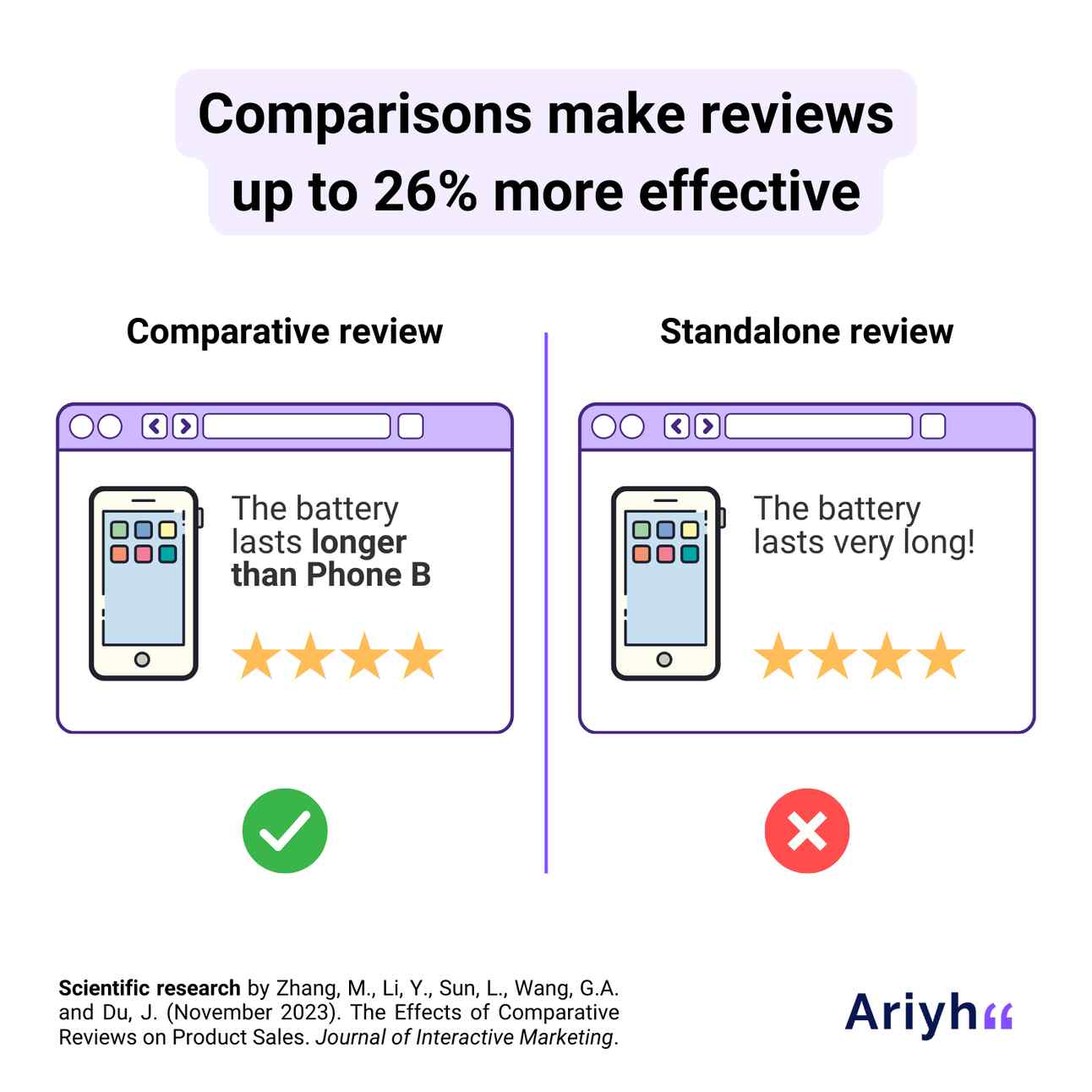
Encourage reviews to compare your product by asking: “How was it compared to a similar product you’ve tried?”
Expert recommendations vs customer reviews
Should you display simple customer reviews or expert recommendations?
It depends on how easy it is for people to judge the product's quality by using it:
- If it’s easy to judge the quality, then do customer reviews. Examples: T-shirts, food, hotels.
- If it’s hard to judge and requires expertise, do an expert recommendation. Examples: insurance, dentists, educational institutions, software, agencies.
- Would you trust “Bob Smith” to recommend a heart surgeon? Or would you trust your family doctor more?
How incentives boost reviews
Most happy customers will never bother to leave a review. Even if you ask them.
But incentivizing them with free products, cash, gift cards, or contest entries makes it much more likely that they will leave a review, and it’s more likely to be positive.
Here’s the data:
- Home improvement store product reviews were 83.4% more positive when incentivized via sweepstakes entries.
- Even a modest $0.25 incentive paid immediately for rating and reviewing a video proved effective, leading to a 20.6% increase in positivity
Do not ask for a positive review. That might backfire and is against Amazon TOS.
Don’t ask for reviews too soon
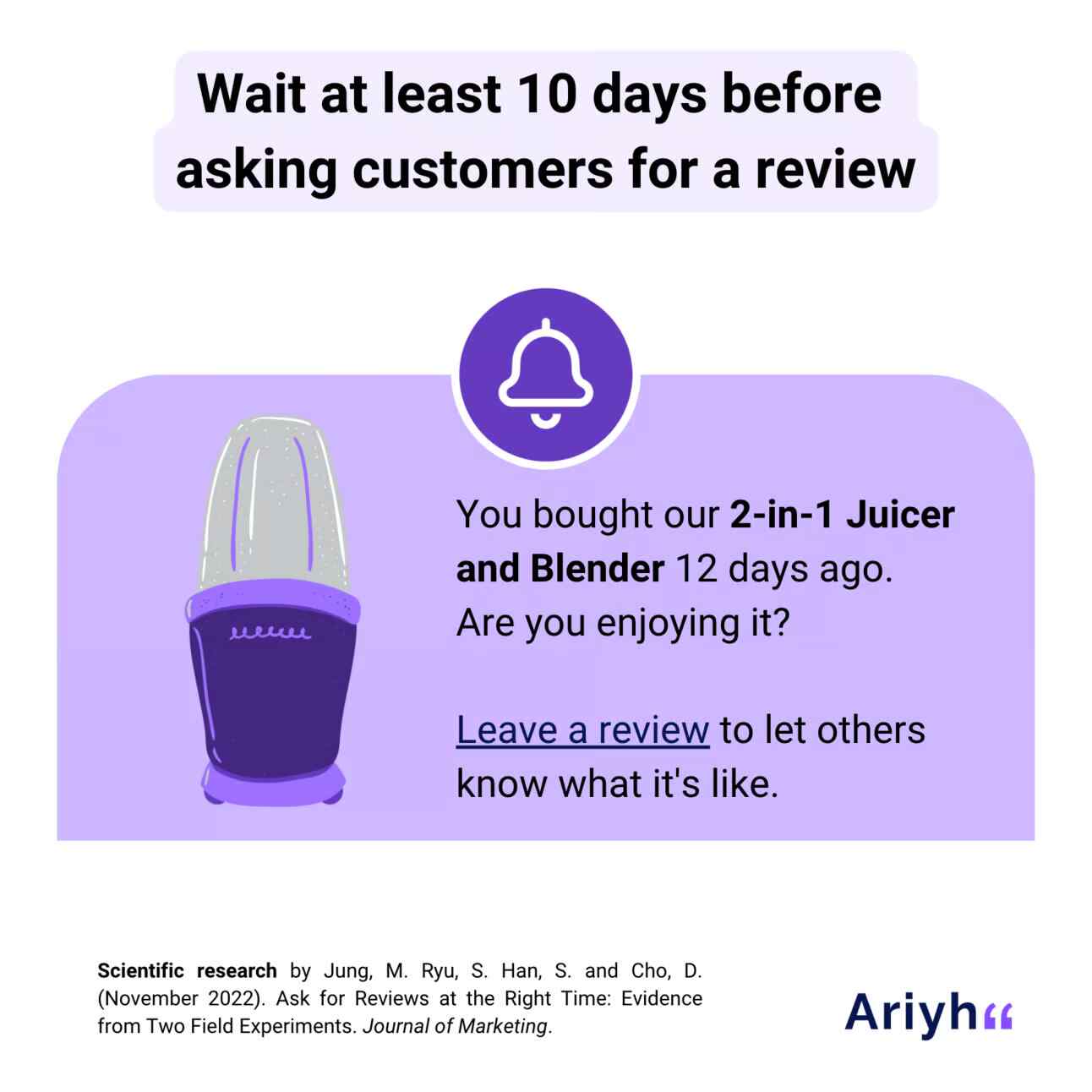
Getting asked to review a product you just got is like a popup modal asking you to subscribe before you even know what the website is.
Recommendation: Wait at least 10 days before asking for a review to increase the chance they review by 40-60%.
Additional recommendations for software reviews:
- Don’t do it based on time after signing up; do it based on milestones of usage (for example, they just hit their "aha" moment with your product.
- Don’t ask them when they’re clearly in the middle of something.
Some negative reviews are good for you
You see a 4.9-star-rated espresso machine and start reading the reviews. They’re all resoundingly positive…, but you start to get a little suspicious that they’re all fake.
You check the 1-star reviews and see: “There is a considerable difference in taste when mineral or filtered water is used rather than tap water”
You laugh and say, “That has nothing to do with the machine, you bozo!! Well, if that’s all people have to complain about, then it must be good.”
Oddly enough, a low, fairly irrelevant review will improve your perception of a highly-rated product by ~15%.
Takeaway: Don’t hide negative irrelevant reviews, or maybe even showcase them!
Show “likes” on the product page
Leverage the engagement your product has received on social media:
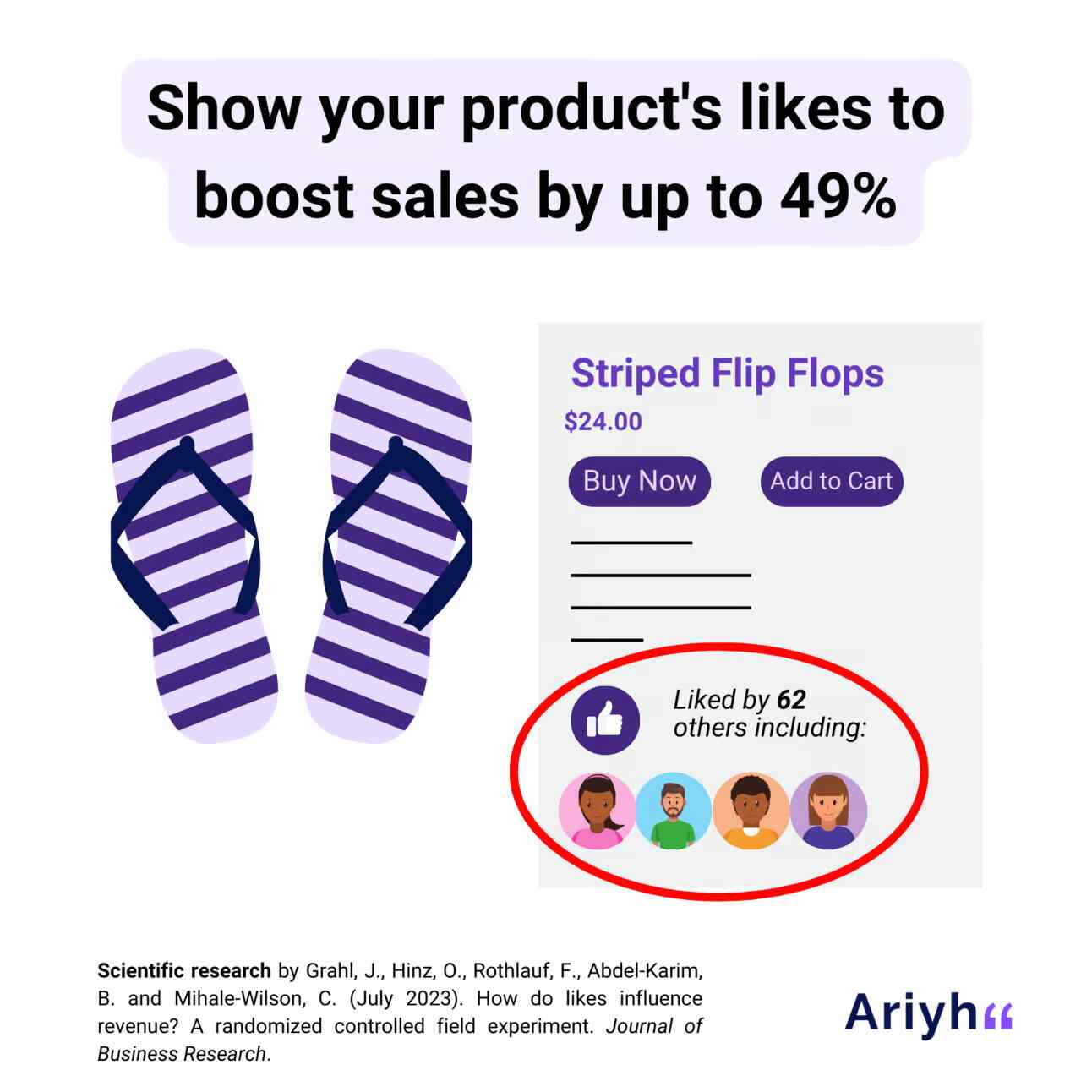
Oddly enough, this only increased sales during non-work hours. However, each additional like received increased sales by €0.26, about 0.14% of the product price.
Takeaway: Show a product’s likes and a few profile photos of people who liked it.
The first review sets the tone
We’re the pinnacle of herd animals.
If the first review is negative, you’ll get fewer sales, fewer reviews, and more negative reviews. This effect can last for 3 years or more.
And the opposite happens if the first review is positive.
Here are some recommendations:
- Launch products to a select group of customers mostly likely to rate it highly.
- Launch on new marketplaces (like Amazon or Walmart) the same way.
- Reach out to early customers that you think are happy and incentivize them to write a review about it.
- If you get a negative review early, do everything you can to correct it.
Order matters
Sales are up to 84% higher if the first review is 5-star versus 1-star, and we rarely read more than 10 reviews before deciding.
Takeaway: Display at least one positive review first before displaying others. Never display a negative review first.
4.3 is better than 4.9 (if it’s your own website)
Oddly, sales peak between 4.0 and 4.5 stars and dip down at 4.5 to 5.0. At really high ratings, we become skeptical and assume the results are manipulated (the study focused on specific retail websites and not a marketplace like Amazon).
Takeaway: Don’t delete or hide all reviews lower than 5.
Reply to all reviews
Replying to reviews has various benefits:
- It can make an upset customer change their mind and increase their rating (and maybe even stay a customer).
- It signals to people that you care about customers.
- And a study showed it increased the number of reviews by 12% and increased the average rating by 0.12 stars.
So make sure to reply to all of them!
–––
Use these 10 research-backed ways to get the most out of customer reviews.
Check our Growth Vault for 84 other CRO tactics (and 373 growth tactics).
Something fun
Honestly, a pretty astute summary of humans: