This newsletter curates growth insights from Demand Curve's community. It keeps you up-to-date on growth tactics.
This week we're covering involuntary churn, email segmentation, COVID-19 and landing pages.
Decrease involuntary churn to boost retention
Insight from Demand Curve.
Failed payments can be a quiet cause of unnecessary churn.
Even very successful startups like Segment have said that non-payment can account for up to 50% of total churn in a given week.
If you sell subscriptions, use this process to reduce churn. (This can be automated.)
- When a card fails, retry the card-on-file again before emailing your customer. Over 20% of payments are resolved by retrying the card before sending emails.
- When you do need to reach customers, email them a mobile-friendly link without a password so they can easily give you their new card details.
- If customers don't engage with your email, send an SMS.
Your customer acquisition efforts aren't optimized without a heavy focus on retention. Limit failed payments to fix a leaky bucket.
Segment your email flows by subscribe intent
Insight from Mike Arsenault of Rejoiner.
New subscribers come into your email list in a variety of ways:
- Some sign up for your newsletter.
- Others sign up after reading your content.
- Customers opt-in at checkout.
Yet many startups send each new subscriber the same welcome series even though we know what drove the sign up in the first place.
Increase your email performance by segmenting your flows:
- When new subscribers sign up for your newsletter, include a sample of the newsletter in your welcome flow—get new subscribers acquainted with your newsletter while it's fresh in their minds. They'll be more likely to notice and open it when you send your next issue.
- When people sign up through your blog content, tailor your welcome flow to send them more relevant blog posts. Get specific: If they signed up while reading a keto blog post, send them more keto content.
- When customers opt-in after a purchase, create a flow that shows them how to use your product. Optimize for a second purchase: 53% of customers who’ve made two purchases make a third purchase.
How COVID-19 forced startups to change their landing pages
Insights from Demand Curve's Twitter.
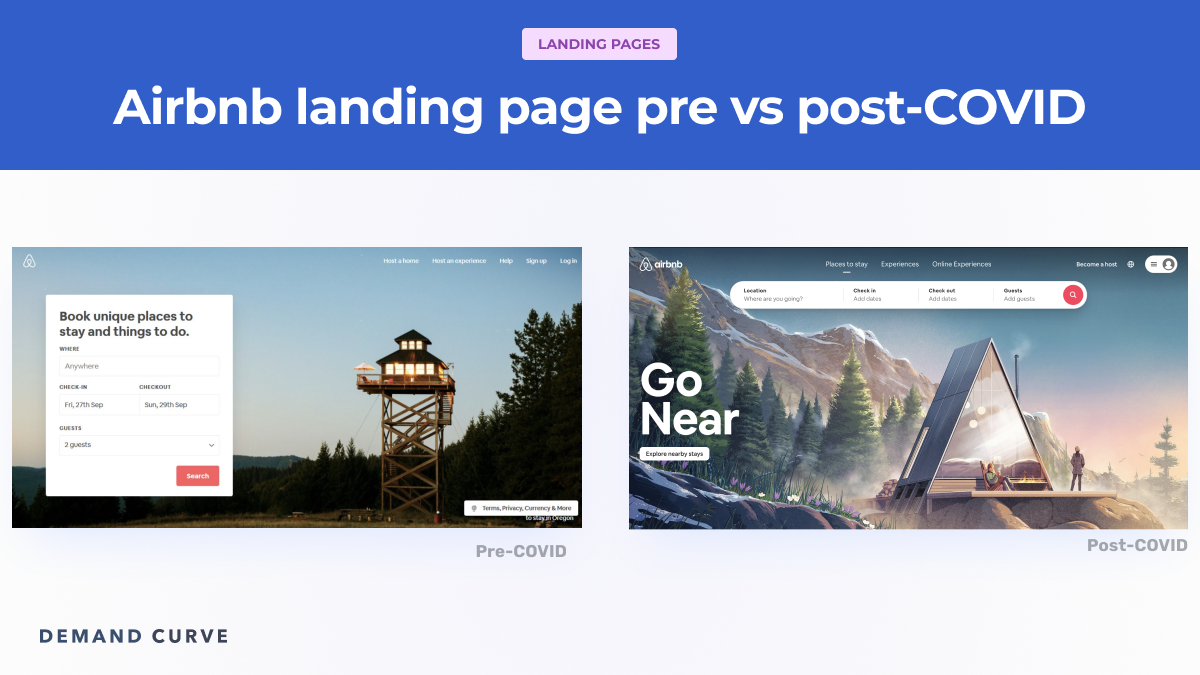
We wrote a thread highlighting how top startup's adjusted their landing pages due to COVID.
Here's an example from Airbnb:
Airbnb's business was upended in April. But by June, rural bookings were growing.
Key site changes during that time:
- Action prompt: "Book unique places" —> "Go Near [places]"
- This handles the objection of "It's not safe to be where everyone else is."
See the full thread on Twitter here.
How to create the most important part of your landing page
Insight from Demand Curve.
Your "above the fold" (ATF) section is the part of your site that's immediately visible before scrolling. It's your first impression. And it's your asset that determines whether people stick around and see what you have to offer, or bounce.
We wrote a playbook on creating a high-converting ATF section. You'll walk away understanding exactly what you can do to level up your landing page. Scroll to the bottom of this newsletter to start reading.
News and links
Newsletter our team is loving: Substack’s VP of Product, Nathan Baschez, quit Substack to start his own newsletter based on all his very interesting learnings from being inside the machine. His newsletter is called Divinations, and it’s what most of our tech friends are reading, including myself. Here’s one of his best posts: Finding Power. He’s sharing tech deep-dives to help you better understand the machinery powering startups and markets. Get the next one here.
Something fun
Marketing meme (from DC Twitter)