
This newsletter curates growth insights from the Demand Curve community. It keeps you up-to-date on growth tactics.
This week we're covering asset sourcing, irrelevant cross-sells, and offering discounts.
Four best practices for offering discounts
Insight from Demand Curve.
Rule of thumb: Early-stage startups should avoid offering discounts.
They can easily become a crutch or a Band-aid that’s covering up—and failing to solve—a bigger problem.
That said, discounts can be effective, depending on your market. As with everything pricing-related, what matters is who’s doing the buying.
Example: Apple Store shoppers don’t typically buy based on discounts, but J.C. Penney shoppers do. The department store chain found that out the hard way when they brought an Apple exec in. He got rid of J.C. Penney’s discounts—and sales tanked.
If you’re considering experimenting with discounts, here are some guidelines to help you get started:
- Don’t offer more than 20-25% off. Steep discounts dilute brand value.
- Make discounts random—in terms of both when the offer is made and what it is. That way, your audience won’t come to expect a discount or hold off on buying until your predictable “annual sale.”
- Don’t start off by offering discounts across your entire audience. Focus on user segments that truly need a bit of a nudge. That way you test discounts without cannibalizing leads who'll likely buy at full price.
- The best kinds of discounts are the ones that are deeply aligned with your product. They incentivize activation, habit building, and long-term use. Some examples:
- “Get 30% off if you buy 10 or more” is a more effective discount than “get 30% off your first order.” The “buy 10 or more” offer means more product use, increasing the chance that your product’s value will be realized—which often leads to a higher LTV.
- Free trials fit the bill too. By offering a 30-day free trial, you decrease initial friction and give prospects time to experience your product’s value.
- A discount on an annual vs. monthly subscription increases the chance that a user will get activated and build a product habit.
Low-cost way to source assets for your brand
Insight from Pencil.
If you’re building a brand, you need quality assets. Think, photo and video for your site, social channels, ads you might run, and the content you create.
Here’s an effective workaround for brands looking for a fast, inexpensive way to source the top three types of quality creative assets you need using vendors.
- Product shots. Use Soona for a quality virtual shoot. Simply choose what types of shots you’re looking for, provide details, and ship your products. You’ll live chat with your photographer so you can make sure you get the shots you need. And you should have finished assets in about 2 weeks.
- High-quality stock video. Use Social Motion Packs for beautiful video content. You can buy individual content packs or a subscription to their library.
- UGC. Use Billo to source talent. Spec out exactly what type of UGC you want. Creators will apply for your project and you choose those who best fit your brand. Send them products. Approve their content as they submit.
Pencil used this process and sourced loads of quality content for their brand ... at a cost of $343.
Irrelevant cross-sells can hurt your average order value (AOV)
Insight from Baymard.
In-cart cross-sells can boost AOV.
But only if the products you’re featuring are relevant to the items already in your customers’ carts.
A Baymard study found that 52% of sites recommend products that are either completely irrelevant or based only on what other customers bought.
In 2022, most people expect a personalized online shopping experience, which is why irrelevant cross-sells rarely work. And worse, they erode users’ confidence in your site and business—dragging down your AOV.
If cross-selling is part of your ecom strategy, consider these 6 tactics to help improve take rate and AOV:
- Avoid listing a fixed number of products: One highly relevant suggestion that stands alone will get more attention than if it’s buried amongst four irrelevant suggestions. For example, If someone is buying a computer mouse, only show them the batteries they'll need, not batteries plus a random selection of office supplies just to fill up space.
- Be cautious about listing alternative products: Introducing alternative products during checkout can cause the customer to second-guess their decision, consider other options, and abandon the checkout process—the last thing you want. Products that complement the item in the cart should be shown over alternative products. For example, if someone is ready to buy a pair of AirPods, don't recommend a headset from Bose or Beats by Dre.
- Use labels to define the context: If you want to present a cross-sell but don't have a high relevance product, consider using labels like "Inspired by Your Browsing History," "Frequently Bought Together," or "Other Products in This Collection." Users will be less dismissive of questionable product recommendations if you simply give them a reason.
- Prioritize products of the same use case or theme: Giving priority to products of the same use case or theme can prevent seemingly unrelated items from being displayed. For example, cross-sell sections with labels like "Winter Essentials", or "Back to School" allow sites to make reasonable suggestions as long as they're thematically related.
- Feature products that customers need to get started: Some examples: A toy that requires batteries to operate, a mobile phone with specific dimensions for a protective case, or a camera needing a particular memory card type.
News and links
Demand Curve blog: We're breaking down growth topics on the Demand Curve blog. This week, we're covering email marketing:
- Email Deliverability: How to get more emails into your recipients’ inboxes. Find out how email deliverability works, why it matters, and how to improve it here.
- The 9 most important email marketing KPIs. With new privacy updates and email trends, you might need to change the email metrics you’re tracking. Check out the top email marketing KPIs for 2022 here.
Something fun
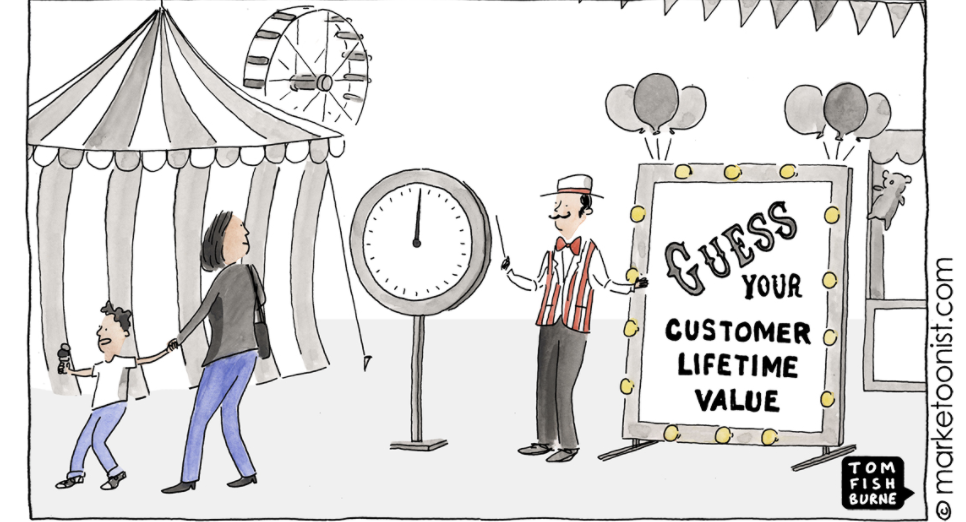
Marketoonist on Twitter.