Welcome to the 778 new marketers and founders who joined last week!
This week we're discussing email loyalty programs, media boosts, and internal link structures.
Three ways to get a media boost
Insight from our agency, Bell Curve.
After The Hustle published an article about Hint Water, the flavored water company saw their CPC drop from ~$5 to < 10¢. Their cost to acquire customers dropped from $80 to $25.
(Source: Nik Sharma during our Growth Summit. That’s an unlisted video, just for DC readers.)
We view PR as an “unscalable channel.” It can help you get traction, but growth won’t compound as you put more resources behind it.
But that doesn’t mean a single media hit can’t cause growth to skyrocket. Think of it as performance PR: using media to earn revenue.
Here are three ways to increase your chances of getting viral PR:
- Run social media ads to your target demographic within a specific location: where editors who cover your industry are. Then reach out to those editors. People view the things they’re familiar with as better. Editors are more likely to respond since they’ll already be familiar with your company because of your ads.
- Pretty much all major media companies are on affiliate platforms. To increase your chances of media traction, join one of those platforms (like Impact, Skimlinks, or ShareASale)—especially if you’re DTC. A higher affiliate percentage usually ups the likelihood of a mention.
- As Bell Curve’s growth strategist Stephanie Jiang puts it, “Media drives media.” Put ad spend behind existing media mentions. They have third-party validation, which carries more weight than a company talking about itself.
Create a quick, high-converting email loyalty program
Insight from Mike at Rejoiner.
Loyalty programs can feel like a nice-to-have, so plenty of brands brush them off.
But building an email-based loyalty program for your best customers could have an incredibly high ROI—trade a few hours of work for a steady stream of revenue.
Here’s an example.
Rejoiner, an email marketing platform for ecommerce brands, built a quick loyalty program for their client Peak Design.
The results are incredible. The program has generated $46.8k in added revenue over the last 90 days—with an 11.6% click-through rate. And it took just six total work hours to build.
Here’s how they pulled it off (and our take so you can replicate the strategy).
Step 1: Rejoiner created two loyalty offers based on Peak’s purchase history:
- Customers who’ve spent over $500 get $20 off their next purchase of $100+.
- Those who’ve spent $1,000 get $40 off their next purchase of $200+.
Our take: Don’t overthink your loyalty segments and offer. Consider targeting the top ~10% of your customers by spend—no need to get too methodical here. Provide an offer that’s materially valuable and test it. You can optimize the offer and segments later.
Step 2: Rejoiner created an email that combines personalized copy with CRO best practices (like the big red button). It feels personal but gets straight to the point.
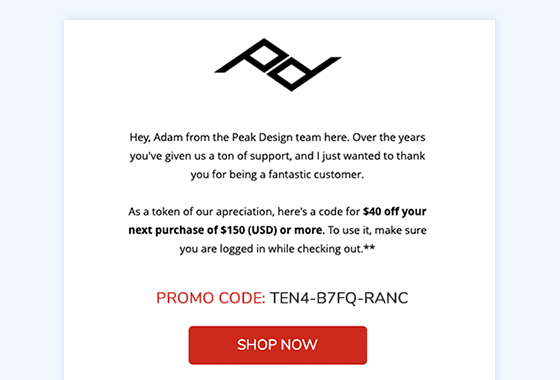
Clean, simple, effective. The result: 8% of recipients make a purchase.
Our take: Customers know that the emails they receive from brands are automated. When you’re writing your email, show there’s a human behind the copy. The Peak Design email feels like it’s coming from a friend. And use “I” instead of “we”—“I” feels more emotionally involved, and studies show that it leads to more purchases.
Step 3: Rejoiner used a unique discount code. A generic discount code like “VIP_10_OFF” would quickly kill the magic the personalization created.
Plenty of apps make it easy to generate randomized discount codes (here’s one for Shopify brands). And most of these apps integrate with email marketing platforms, so you can send each subscriber a unique code.
Bottom line: A simple, thoughtful email loyalty program can be an engine for incremental revenue.
Optimize internal link structure to improve rankings
Insight from Search Engine Land.
There are two main signals Google’s algorithm looks at to rank your pages:
- The types of sites linking to you: What are they? And how big, relevant, and authoritative are they? These are backlinks.
- Your internal link structure: How are you linking pages together? Does your link structure enable productive link flow?
Most marketers over-fixate on backlinks, when they should be paying more attention to internal link structure.
Think of your website as an electrical circuit:
- Backlinks supply energy to the circuit in the form of electrical current (link flow).
- Each page functions as a component of the circuit board.
- Unless each component is calibrated and strung together just right, electrical current won't flow, and the circuit won't function.
To get the most benefit from backlinks, link up your pages in a way that distributes link flow productively throughout your website.
Here are two ways to do it:
- Distribute link flow to high–search value pages. Every internal link you create sends a signal to Google that you think that page is important.
- Your “About us” page may be valuable to you and your site visitors, but if that page has no search value, you’re sending Google the wrong message by linking to it internally.
- As a rule of thumb, remove these links where possible, especially if they’re repeated often. Then prioritize creating links to key pages that are better optimized for search. Think: valuable blog posts and pages that are designed to convert.
- Avoid linking to weak or duplicate content.
- Duplicate content tells search engines that your site has poor content quality. Linking to these pages only adds insult to injury. Apart from your header and footer, make sure your pages share less than ~50% of the same words.
- Pages that are considered “weak” in Google’s eyes typically have low word counts and little information. Think: all the short, half-hearted blog posts of the internet—abundant in quantity, but never quality. To make your link flow more productive, avoid linking to these pages (better yet, avoid having them altogether).
News and links
We've added three articles to the Demand Curve blog.
- The complete guide to organic viral marketing. You can’t hack virality, but you can use tactics to increase your odds of going viral. We look at the four types of organic virality: pull, push, content, and word of mouth. Some are better than others.
- Instagram Story video length: How long your videos should be. Are shorter or longer videos better? Here are the latest best practices.
- What is the ideal Instagram video length? (5 formats compared). In this companion piece to the one above, we look at more IG formats: Reels, Live, Instagram Video, and ads.
Each week, we'll link to the news that will make you a better marketer. Since your growth tactics could be affected by these news items, here’s where the topical and the tactical overlap.
- Social: Starting on April 11, FB and IG users will have more control over ad topics. Messenger is adding Slack-like shortcuts (with more to come), and IG DM inboxes now have music sharing, statuses, and more new tools. TikTok has partnered with GIPHY on the TikTok Library. Now they’re beta testing ads in search results. Twitter is trying out some fresh new formats: interactive text, product explorer, and collection ads. YouTube’s testing new emoji reactions, “search chips,” and possibly podcasting. LinkedIn has new creator tools, and they’re testing a new slideshows feature.
- Search: A lot going on at Google. They confirmed they’re being slow to review Responsive search ads. They released a Retail Search tool to improve shopping search results, some mobile queries just got more visual, and a new “highly cited” label has rolled out to help searchers find valid sources.
- Marketplaces: Etsy sellers are going on strike; Staten Island Amazon workers are unionizing.
- Audio: Podcast listening is down, but we might start getting podcast audio clips in Spotify feeds. Tostitos now has an audio logo.
- Growth: The top challenge marketers say they’re facing in 2022: maximizing performance across channels (source: Oracle survey via Search Engine Journal).
Something fun
Source: @appcues.