

Welcome to the 770 new marketers and founders who joined last week!
This week we're covering the endowment effect, schema markups, and experiments.
Use the endowment effect to increase conversions
Insight from Kristen Berman.
People tend to value items more when they own them.
That’s the endowment effect—the psychological phenomenon behind why someone is more likely to buy a car after taking it for a test drive. When we feel like something is already ours, we place a higher value on it.
Here are a few ways you can use the endowment effect to convert warm prospects into paying customers.
Reframe promos. Instead of standard promos (and free giveaways), frame them as if they already belong to users.
- Example: “Get a 20% discount on camping gear” → “Claim your 20% off new camping gear”
- Livongo, a health management company, replaced the generic copy “Join the program” in its email marketing with “Claim your welcome kit” and drove a 120% increase in registration.
Adjust cart abandonment copy. Consider using the endowment effect in cart abandonment emails. Use language like “your [product] can’t wait to come home” to help shoppers feel as though they already own the items in their carts.
Create interactive content. Help users visualize products as theirs by adding an interactive component to your site, app, or socials.
- For example, IKEA’s Place app lets people see how furniture fits in their home, endowing them as owners.
- You can do something similar by creating custom Snapchat or Instagram filters with your products, like filters for trying on sunglasses or makeup.
Use schema markup to drive more organic traffic
Insight from Demand Curve.
Here's an underrated SEO technique that can improve click-through rate: schema markup.
Schema markups (also known as structured data) are snippets of code that, when added to your pages, help Google represent your content in search results.
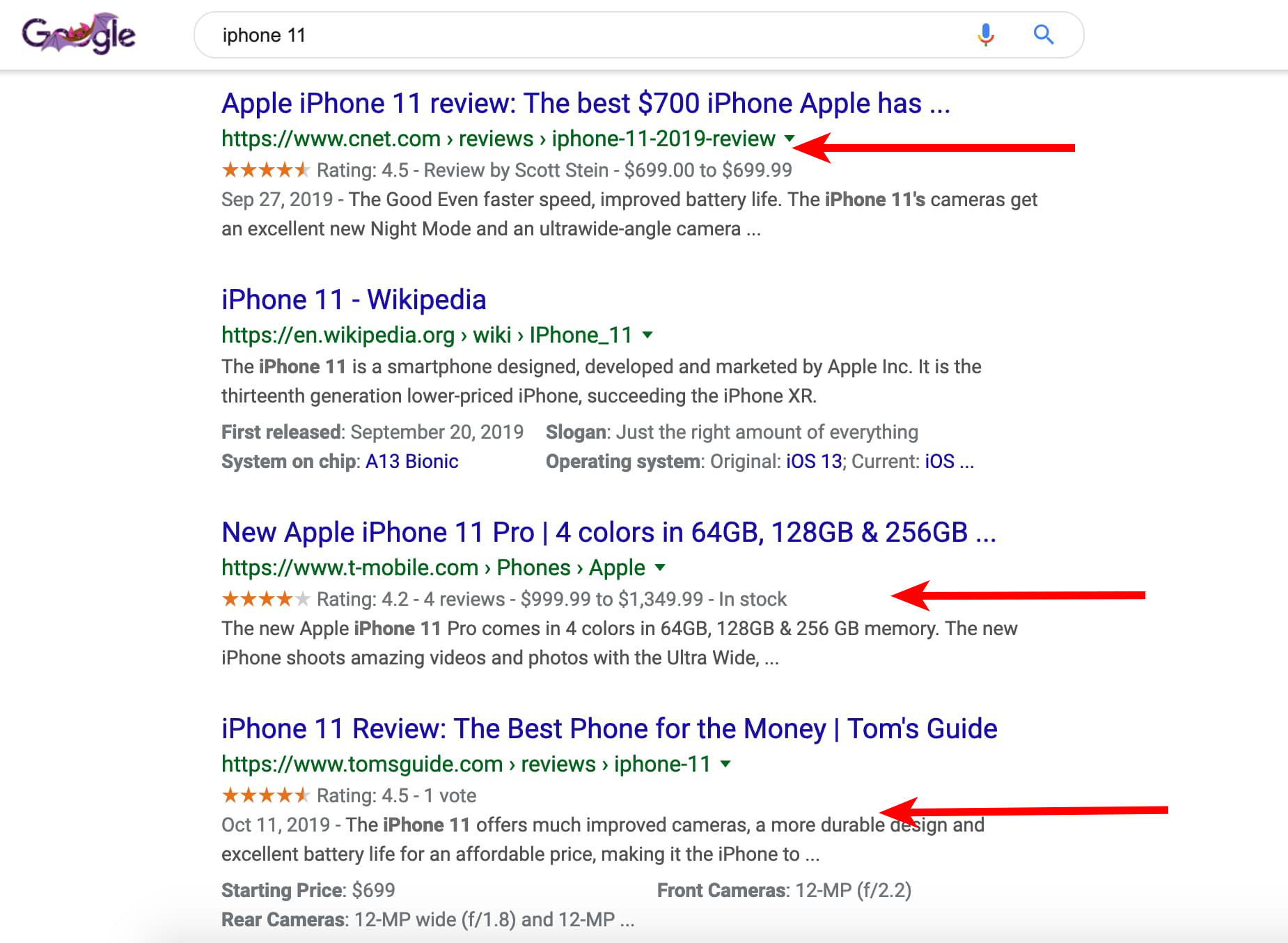
Image: Hubspot
For certain search types, adding schema can get you more clicks. By giving visitors more insight into your content, it can encourage them to click on your site vs. other search results.
For example, someone shopping for a specific product might click on the result that’s labeled “in stock” based on product schema.
Besides product schema, here are three other types worth adding to your pages:
- FAQ: Consider adding this markup to your actual FAQ page, plus your product and service pages. You’ll be able to address objections right on the results page.
- Ratings and reviews: Use this schema as social proof. A search result with strong ratings and reviews is more enticing than one without.
- Video: Since this schema enables a video thumbnail in SERPs, your content gets a visual element that text-only search results lack.
You can find more details about each type of schema on schema.org.
To create your schema markup, use Google’s Structured Data Markup Helper or another free online generator like TechnicalSEO.com. These tools walk you through the markup process and then provide a code to be added to a specific page’s HTML code.
Most tests “fail”
Insight from Demand Curve.
Most business experiments—around 90%—result in so-called failure.
Example: an A/B test in which the status quo ends up being the winner.
But those results are just as important as “successes.” They support startup growth by providing insights into:
- Why the experiment variant “failed”
- What you can learn for your next experiments
- How risky your experiments are. Too many small wins may mean you're not focusing on the most high-leverage opportunities.
Instead of defining “failure” and “success” based on test results, here are the definitions we recommend.
Failure: the act of creating 1. an undisciplined test, like one with an untestable hypothesis 2. a test with low impact on your business, or 3. a test your team won't learn from
Success: the act of developing, launching, and learning from a rigorous test with the potential for high business impact
Basically, a sloppy test is a fail. An inconsequential test is a fail. A well-designed test is a win. And any test that gives you useful new information is a win.
So go ahead and “fail.” Encourage your team to do the same. Disproven hypotheses are part of a healthy growth culture.
News and links
News you can use:
- Google made some big announcements at I/O 2022. Of particular note for marketers: My Ad Center, an upcoming tool that will let users control the kinds of ads they see. Also: more multisearch—think, take a picture, get local results. We’ll be hearing more about Google ads at Google Marketing Live on May 24, but here’s a sneak peek.
- Now available: TikTok Insights. Filter by location, audience, industry, etc. → get revealing insights and trends. E.g., the top three categories for graduation shopping are clothes, watches & jewelry, and food & drink.
- TikTok’s also partnering with Foursquare to improve attribution for in-store visits.
- Podcast ads are now a billion-dollar industry.
Plus, we’ve completely updated our blog article on Facebook Ads targeting. It factors in the latest privacy and algorithm updates and answers the question, Does Facebook targeting still work?
What we're reading: Every.
Every publishes essays analyzing and explaining new ideas in productivity, strategy, Web3, and the creator economy. It's run by a collective of thoughtful and experienced operators in tech like Li Jin, Nathan Baschez, and Nat Eliason. These are folks who are dedicated to writing essays that will actually help you reach your goals and better understand the world. Highly recommend checking it out here.
Something fun
From @punk_history.