


Happy new year to everyone! I hope you all had a restful holiday break.
I also hope that you're as excited about 2023 as we are. We have a lot of exciting new things planned this year... But for now they're gonna remain a secret 🤐
This week we cover boosting engagement with comments, propaganda and Bensi, and ChatGPT outlines.
As always, if you don’t find this valuable, you can unsubscribe at the bottom of this email. If you like it, tell your friends to subscribe here. It's the number one way to support the newsie.
–Neal
How not to make "rush to die" your car slogan
Insight from Grace Parazzoli (Demand Curve).
My new year’s resolution* was to learn Spanish.
*Of like 2012…still working on it.
I came across a word the other day while trying to read in Spanish: propaganda.
In some Spanish-speaking countries, that means “advertising.” 🤯 This took me down a rabbit hole of language and etymology.
Two things I learned:
1) In the early 1900s, PR folks called their work propaganda—that wasn't considered a bad thing then.
Here’s how the “Father of PR,” Edward Bernays, defined it:
“The conscious and intelligent manipulation of the organized habits and opinions of the masses is an important element in democratic society.”
Hmm…
2) The un-literal meaning of “literally” is now accepted.
So it’s now okay to use “literal” literally (“you are literally on fire,” get help fast 🔥) or figuratively (“you are literally on fire,” great job 🔥).
That makes it a Janus word—it means the opposite of itself. (Another example: “Left” can mean “gone” or “remaining.”)
–––
In your messaging, it’s not enough to know what a word or phrase means.
You have to understand its connotations.
And those 1) change, and 2) depend on context.
Think about words like:
- busy, which used to imply not part of the leisure class (i.e., working class), but now implies important
- mainstream, which used to mean the predominant way of thinking, but is now super politicized (like in the term “mainstream media”)
Their meanings are generally the same, but the subtext is very different.
Now, how do you stay on top of changing connotations in your copy?
A key step is to deeply understand your customers. What they say. What they do. What they care about. It’s important for understanding how they might interpret the words you use.
For example, Mercedes-Benz launched in China with the tagline “Bensi.”
Sounds cool, right?
Well, it means “rush to die” in Mandarin (奔死)—not exactly the association you want for your family vehicle.
Good marketers persuade. Great marketers listen.
(Thanks to Raf at Bell Curve for thinking through these concepts with me, and to the book Branding That Means Business for the Mercedes-Benz story.)
Make people comment to get value
Insight from li'l ol' me (Neal).
This tactic helped add over 500 people to the waitlist for our new course in 24 hours—which ended up selling out in six minutes.
One-third of the sales were from those 500 people.
It’s pretty simple:
Instead of sharing the link directly, get people to comment to ask for it.
For example, in my LinkedIn post last Friday, I shared the success stories of people who took our previous audience building course.
At the end, I pitched our revamped version with Katelyn Bourgoin. To get the link to the waitlist, I asked them to comment with "👀"
The result?
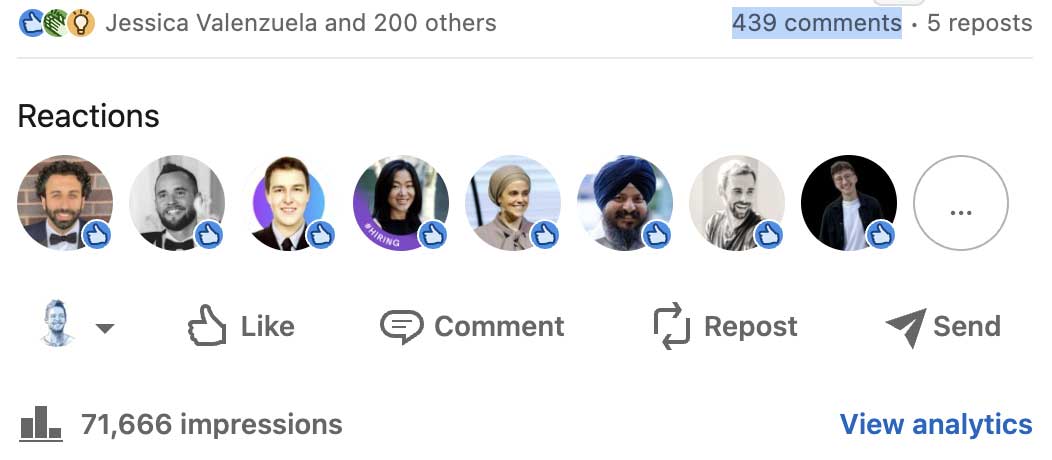
I had to DM so many people that I was afraid I was going to get suspended.
I eventually gave up and added a comment on the post with the link. (Yet people continued to comment for two more days.)
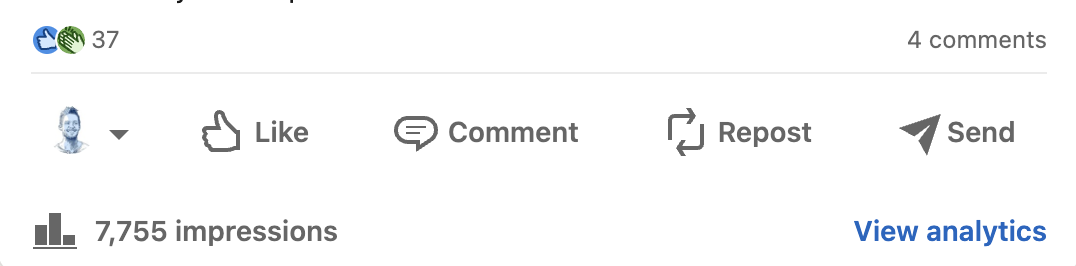
Compare that to another time I promoted a similar course and didn't ask for comments:
Why does this work?
A few reasons:
- External links on social platforms are penalized by algorithms. My post had zero links.
- When someone comments on a post, it gets shown to some of their connections. When some of their connections also comment, it shows to even more. This snowballs until it’s been seen by tens of thousands of people.
- When people comment to signal their interest, it’s a low-friction first step in the funnel. They’re now more likely to take an even higher friction step: clicking a link and giving up their email address. More so than if I had started by asking their email.
- When you receive a DM from someone, it feels more real and personal. It starts a connection with someone and increases the likelihood they take action.
I’ve used this tactic numerous times to promote various courses and services.
Each time it’s led to plenty of leads. And hundreds of new followers each time. Here are some other examples for inspiration: Un-Ignorable, Audience Building, and ChatGPT.
Use ChatGPT to create content outlines
Insight from Mohammed Osman and Joyce Chou (Demand Curve).
The robots are here. Our jobs are lost.
At least to some content marketers, ChatGPT and other AI writing services are seen as a threat to their livelihoods.
But rather than oppose these innovations, we think it’s better to leverage them as another tool in your content arsenal.
Specifically, by using AI to create content outlines.
Software architect Mohammed Osman tested this by asking ChatGPT for a blog post outline about a highly technical topic (C# abstract factory design pattern—huh?).
And ChatGPT delivered.
Why give it a shot?
You can save hours on SEO research.
Since ChatGPT was trained with text from around the web, the outlines it produces reflect how content about a given topic is generally structured.
We don’t advise using ChatGPT to do all of your content creation work, though.
For one, it’s not there yet. The quality isn't the best and GPT3 is notorious for making stuff up if it doesn't know the answer.
Also, Google will find and penalize AI-generated content. Guaranteed.
For now, stick to asking our robot overlords for an outline. It’s much easier to edit than to overcome Blank Page Syndrome.
Then apply your creative adjustments and fresh perspective—something purely AI-generated content can’t do.
News and links
News you can use:
Platforms have given a sneak peek of things to come in 2023. Here are a few highlights:
- LinkedIn will introduce new job category filters and search options for product listings in its app. That’s right—you can list products on their own LinkedIn page (there are already +90k). Find the complete rundown of upcoming changes here.
- While Meta continues to invest in VR and AR, Instagram will probably focus on visual editing tools and changes to its algorithm for content discovery. Aka more features à la TikTok and other platforms.
- Shopify is going all in on enterprise retail, beginning with its newly launched Commerce Components toolkit. Now big retailers like Mattel can integrate specific Shopify features into their own systems.
- Finally, expect more tech and social media regulation this year. The U.S. government’s ban on TikTok may be the first of more privacy policies aimed at Meta, Microsoft, and Apple, among others.
And I've written a post on how we sold out Un-ignorable in 6 minutes here.
Newsletter we love
It's been incredible watching our friend, Sahil Bloom, grow his newsletter, The Curiosity Chronicle to over 200,000 subscribers! Just a year ago it was 50,000.
Each week he provides actionable, tactical insights that you can immediately implement to improve your life. It's for anyone interested in personal development, growth, productivity, wealth creation, and business.
Something fun
From @TrungTPhan.