

Welcome to all you growth-loving founders and marketers!
We're back from the team retreat in Palm Springs, a bunch of us got COVID, BUT we've got some exciting things to come :)
Now that I've hit send, I'm off to go move! I'm moving into a house with my partner, her two kiddos, and my 1.5 year-old Australian Shepherd. Wish us luck 🤪
Now for: Death to PMF, grow with free tools, landing pages that convert.
Let's dive in 🥥
– Neal
Ortto
Platform we love*: Ortto
In the early stages, you can stumble your way into growth.
To continue scaling, your customer data, marketing automation, and analytics should work as one.
Get access to:
- Customer data platform: Connect your data sources, organize your data, and then use it to build audiences and create campaigns across marketing channels.
- A better messaging journey builder: An intuitive and visual journey builder with precise delay controls and sophisticated filtering.
- Powerful reports and dashboards: Analyze performance with real-time reports and track key metrics in shareable and visual dashboards.
Try Ortto for free today to discover a better way to build campaigns.
Brought to you by Positional.com, {insert copy about why DC readers need this tool for content marketing and SEO}.
Positional has a number of incredible features:
- {insert point about how Positional is cool}
- {insert point about how Positional helps teams save time}
- {insert point about how Positional helps drive more traffic from SEO}
Positional helps content teams check all of the boxes while scaling an SEO channel. Sign-up for Positional's private beta. You won't want to forget about this.
PS: This was intentional, just making sure you're awake ;0
How to write a landing page that converts
Insight from The Growth Guide.
To grow you need a website that converts visitors into purchasers:
Purchase Rate = Desire - (Labor + Confusion)
To increase the purchase rate, increase the visitor's desire to purchase while decreasing their labor (effort) and confusion:
- Increase desire — Entice visitors with how much value you provide. Create intrigue.
- Decrease labor — Reduce the work your visitors have to perform so they don't get tired or annoyed. Be concise and ensure every word and element is of value.
- Decrease confusion — Don't confuse visitors with obscure or verbose messaging. Ensure every sentence can be easily understood. And make it self-evident which action they should take next (e.g. sign up or purchase). And ensure your action elements (e.g. buttons) are unmissable.
This means don't get overly fancy with your pages.
It's not an art piece.
It's not a statement.
It's a tool to convert attention into intention into action.
A lot can be accomplished with this simple, tried-and-true page structure:

By "Features" I don't mean just saying "easy-to-use!"
Instead translate features into the value they'll get from using it. And proactively handle any objections they might have.
For a detailed breakdown of how to create each of these sections, read out Landing Pages section of our comprehensive Growth Guide.
Grow by offering free, related tools
Insight derived from Taplio and Perfect Keto.
Taplio scaled to $1M in ARR in 9 months. They then got acquired by Lemlist.
They did it with a small team and no sales people.
Perfect Keto, a former client of ours, grew to 8-figures in revenue in under 2 years with a team of less than 10 people.
A big driver for both were free tools:
Taplio
Taplio launched 12 free tools that drove a ton of growth.
For example, when carousels were becoming popular on LinkedIn, people were manually repurposing screenshots of tweets. So they created a free Tweet -> Carousel generator.
On that page they pitched to product, then added a watermark that'd only be hidden if you become a paid member of Taplio
Pefect Keto
Perfect Keto sells supplements for people on the keto diet. They started producing a ton of SEO-content about keto diets right as the trend of keto diets was on the up.
One of the biggest drivers of traffic, sales, subscribers, and domain authority (at least at the time) was a free ketogenic diet calculator.
Create your own
To take advantage on this strategy, the sweet spot is:
- It's related to what you sell
- Would-be or current customers would need to do it. Bonus if it's frequently.
- A lot of people are searching for it (do keyword research)
- It's trending upwards (keto diets in 2017 or linkedin carousels in 2022)
Death to PMF obsession
Insight from Neal's newsletter and the Growth Program.
Product-Market Fit is a tiny piece of the puzzle.
Yet it's what every startup is chasing.
Of course, creating a product that solves a painful and unsolved problem is critical. But it's way more complicated than that.
We like to use the 5 Fits Framework (adapted from Brian Balfour's Four Fits):
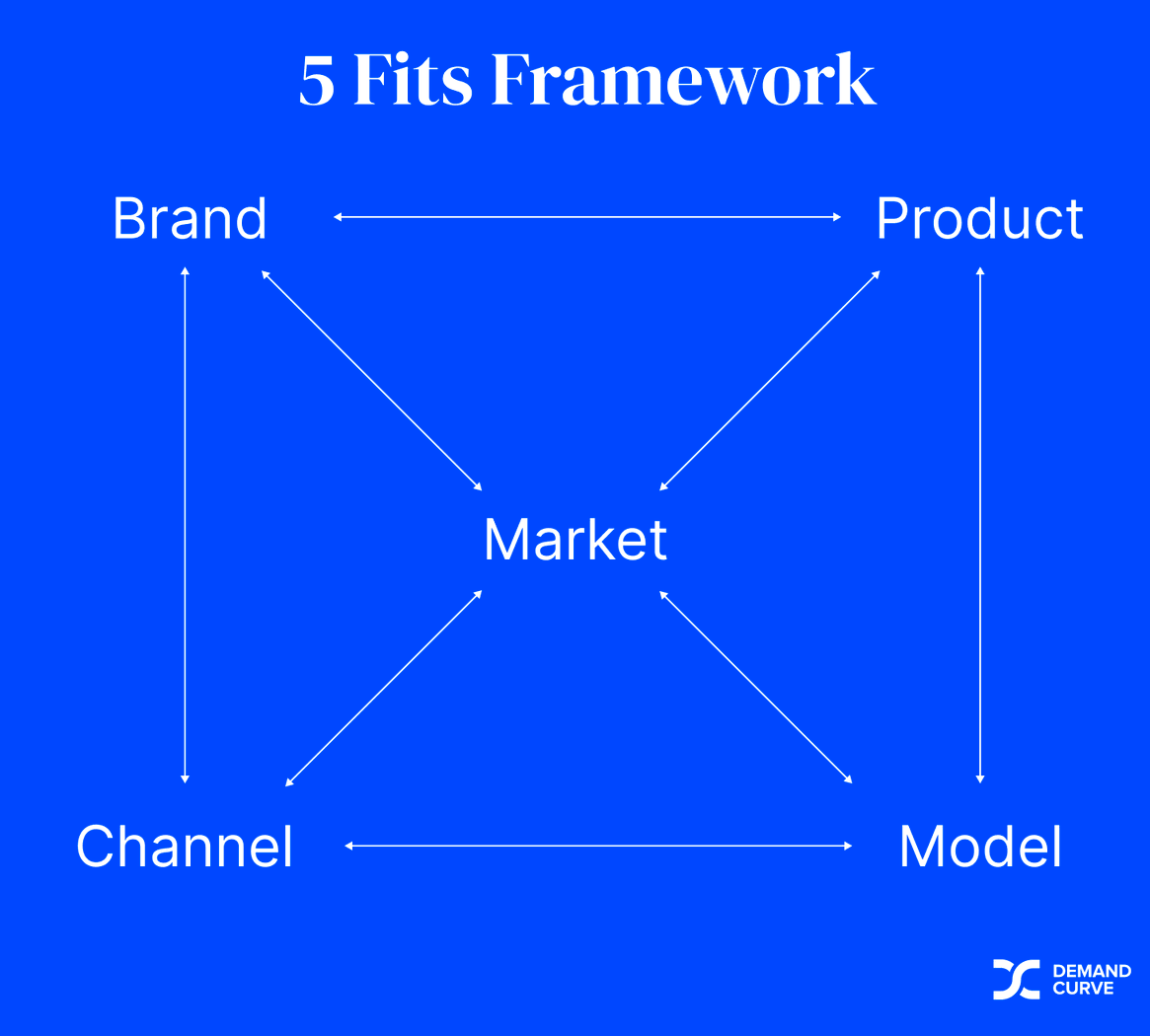
- Product – WHAT you sell. What problem does it solve? How unique is that? And, how well does it solve it?
- Market – WHO you're selling to. Do they have that problem? How painful is it?
- Model – HOW you charge (monthly, one-time, per unit), and how MUCH you charge.
- Channel – WHERE you're marketing and selling it.
- Brand – The perception, identity, and reputation of the company/people selling it.
All five of these need to be in sync for a company to take off. Examples:
- A Rolex-equivalent watch wouldn't work if sold by My Little Pony.
- You couldn't sell a kids toy for a $10,000 monthly subscription.
- You'd go bust if you paid for LinkedIn Ads to sell Fidget Spinners.
A great product that solves your painful problem just doesn't work if:
- It's sold by a brand that you don't trust to make it.
- It costs either way too much or way too little.
- If it's marketed or sold where you aren't spending time.
- And various other permutations of how these fit together.
So as you're building a great product, consider how it all fits together.
Wanna go deeper?
If you wanna go deeper into Five Fits, growth strategy, brand strategy, onboarding, landing pages, as well as setting up marketing channels like ads, cold emails, and SEO—we're offering $300 off our Growth Program in our Black Friday/Cyber Monday promo.
It's for early-stage founders that need to get their startup ready to go grow. We'll teach you the 80/20's of growth for your startup. And show you step-by-step how to do it.
Grab your $300 off →
(Or reply to this newsletter with questions)
News and links
News you can use:
- OpenAI now let's you create your own "GPT" trained through conversation (and file uploads) to give answers in specific ways. Note: It's better to upload one mega text file rather than several small ones.
- Meta reveals 5 new tools for lead generation for Facebook and Instagram.
- Meta has partnered with Amazon to roll out a feature that simplifies the conversion process for Amazon sellers.
- YouTube rolls out 'For You' section on the home tab of creators' channels.
- Google is rolling out new shopping features to help brands engage with shoppers.
- Google is rolling out new AI features in Performance Max by the end of the year.
Platform we love*: Ortto
In the early stages, you can stumble your way into growth.
To keep growing, you need to get your customer data, marketing automation, and analytics working as one.
Get access to:
- Customer data platform: Connect your data sources, organize your data, then use it to build audiences and create campaigns across marketing channels.
- A better messaging journey builder: An intuitive and visual journey builder with precise delay controls and sophisticated filtering.
- Powerful reports and dashboards: Analyze performance with real-time reports and track key metrics in shareable and visual dashboards.
Try Ortto for free today to discover a better way to build campaigns.
*Sponsored by Ortto
Something fun
From @the_marketing_millenials.