
St Patrick's Day is this weekend 🍀🌈🥇🍀
There are only 5M people in Ireland and 1.8M in Northern Ireland. Yet there are over 70,000,000 people worldwide with Irish heritage, including me.
Happy St Paddy's to everyone this Sunday :)
Topics for the day: Sales-to-Fulfillment Continuum. Milkshake's Job. Dynamic repurposing.
Let's dive in 🍀
– Neal O'Grady
Ortto
Tool we recommend: Ortto
Marketing without proper attribution is a big waste of money.
Ortto just added even more attribution settings to their feature-packed marketing analytics platform.
Control whether you want to track campaign attribution against email sends, opens, or clicks and track progress in easy-to-build reports and dashboards.
Ortto brings your customer data, marketing automation & analytics together for more effective marketing.
Sign up for a 14-day free trial today and see why they're rated highly for ease of use. (No credit card required).
Brought to you by Vidico
Creative is the number one way to influence the profitability of a campaign.
And a video is far more impactful than an image. But so much harder to get right.
That's where Vidico comes in. They craft best-in-class videos that ensure your brand shines like the next unicorn without breaking the bank.
Try them out risk-free: Join a 1-on-1 video strategy session and get a free video script worth $500 tailored to your audience. You'll walk away with a ton of value in just 20min.
Insense
Bought to you by Insense—the influencer marketing software with a human touch.
No design team? No problem! Source UGC footage at scale on the Insense platform.
And use their in-house post-production team to transform the footage into high-converting UGC ads.
Book a free strategy call and get $200 for your first campaign until March 29.
The Sales to Fulfillment Continuum
Insight from $100M Offers by Alex Hormozi.
Charging less doesn't always mean you'll sell more.
Here's a mistake many service-based founders make:
“I currently charge people $$$$ for my expertise, and it’s a ton of work. I'll make a $99 course and sell it to a LOT of people. It’s scalable, and they’re getting a big discount on my expertise.”
It seems reasonable.
But, sadly, in most cases, it does not work.
This same line of thinking is also super common amongst SaaS founders.
They assume that an inexpensive, self-serve product will sell a lot more than the expensive product that requires whiteglove onboarding.
Alex Hormozi explains this with the Sales to Fulfillment Continuum:

In summary:
- If it's easy for you to fulfill on the product/service (ex: digital product or self-serve course/software) it will be a hard sell.
- If it's hard for you to fulfill on the product/service (ex: coaching, service, whiteglove onboarding, custom tooling) it will be an easy sell.
Let’s use an example to illustrate this:
You’re a busy founder of a successful 8-figure startup.
You know the importance of growing an audience on social media both for your existing business and your overall career.
You see two people online that can help you with it:
Option 1 – For $10k/mo, Person A will 100% do it all for you:
They'll:
- Come up with ideas,
- Write and post the content,
- Engage on other's posts,
- DM prospects and high value, and
- Set up meetings.
All you have to do is answer questions upfront on a call and they'll get calls booked with your sales team.
They’ll start posting next week, guaranteeing you at least 10k followers and 20 leads/month in 6 months—or your money back.
Option 2 – For $100, Person B has a 50-hour video course:
The course will teach you everything you need to do it yourself.
However, it will take you 10+ hours per week at minimum, and there are no guarantees it will work.
Which are you likely to pick?
Well let's pull apart what might influence the founders decision to determine which one is a better value by looking at Hormozi's Value Equation.
The Value Equation

Essentially, you increase value (perceived or actual) with these four variables:
Dream Outcome (↑ Higher is better)
This is what the customer really wants. The stronger the desire, the more valuable your offer.
You can increase this by:
- Big or specific promises: Losing "20 lbs in 30 days" is more appealing than "gradual weight loss over a year." Just be weary as overly big promises can trigger disbelief if not backed up.
- Aspirational framing: Sell the best version of their desired outcome.
- Make it easy to visualize: "Beach body" versus "lose 10 pounds."
- Tying it to identity shifts: Make them feel like they’ll become a new person ("become a thought leader" versus "get 20k followers")
Perceived Likelihood of Achievement (↑ Higher is better)
How much the customer believes your offer will actually work for them.
You increase perceived likelihood with:
- Guarantees or risk reversals: "100% refund if we don’t hit X results" or "only pay if we're successful."
- If you can't guarantee results, guarantee the process 👇
- Process transparency: Show your system/process so it feels structured and predictable.
- Authority & social proof: Display logos of companies you’ve helped or media features to build trust.
For social proof, don't just use really big customer wins like "100+ pounds lost" or "100k+ followers gained." It can be seen as unlikely to happen to them.
Instead, make sure to include "people like me" social proof like "20 pounds lost" or "5k followers gained." It's more relatable and likely to happen.
Time Delay (↓ Lower is better)
This is how long it takes to get results. The shorter, the better.
You can decrease the time delay by:
- Pre-built templates or automation: Let them skip the hard parts.
- Speed guarantees: Deliver results in a set timeframe.
- Done-for-you services: Remove work on their end.
- Small early wins: "In the first 7 days, we’ll identify your 3 biggest funnel leaks—and show how to fix them." (Small, fast, measurable wins)
Examples of optimizing for Time Delay:
- B2B SaaS: Instead of "a CRM that helps you close deals," say:"Close your next deal in 7 days with our AI-powered pipeline nudges."
- Marketing Agency: Instead of “We optimize your funnel,” say:"Your first profitable ad campaign live in 14 days—or it’s free."
- Coaching Program: Instead of “Learn how to fundraise,” say:"Land investor meetings in 30 days with our cold outreach scripts."
Effort & Sacrifice (↓ Lower is better)
This is how much work, discomfort, or trade-offs the customer has to endure.
You can decrease their effort and sacrifice witH:
- Done-for-you execution: Remove work from the customer.
- Clear step-by-step processes: Make it feel plug-and-play.
- Pre-built tools: Give templates, scripts, checklists.
Examples when optimizing for Effort & Sacrifice:
- B2B SaaS: Instead of "customize your sales workflow," say:"Pre-built sales automation workflows—just plug in your leads."
- Marketing Agency: Instead of "we consult on growth," say:"We build, launch, & scale your ads—no effort required on your end."
- Founder Coaching Program: Instead of “Follow our framework,” say:"We give you the exact email templates to use for fundraising."
Example: A meal delivery service that provides healthy meals is more attractive than a diet that requires cooking complicated meals from scratch.
So which would you chose?
Okay let's go back to our founder who wants to build his audience:
- For $10k/mo, Person A will 100% do it all for you: come up with ideas, write the content, engage, DM people, and set up meetings. All you have to do is answer questions upfront on a call, meet new people, and sell them. They’ll start posting next week, guaranteeing you at least 10k followers and 20 leads/month in 6 months—or your money back.
- For $100, Person B has a 50-hour video course that teaches you everything you need to do it yourself. However, it will take you 10+ hours per week at minimum, and there are no guarantees it will work.
Let's beak these down in the Value Equation:
Option 1: Done-for-You Service ($10K/mo)
✅ Dream Outcome (High) → Gain 10K+ followers & 20 leads/month, plus done-for-you execution.
✅ Perceived Likelihood of Achievement (Very High) → Guaranteed outcome or money-back.
✅ Time Delay (Low) → They start posting next week; results within 6 months.
✅ Effort & Sacrifice (Very Low) → Just answer questions upfront.
Value Score: Extremely High
- The offer removes all effort, makes fast progress, and guarantees results.
- The only friction is the high price ($10K/mo), but for someone who values time > money, it’s a no-brainer.
Option 2: DIY Course ($100)
✅ Dream Outcome (Medium) → Learn how to do it yourself, but outcome depends on execution.
❌ Perceived Likelihood of Achievement (Low) → No guarantee it works and high probability no progress is made.
❌ Time Delay (Very High) → Requires months of work before seeing traction.
❌ Effort & Sacrifice (Very High) → 10+ hours per week, plus trial and error.
Value Score: Low
- The price is cheap, but the risk is all on the buyer.
- It’s a huge time commitment, no guarantees, and outcomes vary dramatically with most people failing.
Less expensive isn't always better
It might be tempting to create a self-serve product or course so your job is easier. And you might reasonably assume that the low price will attract a large group of people.
But as we've shown, that's often not the case.
For example, one of our clients, FirmPilot, is an AI tool that does all the content marketing for law firms. They had two options for the product:
- Make it self-serve and inexpensive. They could let lawyers sign up for the tool, set up the AI, and monitor it and charge them $XX to $XXX per month for it.
- Manage it for them. Instead, they personally onboard the law firm, revamp their terrible website, set up and tune the AI for them. And they charge nearly as much as a marketing agency does even though it's not a bunch of humans doing the work.
As a result of going Option 2 (which is a lot more work for them per customer), each law firm they sign on is easily 10x more revenue, and they're excited to sign up because it checks the boxes on the Value Equation:
- Dream Outcome: Grow your law firm with organic digital marketing and be at the top of Google.
- Perceived Likelihood of Achievement: An AI and marketing expert is doing it for you, and they have proof of it working for other law firms.
- Time Delay: They revamp their sites and get it going within days/weeks.
- Effort & Sacrifice: They do it all for you.
More software companies should start out going this route since it'll be an easier sell, higher LTV, and you'll be closer to customers to learn their needs.
When and how to break this
Obviously there are TONS of different self-serve courses and products out there, so clearly this doesn't apply in all cases. For example:
- You have a ton of demand. If demand exceeds your ability to fulfill it, then reduce the amount you're doing for people. This is why we started creating courses in addition to our agency services.
- Your product is validated and easy to use. If your product is validated and has hit Product-Market Fit and it's easy for people to learn and use, then open it up for people to try without a demo or personal onboarding
- You have a ton of social proof. The higher the perceived likelihood of success due to your social proof and reputation, the easier the sale.
- You can do both. If the high-end product/service is working, expand to a larger market by making a more accessible, but less hands-on option.
So when you're creating your product, plug it into the Value Equation and consider where it sits on the Sales to Fulfillment Continuum and tweak the variables so it's more enticing for people.
Although Hormozi's brand can often be a bit over the top at times, his book $100M Offers is filled with great insights on how to create desirable products and services.
The Job-to-be-Done of a Milkshake
Insight from Clayton Christensen.
What job do you hire a milkshake to do?
Your customers “hire” products to do certain “jobs” for them.
Often, they’re not consciously aware of this.
The milkshake example is from a restaurant client of Clayton Christensen’s. To sell more milkshakes, the restaurant polled customers to see what attributes of the milkshake they liked best and what could be improved (chocolateiness, thickness, etc.).
They improved all of the most common answers. Nothing happened to overall sales.
Unsurprisingly, customers didn’t have insight into their purchase preferences.
Instead, the answer was much deeper.
So, Clayton’s team dove into WHO the customers are, WHEN they’re buying milkshakes, and WHY they’re buying them at that moment. Here’s what they found:
- 50% of milkshakes sold before 8AM to solo customers who drove off in their cars.
- After confronting customers in the parking lot to ask them WHY they were doing it, they eventually determined they used it for breakfast during a long commute.
- The milkshake optimally achieved that because it fit in the car’s cupholder, required only one hand, was clean, and lasted throughout the commute.
So compared to most other breakfast items like bagels, muffins, fruit, cereal, a plate of eggs, and doughnuts, milkshakes (and likely smoothies) performed that job best.
Knowing what customers cared about made improving the product and marketing it easier.
Here’s Clayton’s famous talk about his so-called Jobs-to-be-Done Framework:
Examples of famous products’ non-obvious jobs:
- Rolex/Ferrari: Make me feel like I’ve succeeded and signal that to others.
- Doordash: I’m too exhausted to cook tonight or go out to eat; bring me food.
- Slack: Email crushes my soul. I want to feel like I’m texting with my team.
- Duolingo: I want to feel smart, but I want it to be fun and easy.
- Airbnb: I don’t want to feel like an annoying tourist. I want to feel like I live there.
- TikTok: I don’t want to do this thing I’m procrastinating on.
Repurpose content into a dynamic database
Insight from us.
Newsletters are ephemeral.
Once they're sent out, reads trickle in only for a few days. People do not re-read old emails.
If you put your newsletter on your website, you get additional longevity from people promoting it, bookmarking it, stumbling upon it, or finding it via Google.
Or, if you're lucky, you'll earn some backlinks with steady referral traffic.
But for that, it needs to be a thorough guide (like our Growth Guide and my 10 Ways to Hook People) or reference material, like Lenny Rachitsky's benchmark articles:
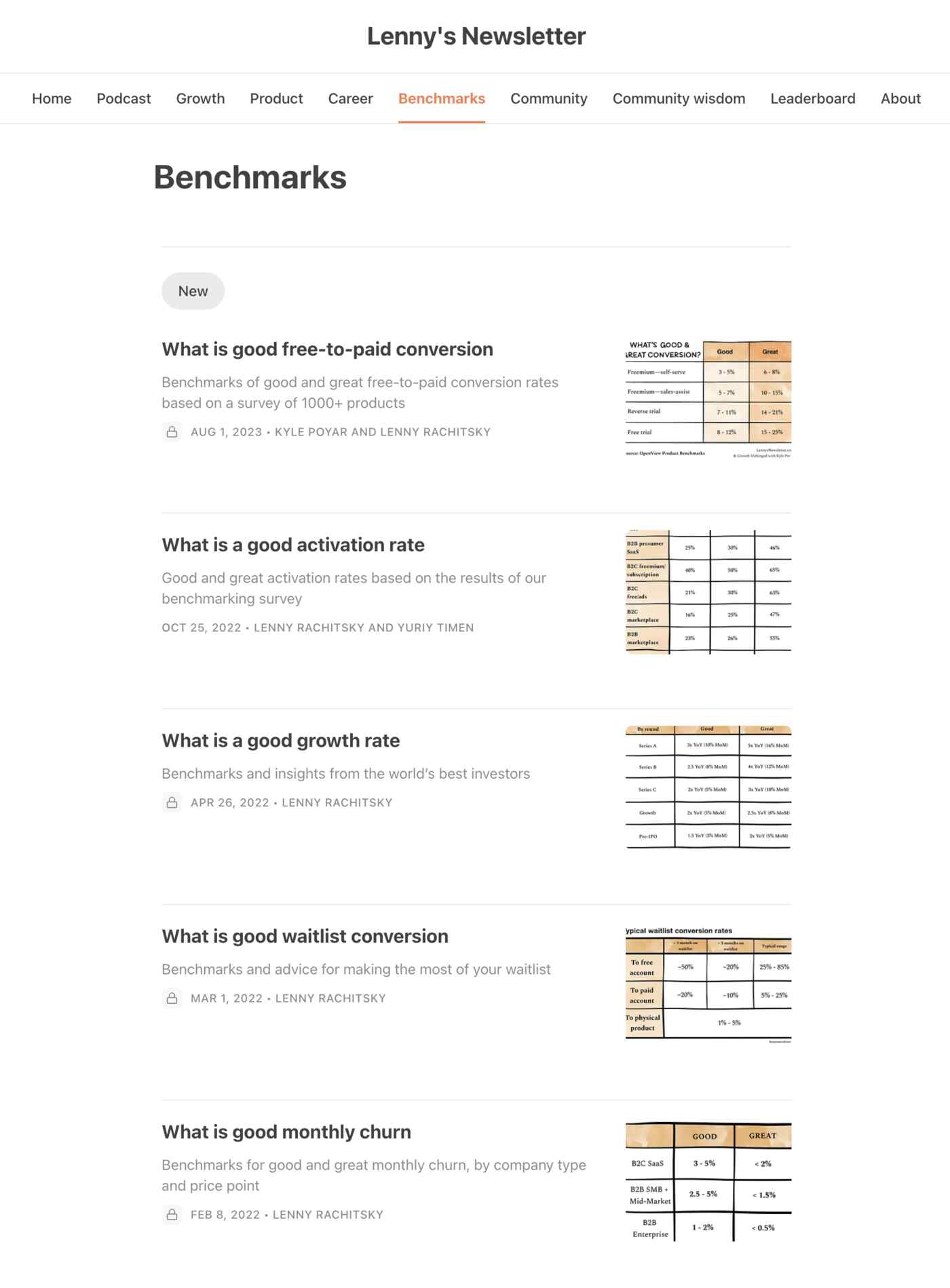
Our newsletter isn't conducive to any of those. It's 3 separate tactics in one edition. As a result, they receive little organic traffic after they're sent out.
How we're solving that problem: The Growth Vault
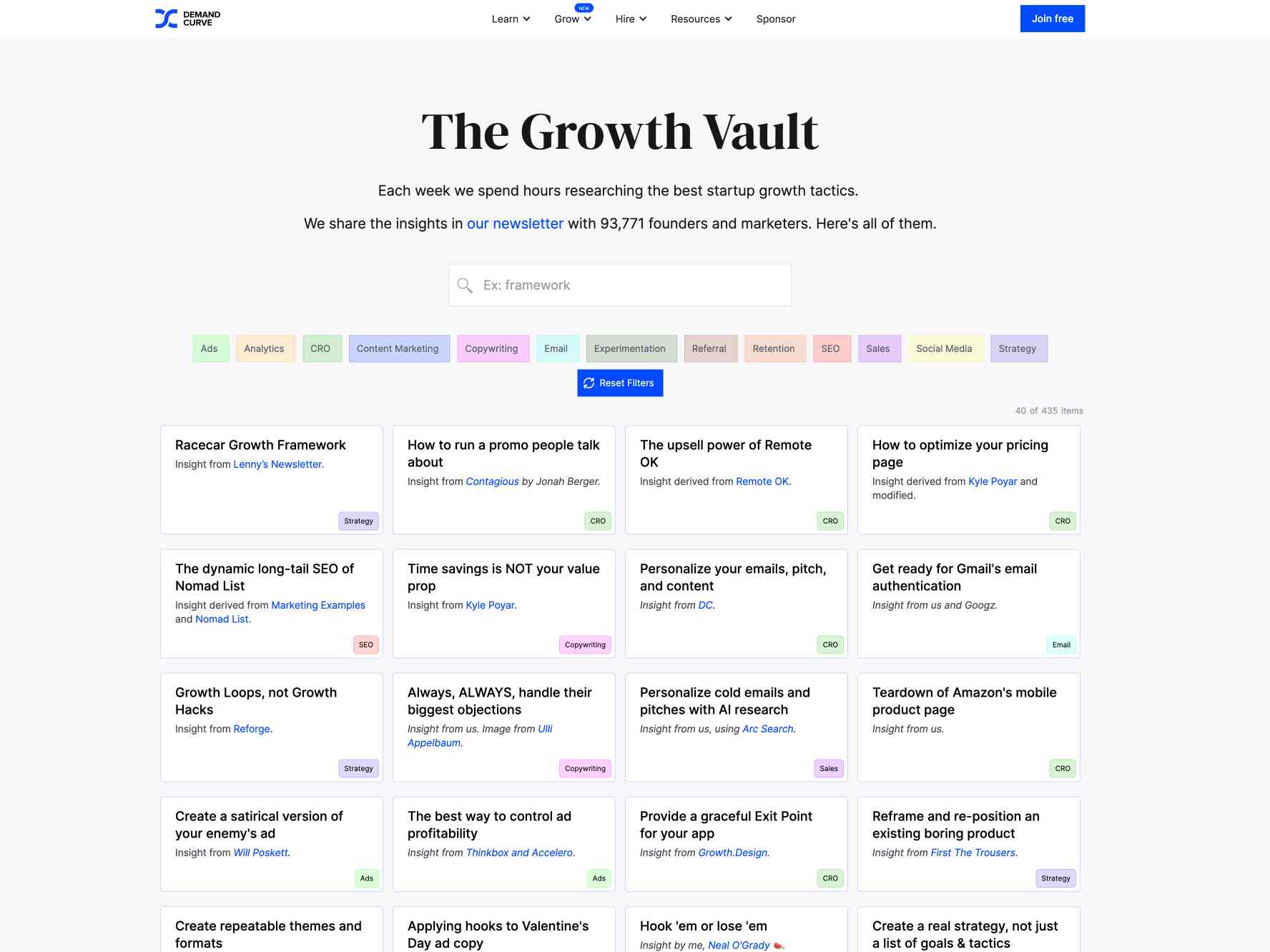
Instead of hiding our tactics across 163 newsletter pages, we've created a searchable and filterable database of 435 startup growth tactics (and counting).
Not only does this provide additional value to subscribers, but it's also something:
- People can bookmark.
- We can share on social media.
- We can launch on Product Hunt.
- That can earn organic backlinks.
- That can generate even more subscribers.
If you generate content on an ongoing basis, find better and better ways to package it and let people consume it.
Check out the Growth Vault.
News and links
News you can use:
- TikTok's crackdown bill is getting voted on this week.
- Reddit announces their new toolkit for business growth: Reddit Pro.
- Twitter/X introduces a new way to share long-form content for premium subscribers: Articles.
- Facebook introduces a new feature for Meta Verified subscribers, allowing them to customize links with images.
- Twitter/X introduces a concept for a new timeline, only showing time and views.
Tool we recommend: Ortto
Marketing without proper attribution is a big waste of money.
Ortto just added even more attribution settings to their feature-packed marketing analytics platform.
Control whether you want to track campaign attribution against email sends, opens, or clicks and track progress in easy-to-build reports and dashboards.
Ortto brings your customer data, marketing automation & analytics together for more effective marketing.
Sign up for a 14-day free trial today and see why they're rated highly for ease of use. (No credit card required).
*Sponsored by Ortto
Something fun