
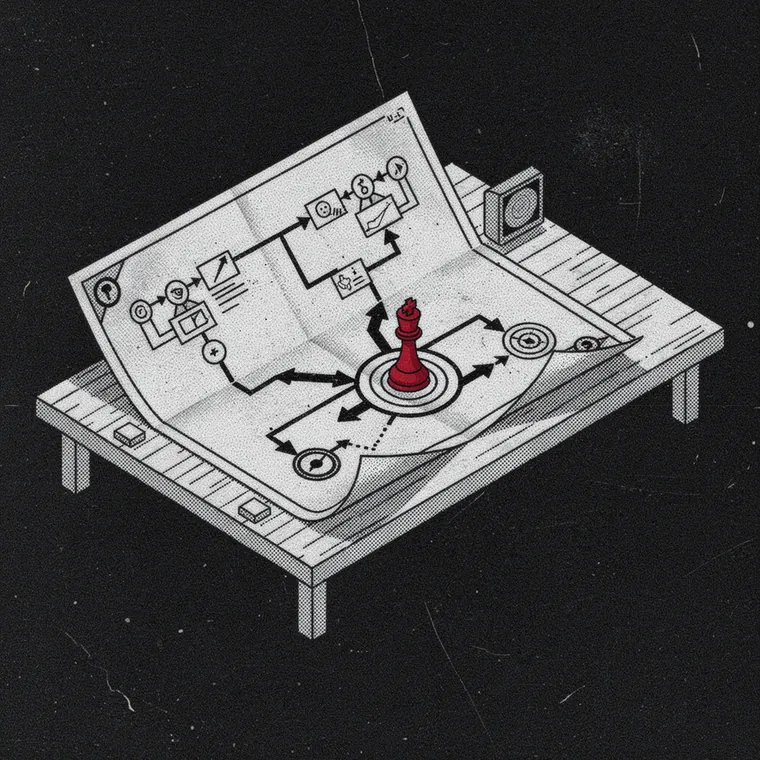
You can explain what makes your product unique in a conversation.
But the moment you write it down (on your homepage, in your ads, in your deck), it somehow sounds like everyone else.
If you’re building in a crowded category, you’ve probably felt this:
- Everything you publish feels a little too similar to your competitors
- Your homepage could easily belong to another product in your space
- Your differentiator feels real, but it doesn’t stick
- Your angle makes sense internally, but falls flat externally
This isn’t a copywriting issue. It’s a salience issue.
Let’s walk through why this happens and how to stand out even when you’re surrounded by competitors.
— Devon

Brought to you by BlueAlpha
Marketing teams move faster with BlueAlpha. Instead of sifting through dashboards, you get a clear, prioritized set of high-leverage actions: which campaigns to scale, where to reallocate spend for maximum ROI, which audiences are heating up, and which creatives are dragging performance down.
BlueAlpha turns messy cross-channel data into concrete steps your team can execute immediately to drive growth and eliminate wasted spend.
Book a demo before Dec 22 to get a free strategy audit call
Learn more about BlueAlpha
Keeper
Weak passwords put your company at risk of a massive data breach. Keeper Security is the most secure password and passkey manager for businesses and keeps your team's logins safe. Get 30% off Business plans through 12/31. [Protect your accounts →]
The real enemy isn’t the competition. It’s the category story.
Insight from Devon Reynolds— Demand Curve Creative Strategist
Every crowded category comes with a default narrative:
- CRMs → manage contacts
- Project tools → assign and track tasks
- Email tools → write and send faster
- AI tools → automate repetitive work
- Fitness apps → track workouts
- Protein bars → high protein, low sugar
The category defines the problem for you before you ever show up.
So most founders position themselves as a variation of the familiar:
- “Faster than…”
- “Cheaper than…”
- “All-in-one alternative to…”
- “AI-powered version of…”
It sounds logical, but it's also the reason your positioning feels interchangeable.
Because if your story reinforces the existing frame, customers don’t assign you a new mental slot. They simply file you under “another one of those.”
In a cluttered market, that’s the fastest way to disappear.
Salience decides who wins crowded markets
Growth can feel complex, but our brains are simple:
We pick whatever comes to mind first. (That first thought is called "salience".)
If the category owns the story, the incumbent wins by default because they’re already associated with that story.
Which is why:
- Better features don’t automatically convert
- Lower pricing doesn’t create loyalty
- A nicer homepage doesn’t fix a weak narrative
You can improve the product.
You can add features.
You can polish your copy.
But if your messaging stays inside the category’s frame, your salience never rises.
You remain a version of something else, not a category of one.
So what’s the alternative?
You have to reframe the problem.
Great positioning doesn’t come from describing what you do.
It comes from redefining the problem so your category stops being the best answer.
Breakout companies don’t fight incumbents head-on.
They make incumbents look misaligned with the real problem.
For example:
- Notion
Didn’t say “better project management.”
👉Reframed: “Your work is scattered. You need an all-in-one workspace.” - Figma
Didn’t say “cloud-based Sketch.”
👉Reframed: “Design is collaborative. Tools should be multiplayer.” - Superhuman
Didn’t say “a faster Gmail.”
👉Reframed: “Email is leverage… here’s the premium performance layer.” - Liquid Death
Didn’t say “better water.”
🤘Reframed: “Water is boring. Let’s make it punk.”
None of these companies invented new categories.
They reframed the problem so that the incumbent’s story no longer fit.
That’s how you create salience when the category is crowded.
A simple tool you can use today: The Reframe Ladder
Here’s a quick, four-step exercise inspired by the deeper work we do inside the Growth Program.
Use it to shift your message out of the category’s frame and into your own.
We’ve included a worksheet you can work directly in here.
Pick your category and walk through these four steps:
1. Start with the obvious problem the category solves
What the category assumes everyone cares about.
e.g., “Teams need better communication.”
2. Surface the deeper problem your persona actually feels
The emotional or operational tension the category is ignoring.
e.g., “The issue isn’t communication. It’s scattered context and switching.”
3. Show why the category fails to solve that deeper problem
Expose the misalignment.
e.g., “Communication tools help you talk more, not work better.”
4. Define the new problem only your product is built to solve
This becomes the foundation of your narrative.
e.g., “Your real bottleneck is fragmented information. You need one workspace.”
Once you articulate this, you immediately stop sounding like everyone else because you’re no longer solving the same problem they are.
Want help finding your own reframe?
If you’re in a saturated category and your messaging feels like it blends in, you don’t need a new slogan.
You need a new problem story.
Inside the Growth Program, we walk you through the full process we use with founders to build a story that actually performs across channels.
It’s called the Story System, our proprietary framework we’ve used with some of the fastest-growing brands out there. And it fixes the two problems that make growth a lot harder than it needs to be:
- People don’t understand why they should choose you.
- Your team is telling slightly different versions of the story.
When those two things aren’t clear, everything downstream gets harder. Ads fall flat, landing pages get rewritten every month, and creative tests don’t compound.
Inside the Story System, you’ll build:
- Core Problems → the deeper tension your narrative should anchor to
- Personas → the motivations and pressures that shape what actually resonates
- Value Props → the “why us” your competitors can’t copy
- Hooks → angles that stop the scroll and lift conversions
- Narrative Map → how your message shows up across ads, pages, product, sales, and onboarding
Founders tell us this is the point where everything clicks and where growth finally feels like it’s moving in one direction instead of five.
(And if this newsletter resonated, you’re already doing the first step.)
👉 Build your own Story System inside Growth Program 2.0
Devon Reynolds
Demand Curve Creative Strategist