

Welcome to the 2250(!) new marketers and founders who joined last week!
This week we're bringing you a few ecom tactics. Specifically, we're covering handwritten notes, Shopify's Meta integration, and timing for influencer seeding. But if you're in B2B, SaaS, or otherwise, you can still apply some of these. In an upcoming issue, we'll even it out with some SaaS-specific tactics.
Learn content marketing from Amanda Natividad (speaker at our Growth Summit)
If you want to learn how to create content that engages and converts, check out Amanda Natividad’s course Content Marketing 201.
Amanda has taken her experiences as VP of Marketing for SparkToro and condensed them into her program. You’ll go far beyond traditional keyword research to generate big ideas for your brand, repurpose your content for high-engagement channels, and use templates to grow through content.
You’ll leave the 2-week live course with a consistent, high-performing content engine. Check it out here.
Thank customers with handwritten notes
Insight from Ariyh.
To get customers to spend more, try sending handwritten thank-you notes with their orders.
In one experiment, a beauty company sent thank-you notes to 1,232 customers and tracked their future spending. Here’s what they found:
- People who didn’t receive a note spent $25.97 later on.
- People who received a typed note spent slightly more—$29.74.
- People who received an original handwritten note or photocopy of one spent $52.07.
What explains these results?
DTC companies prioritizing growth can often come across as transactional. A handwritten note—or even a photocopy of one—shows warmth and consideration. Since we feel closer to a brand with these qualities, we’re more compelled to buy from it again.
Consider testing handwritten thank-you notes to improve your customer lifetime value. Try personalizing the message with a first name. If you're at an early-stage company, you can write them yourself or hire someone from TaskRabbit. If you’re scaling, you can use a dedicated service like Handwrytten.
This finding isn't just for ecom. It might work well for service-based businesses like hotels and restaurants. Even if you run a SaaS company or sell digital products, you can send a handwritten thank you to the billing address on file.
How to time your product seeding strategy
Insight from Marketing Brew.
If you’ve been a reader for a bit, you might remember the DTC company Graza. They sell olive oil. We wrote about their clever retention tactic back in Newsletter 83.
Turns out they also perfected their launch. Within 24 hours of launching, Graza sold out and got a 7.91% conversion rate from Instagram.
A large part of their hot start came from product seeding—sending influencers products with the hope that they’d promote them to their audiences.
Since Graza targeted a variety of influencers with different-sized audiences, timing played a big role here. According to Graza’s social media consultant Kendall Dickieson, smaller influencers helped sell out the launch, while larger influencers contributed to pre-orders for the next shipment.
To create a similar effect, here’s how to time your product seeding:
- Send micro-influencers (25k–150k followers) and nano-influencers (under 10k followers) products weeks before your launch. Their UGC is ideal for building anticipation for launch day. For Graza, these smaller influencers often posted about the olive oil right away.
- Send macro-influencers (200k+ followers) products closer to launch. These influencers have backed-up content calendars, but their posts tend to get more reach (and, in some cases, more conversions). If they post pre-launch, their followers won’t be able to buy anything. But after launch, their posts can generate a lot of momentum.
Shopify stores, your Meta integration could be hurting ad performance
Insight from Disruptive Digital.
Over 600,000 Shopify merchants use the native Meta integration. It's convenient and easy to set up, and the implication is that you're maximizing data sharing.
But, as Disruptive Digital reports, this “solution” is likely hurting ad performance.
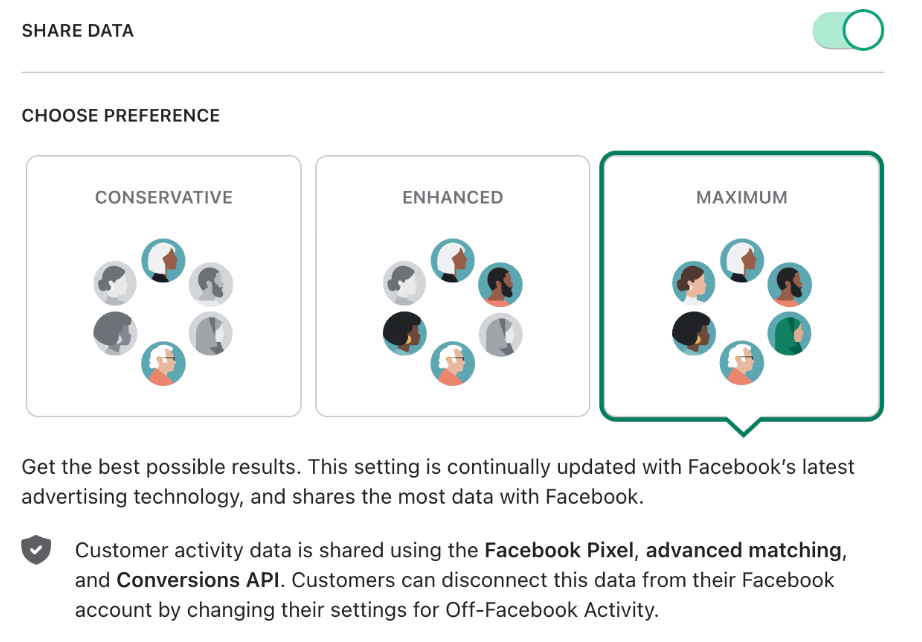
Shopify doesn't provide all the data it actually has available for Facebook to use in its ad optimizations.
Specifically, Shopify's Conversion API (CAPI) either doesn't pass along, or severely limits, two crucial parameters: click ID and browser ID.
- Without click ID and browser ID, Facebook might only see a purchase that happens in the same browser session as the click. Trackable purchase paths are severely limited.
- With click ID and browser ID, Facebook can track someone who, for example, adds to cart the same day as a click, then uses a different browser to check out a week later. Purchase paths are more robust, leading to greater overall account performance.
Facebook recommends 50+ conversions per ad set per week to optimize performance. Every unused data point can hurt your ROAS.
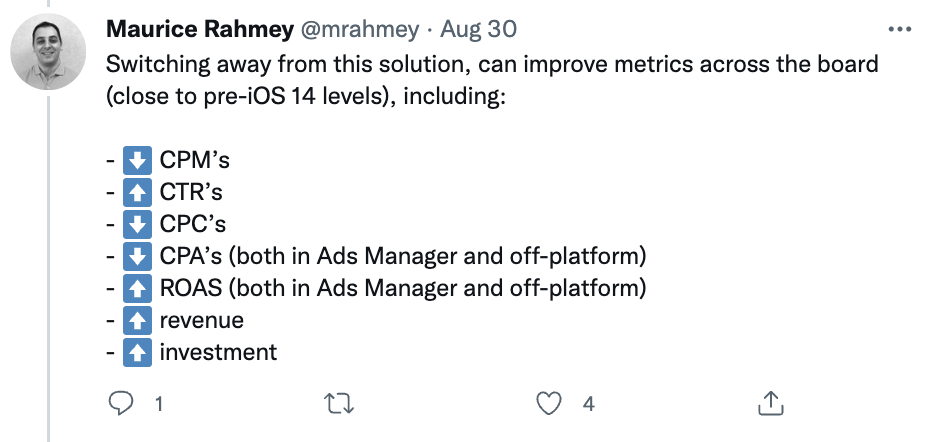
Disruptive Digital (and many Shopify brands) have reported serious performance improvements after migrating away from the integration:
Three alternative solutions to consider:
- CAPI Gateway implementation
- Direct integration
- 3rd-party partner (recommended). Popsixle or Elevar are reputable choices.
News and links
News you can use:
- About half of US adults get at least some of their news from social media, according to new findings from the Pew Research Center. Pretty much all platforms have seen a drop since 2020 in the percentage of users who regularly get news there—except for slight upticks on Instagram and Twitch, and a much larger one on TikTok (22% in 2020, 33% in 2022). That’s still a good deal lower than Twitter, where 53% of users get their news.
- What makes an effective TikTok ad campaign? TikTok’s global head of marketing science, Jorge Ruiz, gave Insider Intelligence the lowdown, covering topics like frequency and customization. More TikTok news: Video descriptions are getting longer, and a comment dislike button is coming.
- Instagram Stories that are under 60 seconds will no longer be broken into 15-second clips. Meta also released a new three-part series on Facebook content discovery.
Superside*: How startups get quality creative
Superside is the creative-as-a-subscription service designed with marketers and creatives in mind. By combining the top 1% of creative talent from around the world with purpose-built design ops technology, Superside helps companies grow faster.
Superside is offering free calls for DC readers. Grab one and see for yourself how they can help with your creative needs.
*sponsored
Something fun
From @the_marketing_millennials