

A big thanks to our sponsors, who keep this newsletter free for all of you. Check them out—it's the best way to support this newsletter :)
Brought to you by Ortto, execute impressive marketing campaigns that drive business growth with a consolidated customer data, automation and analytics platform. Try it for free.
And by Exclaimer. In 2023, everyone expects a tailored experience. Yet it's become even more difficult to get your messaging and promotions in front of the right people. Email signatures can easily become a piece of digital real estate that gives your marketing efforts an extra boost.
To learn more, get your free white paper on the marketing value of email signatures—your untapped opportunity to reach a high-quality audience without touching your advertising budget.
Exclaimer
Create professional and consistent email signatures, save time and reduce workload, meet compliance requirements, unlock marketing opportunities, and gather valuable analytics data. See Exclaimer in action. Book a demo to get started.
Brought to you by Ortto, execute impressive marketing campaigns that drive business growth with a consolidated customer data, automation and analytics platform.
How to get people hooked
Insight from Hooked: How to Build Habit-Forming Products, by Nir Eyal.
Ever realize you’ve been browsing Instagram or TikTok for over an hour?
Or find yourself checking them whenever you’re bored? (ie 50 times per day)
That’s because those companies have developed the perfect system to get you completely hooked.
They've nailed the Hook Model, a concept from Nir Eyal. It's a four-step process to get people to use a product habitually.
The four steps are: Trigger → Action → Variable Reward → Investment
- Trigger: The thing that sets the process off. It can be external or internal.
- External: Something happens in your environment. An ad, a phone notification, a headline about the economy.
- Internal: Something happens with your own mental state. Maybe you're bored, anxious, or hungry.
- Action: You take an action based on the trigger, expecting a reward. You saw a headline about the economy, so you check stock prices. The likelihood that you take an action depends on whether you’re:
- Adequately motivated by the reward, relative to the amount of effort required
- Able to perform the action after the trigger occurs
- Variable Reward: We’re more motivated by rewards that are unpredictable. For example, stock prices are different every time. Opening up Twitter gives you a different thing to be annoyed at each time. The rewards can be:
- Social validation, e.g., likes on social media or messages from friends
- The collection of resources: money, points, prizes
- Personal gratification, like you get when completing or perfecting something
- Investment: This is where you put something into the product or service to make it your own, increasing the likelihood that you'll return. That could be:
- Time, like the time you spend creating a profileData, e.g., choosing your favorite stocksThe effort it takes to learn how to use the productSocial capital, like inviting friends or publicizing usage
- Money: According to the sunk-cost fallacy, we don't like to abandon something after we've invested in it.
SaaS products that benefit from frequent use stand to gain a lot from the Hooked model.
Just make sure to use it ethically :). These are the same tools that companies use to get people addicted to gambling. So use them for good to get them addicted to things that benefit their lives.
If you want to hear Nir Eyal speak more about it, check out our interview with him.
Make product-page CTAs sticky on mobile
Insight from AB Tasty (mobile commerce stat from Statista).
With mobile commerce sales hitting $387 billion in the US last year, nailing the mobile buying experience is key.
So make your product-page CTAs sticky.
That way, it's easier for shoppers to add to cart—no scrolling back and forth to find what they’re looking for.
The luxury brand Baume & Mercier saw clicks on its “Add to Cart” button rise by 78% after making this change.
Consider the difference between these product pages from Sephora and Missha:
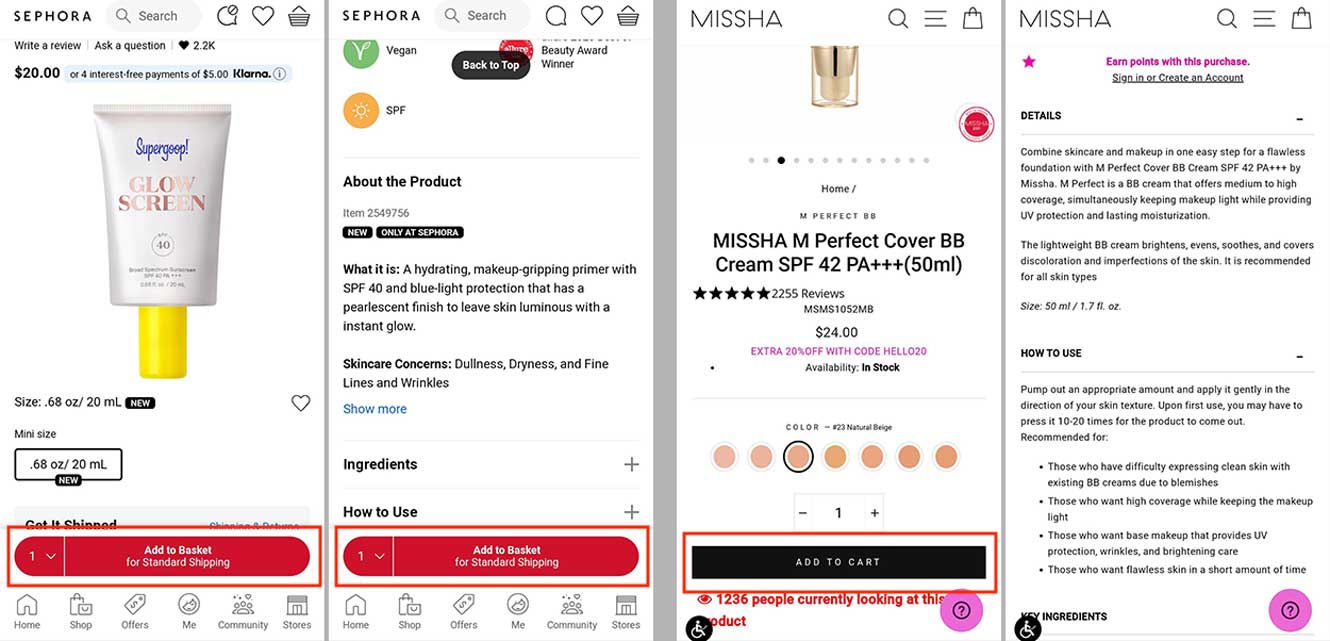
Let’s look at Missha first. Once someone has scrolled down to learn more about Missha’s product, they have to scroll back up to find the “Add to Cart” button again and make a purchase.
Meanwhile, someone shopping on Sephora’s mobile site has constant access to the “Add to Basket” button. They even have the option to adjust the quantity they want.
Once someone has decided that they're ready to buy, let them take action immediately. Every bit of thought and effort could make them change their mind.
Acknowledge people's right to choose
Also from Hooked.
This tactic can 2x the likelihood that someone says "yes" to your requests.
And it's hilariously simple. At the end of your request, just add:
"...but you are free to accept or refuse."
Studies have shown that adding those words can significantly increase the chances of a "yes."
For instance, in one study, strangers were asked to give someone money for bus fare. They gave twice the amount when those words were part of the request.
Why do they matter so much?
We hate being told what to do. In contrast, we like to feel understood, respected, and in control.
Paradoxically, acknowledging a person's right to choose is enough of a nudge to increase the likelihood that they do what you want them to do.
Brains are weird.
So give people choice by using either the above phrase or a less-formal variation of it. Some places you can do that:
- "But it's totally up to you"
- "It's your choice"
- "Take it or leave it"
News and links
News you can use:
- There’s been a lot happening with tech + US government lately. Like: OpenAI CEO Sam Altman’s testimony to Congress, Supreme Court rulings that mean big things for online platforms and copyright, and Montana banning, then getting sued by, TikTok.
- Meta’s had quite a bit going on recently too, including testing on a new ad format that helps users find relevant sales and promotions. They’re also working on a text-based app for Instagram, planned for release this summer. Maybe they saw the news that a quarter of US adults who use Twitter say they’re unlikely to still be using it a year from now.
- Google’s AI plans are wide-ranging—everything from allowing advertisers to generate media assets, to suggesting video ideas for YouTube content creators. And, of course, search. The Verge has a helpful explanation of Google’s plans for AI search (“Google executives … see it as a foundational long-term change to the way people search”).
- Random stats worth knowing about:
- 1%: Chrome users that Google says will have third-party cookies turned off in Q1 of 2024
- 25%: New Netflix subscribers who are opting in for their ad-supported tier, where it’s available. No wonder other media companies are pursuing ads too.
- 50%: Product searches that start on Amazon (which, no surprise here, has its own plans for incorporating AI into search)
Tool we recommend: CommonRoom*
70% of the typical SaaS tool evaluation process happens in the dark funnel before your sales reps engage.
Innovative growth and marketing teams use Common Room to tap into that dark funnel activity to build pipeline, accelerate deals, and drive more revenue.
They flag high-intent prospects based on the buying signals most companies don't have visibility into.
Want to see for yourself?
Get started with this buyer intent playbook.
Psst... DC members who either book a demo or start a free trial and connect a source qualify for a 15% discount on paid plans.
*Sponsored by CommonRoom
Something fun
From @pun_torture